

Topics in Current Chemistry (2019) 377:27
1 3
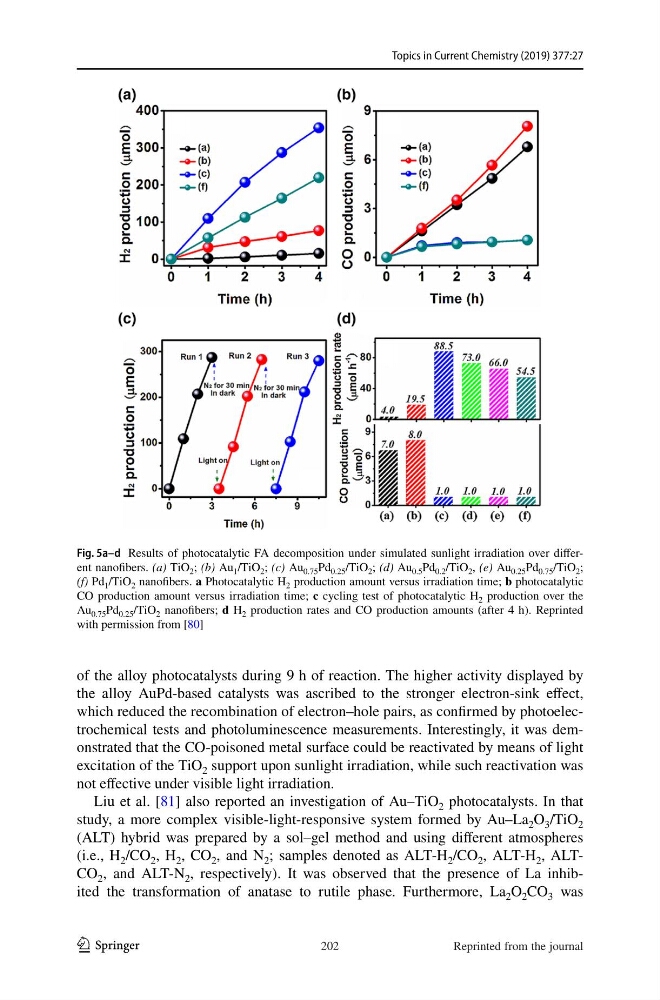
of the alloy photocatalysts during 9 h of reaction. The higher activity displayed by
the alloy AuPd-based catalysts was ascribed to the stronger electron-sink effect,
which reduced the recombination of electron–hole pairs, as confirmed by photoelectrochemical tests and photoluminescence measurements. Interestingly, it was demonstrated that the CO-poisoned metal surface could be reactivated by means of light
excitation of the TiO 2 support upon sunlight irradiation, while such reactivation was
not effective under visible light irradiation.
Liu et al. [81] also reported an investigation of Au–TiO 2 photocatalysts. In that
study, a more complex visible-light-responsive system formed by Au–La 2 O 3 /TiO 2
(ALT) hybrid was prepared by a sol–gel method and using different atmospheres
(i.e., H 2 /CO 2 , H 2 , CO 2 , and N 2 ; samples denoted as ALT-H 2 /CO 2 , ALT-H 2 , ALTCO 2 , and ALT-N 2 , respectively). It was observed that the presence of La inhibited the transformation of anatase to rutile phase. Furthermore, La 2 O 2 CO 3 was
Fig. 5a–d Results of photocatalytic FA decomposition under simulated sunlight irradiation over different nanofibers. (a) TiO 2 ; (b) Au 1 /TiO 2 ; (c) Au 0.75 Pd 0.25 /TiO 2 ; (d) Au 0.5 Pd 0.2 /TiO 2 , (e) Au 0.25 Pd 0.75 /TiO 2 ;
(f) Pd 1 /TiO 2 nanofibers. a Photocatalytic H 2 production amount versus irradiation time; b photocatalytic
CO production amount versus irradiation time; c cycling test of photocatalytic H 2 production over the
Au 0.75 Pd 0.25 /TiO 2 nanofibers; d H 2 production rates and CO production amounts (after 4 h). Reprinted
with permission from [80]
202
Reprinted from the journal
1 3
of the alloy photocatalysts during 9 h of reaction. The higher activity displayed by
the alloy AuPd-based catalysts was ascribed to the stronger electron-sink effect,
which reduced the recombination of electron–hole pairs, as confirmed by photoelectrochemical tests and photoluminescence measurements. Interestingly, it was demonstrated that the CO-poisoned metal surface could be reactivated by means of light
excitation of the TiO 2 support upon sunlight irradiation, while such reactivation was
not effective under visible light irradiation.
Liu et al. [81] also reported an investigation of Au–TiO 2 photocatalysts. In that
study, a more complex visible-light-responsive system formed by Au–La 2 O 3 /TiO 2
(ALT) hybrid was prepared by a sol–gel method and using different atmospheres
(i.e., H 2 /CO 2 , H 2 , CO 2 , and N 2 ; samples denoted as ALT-H 2 /CO 2 , ALT-H 2 , ALTCO 2 , and ALT-N 2 , respectively). It was observed that the presence of La inhibited the transformation of anatase to rutile phase. Furthermore, La 2 O 2 CO 3 was
Fig. 5a–d Results of photocatalytic FA decomposition under simulated sunlight irradiation over different nanofibers. (a) TiO 2 ; (b) Au 1 /TiO 2 ; (c) Au 0.75 Pd 0.25 /TiO 2 ; (d) Au 0.5 Pd 0.2 /TiO 2 , (e) Au 0.25 Pd 0.75 /TiO 2 ;
(f) Pd 1 /TiO 2 nanofibers. a Photocatalytic H 2 production amount versus irradiation time; b photocatalytic
CO production amount versus irradiation time; c cycling test of photocatalytic H 2 production over the
Au 0.75 Pd 0.25 /TiO 2 nanofibers; d H 2 production rates and CO production amounts (after 4 h). Reprinted
with permission from [80]
202
Reprinted from the journal