

1 3
Topics in Current Chemistry (2019) 377:27
formed upon treatment under H 2 /CO 2 atmosphere, which was claimed to be able
to decompose to La 2 O 3. As for the morphology of the samples, it was observed
that Au nanoparticles were embedded in sample ALT-H 2 /CO 2 , that they interacted
strongly with TiO 2 and La 2 O 3 phases, and had an average size of 5–6 nm, while
larger nanoparticles with hemispherical shape were identified in sample ALT-H 2 .
The presence of La 2 O 2 CO 3 in samples treated under H 2 /CO 2 atmosphere and its
dynamic formation and decomposition was found to be responsible for the good
dispersion of nanoparticles observed in ALT-H 2 /CO 2 . However, Au nanoparticles
were not detected in ALT-CO 2 and ALT-N 2 , possibly due to the absence of reducing agent in the calcination step. UV–Vis characterization of the catalysts revealed
that co-doping of La and Au provoked a reduction in the band gap, following the
order ALT-H 2 (2.56 eV) < ALT-H 2 /CO 2 (2.66 eV) < ALT-CO 2 (2.77 eV) < ALT-N 2
(2.84 eV), which was ascribed to a synergistic effect between Au and La under the
different atmospheres used. In addition, photoluminescence analysis demonstrated
the prolonged lifetime of electron–hole pairs in sample ALT-H 2 /CO 2 . As expected,
after all the results of characterization of the samples, ALT-H 2 /CO 2 displayed the
best photocatalytic performance among investigated, with a H 2 production rate of
178.4 μmol g
−1
cat h
−1
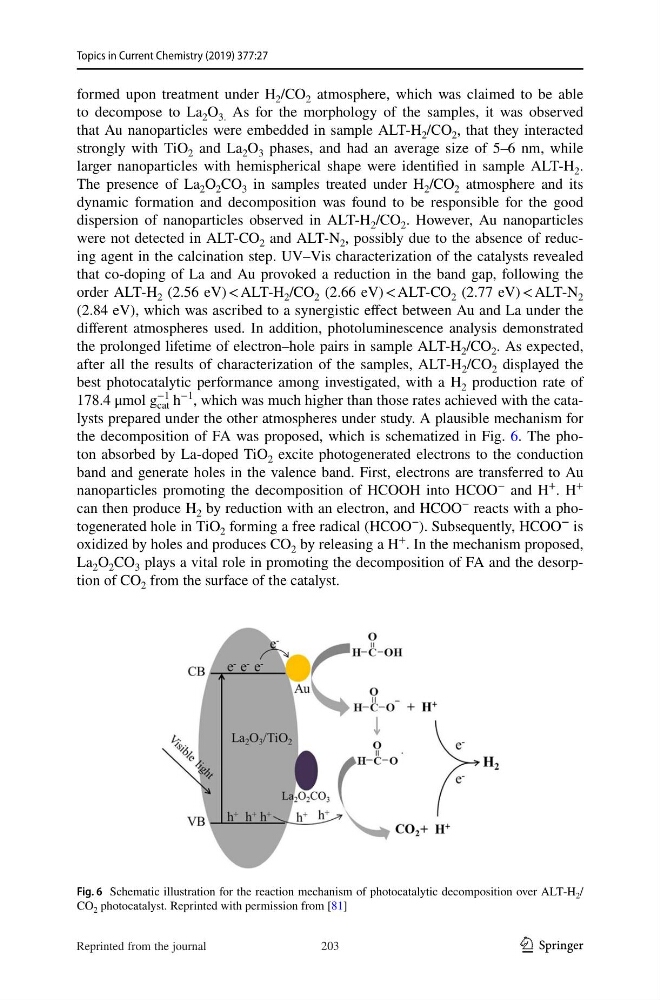
, which was much higher than those rates achieved with the catalysts prepared under the other atmospheres under study. A plausible mechanism for
the decomposition of FA was proposed, which is schematized in Fig. 6. The photon absorbed by La-doped TiO 2 excite photogenerated electrons to the conduction
band and generate holes in the valence band. First, electrons are transferred to Au
nanoparticles promoting the decomposition of HCOOH into HCOO
−
and H
+
. H
+
can then produce H 2 by reduction with an electron, and HCOO
−
reacts with a photogenerated hole in TiO 2 forming a free radical (HCOO
−
). Subsequently, HCOO
−
is
oxidized by holes and produces CO 2 by releasing a H
+
. In the mechanism proposed,
La 2 O 2 CO 3 plays a vital role in promoting the decomposition of FA and the desorption of CO 2 from the surface of the catalyst.
Fig. 6 Schematic illustration for the reaction mechanism of photocatalytic decomposition over ALT-H 2 /
CO 2 photocatalyst. Reprinted with permission from [81]
203
Reprinted from the journal
Topics in Current Chemistry (2019) 377:27
formed upon treatment under H 2 /CO 2 atmosphere, which was claimed to be able
to decompose to La 2 O 3. As for the morphology of the samples, it was observed
that Au nanoparticles were embedded in sample ALT-H 2 /CO 2 , that they interacted
strongly with TiO 2 and La 2 O 3 phases, and had an average size of 5–6 nm, while
larger nanoparticles with hemispherical shape were identified in sample ALT-H 2 .
The presence of La 2 O 2 CO 3 in samples treated under H 2 /CO 2 atmosphere and its
dynamic formation and decomposition was found to be responsible for the good
dispersion of nanoparticles observed in ALT-H 2 /CO 2 . However, Au nanoparticles
were not detected in ALT-CO 2 and ALT-N 2 , possibly due to the absence of reducing agent in the calcination step. UV–Vis characterization of the catalysts revealed
that co-doping of La and Au provoked a reduction in the band gap, following the
order ALT-H 2 (2.56 eV) < ALT-H 2 /CO 2 (2.66 eV) < ALT-CO 2 (2.77 eV) < ALT-N 2
(2.84 eV), which was ascribed to a synergistic effect between Au and La under the
different atmospheres used. In addition, photoluminescence analysis demonstrated
the prolonged lifetime of electron–hole pairs in sample ALT-H 2 /CO 2 . As expected,
after all the results of characterization of the samples, ALT-H 2 /CO 2 displayed the
best photocatalytic performance among investigated, with a H 2 production rate of
178.4 μmol g
−1
cat h
−1
, which was much higher than those rates achieved with the catalysts prepared under the other atmospheres under study. A plausible mechanism for
the decomposition of FA was proposed, which is schematized in Fig. 6. The photon absorbed by La-doped TiO 2 excite photogenerated electrons to the conduction
band and generate holes in the valence band. First, electrons are transferred to Au
nanoparticles promoting the decomposition of HCOOH into HCOO
−
and H
+
. H
+
can then produce H 2 by reduction with an electron, and HCOO
−
reacts with a photogenerated hole in TiO 2 forming a free radical (HCOO
−
). Subsequently, HCOO
−
is
oxidized by holes and produces CO 2 by releasing a H
+
. In the mechanism proposed,
La 2 O 2 CO 3 plays a vital role in promoting the decomposition of FA and the desorption of CO 2 from the surface of the catalyst.
Fig. 6 Schematic illustration for the reaction mechanism of photocatalytic decomposition over ALT-H 2 /
CO 2 photocatalyst. Reprinted with permission from [81]
203
Reprinted from the journal