

1 3
Topics in Current Chemistry (2019) 377:27
Au 0.75 Pd 0.25 /TiO 2 displayed the highest H 2 production rate. The presence of alloyed
nanoparticles was confirmed by high resolution transmission electron microscopy
(TEM), X-ray photoelectron spectroscopy (XPS), and UV–Vis spectra. Samples
with Au nanoparticles showed an absorption band at 590 nm, corresponding to the
SPR of Au, while the AuPd-based catalysts displayed a blue-shift to 540 nm with
lower intensity due to the increase of electron density in Au particles.
The photocatalytic tests were carried out under simulated sunlight irradiation,
with a light intensity of 100 mW cm
−2
. The results of the photocatalytic test are
depicted in Fig. 5. The hydrogen generation rate was calculated to be 4.0, 19.5, 54.5,
and 88.5 µmol h
−1
, for TiO 2 , Au 1 /TiO 2 , Pd 1 /TiO 2 , and Au 0.75 Pd 0.25 /TiO 2 , respectively. This tendency confirms the ability of Au and Pd to hold the photogenerated
electrons from TiO 2 and act as an active site for the dehydrogenation reaction. The
test under visible light irradiation did not show generation of H 2 for the alloy catalysts, which suggested that TiO 2 excitation is mainly responsible for the photocatalytic activity of the sample. Furthermore, the cyclability tests showed a high stability
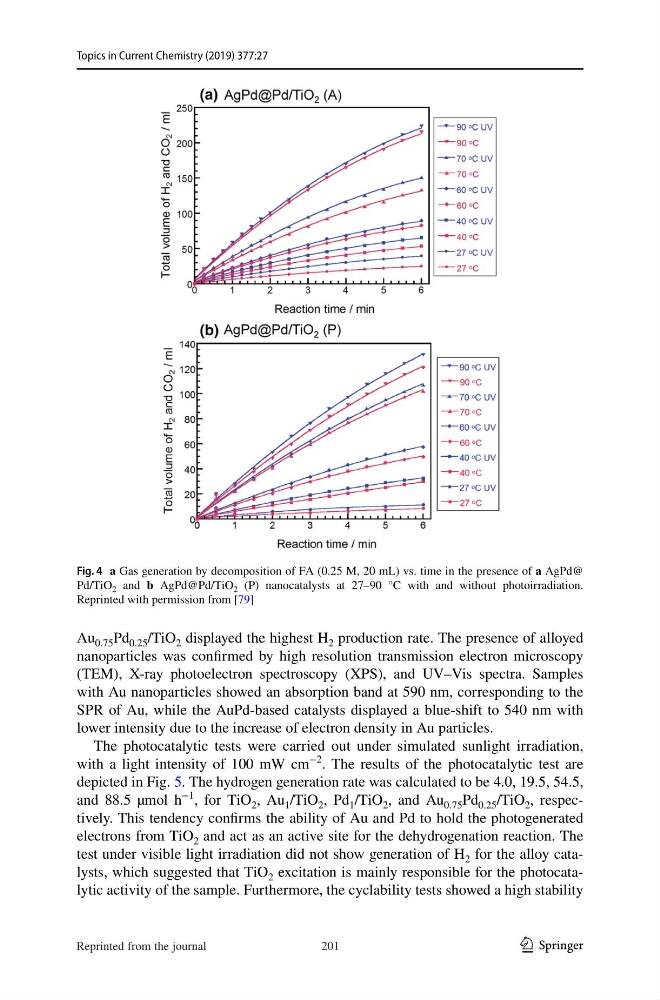
Fig. 4 a Gas generation by decomposition of FA (0.25 M, 20 mL) vs. time in the presence of a AgPd@
Pd/TiO 2 and b AgPd@Pd/TiO 2 (P) nanocatalysts at 27–90 °C with and without photoirradiation.
Reprinted with permission from [79]
201
Reprinted from the journal
Topics in Current Chemistry (2019) 377:27
Au 0.75 Pd 0.25 /TiO 2 displayed the highest H 2 production rate. The presence of alloyed
nanoparticles was confirmed by high resolution transmission electron microscopy
(TEM), X-ray photoelectron spectroscopy (XPS), and UV–Vis spectra. Samples
with Au nanoparticles showed an absorption band at 590 nm, corresponding to the
SPR of Au, while the AuPd-based catalysts displayed a blue-shift to 540 nm with
lower intensity due to the increase of electron density in Au particles.
The photocatalytic tests were carried out under simulated sunlight irradiation,
with a light intensity of 100 mW cm
−2
. The results of the photocatalytic test are
depicted in Fig. 5. The hydrogen generation rate was calculated to be 4.0, 19.5, 54.5,
and 88.5 µmol h
−1
, for TiO 2 , Au 1 /TiO 2 , Pd 1 /TiO 2 , and Au 0.75 Pd 0.25 /TiO 2 , respectively. This tendency confirms the ability of Au and Pd to hold the photogenerated
electrons from TiO 2 and act as an active site for the dehydrogenation reaction. The
test under visible light irradiation did not show generation of H 2 for the alloy catalysts, which suggested that TiO 2 excitation is mainly responsible for the photocatalytic activity of the sample. Furthermore, the cyclability tests showed a high stability
Fig. 4 a Gas generation by decomposition of FA (0.25 M, 20 mL) vs. time in the presence of a AgPd@
Pd/TiO 2 and b AgPd@Pd/TiO 2 (P) nanocatalysts at 27–90 °C with and without photoirradiation.
Reprinted with permission from [79]
201
Reprinted from the journal