

1 3
Topics in Current Chemistry (2019) 377:27
viewpoint, Liu and co-workers explored the effect of both energies in the decomposition of FA [77]. For this purpose, Pt/TiO 2 catalysts prepared by photodeposition and
with H 2 PtCl 6 ·6H 2 O as the metal precursor were used as model to study the photothermal generation of hydrogen up to 90 °C (i.e. 35, 70, 80, and 90 °C). The impact
of the photo and thermal effects was differentiated by using LEDs emitting purple,
blue and white light. The sets of catalytic tests consisted of: (1) photocatalytic test at
35 °C (Pt/TiO 2 -P); (2) thermal reaction at 90 °C (Pt/TiO 2 -P); (3) photothermal coupling reaction (photo + 35 °C, photo + 70 °C, photo + 80 °C, and photo + 90 °C, Pt/
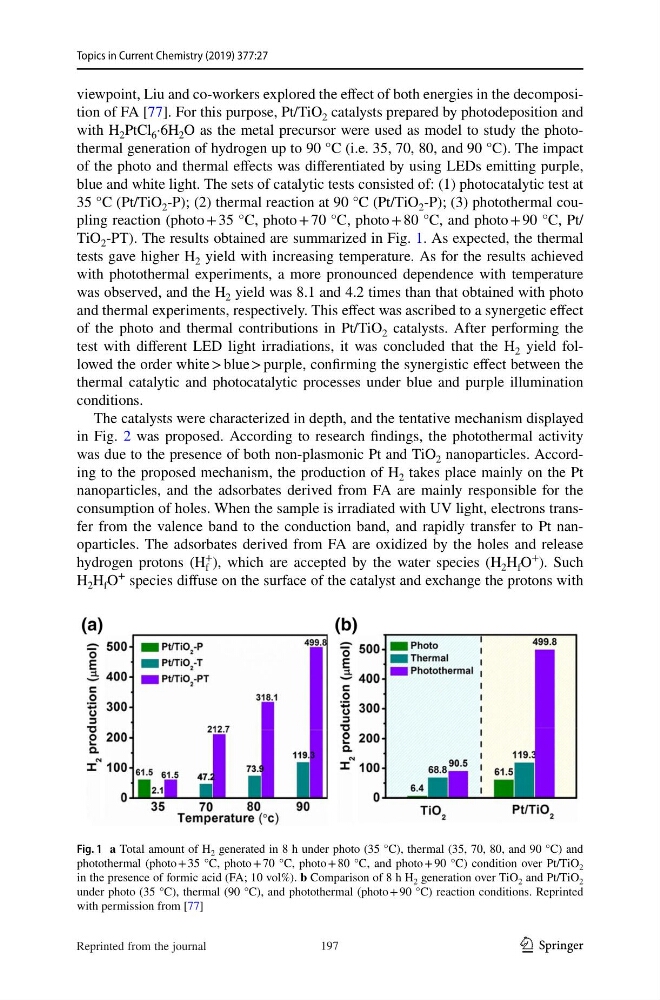
TiO 2 -PT). The results obtained are summarized in Fig. 1. As expected, the thermal
tests gave higher H 2 yield with increasing temperature. As for the results achieved
with photothermal experiments, a more pronounced dependence with temperature
was observed, and the H 2 yield was 8.1 and 4.2 times than that obtained with photo
and thermal experiments, respectively. This effect was ascribed to a synergetic effect
of the photo and thermal contributions in Pt/TiO 2 catalysts. After performing the
test with different LED light irradiations, it was concluded that the H 2 yield followed the order white > blue > purple, confirming the synergistic effect between the
thermal catalytic and photocatalytic processes under blue and purple illumination
conditions.
The catalysts were characterized in depth, and the tentative mechanism displayed
in Fig. 2 was proposed. According to research findings, the photothermal activity
was due to the presence of both non-plasmonic Pt and TiO 2 nanoparticles. According to the proposed mechanism, the production of H 2 takes place mainly on the Pt
nanoparticles, and the adsorbates derived from FA are mainly responsible for the
consumption of holes. When the sample is irradiated with UV light, electrons transfer from the valence band to the conduction band, and rapidly transfer to Pt nanoparticles. The adsorbates derived from FA are oxidized by the holes and release
hydrogen protons (H f
+
), which are accepted by the water species (H 2 H f O
+
). Such
H 2 H f O
+
species diffuse on the surface of the catalyst and exchange the protons with
Fig. 1 a Total amount of H 2 generated in 8 h under photo (35 °C), thermal (35, 70, 80, and 90 °C) and
photothermal (photo + 35 °C, photo + 70 °C, photo + 80 °C, and photo + 90 °C) condition over Pt/TiO 2
in the presence of formic acid (FA; 10 vol%). b Comparison of 8 h H 2 generation over TiO 2 and Pt/TiO 2
under photo (35 °C), thermal (90 °C), and photothermal (photo + 90 °C) reaction conditions. Reprinted
with permission from [77]
197
Reprinted from the journal
Topics in Current Chemistry (2019) 377:27
viewpoint, Liu and co-workers explored the effect of both energies in the decomposition of FA [77]. For this purpose, Pt/TiO 2 catalysts prepared by photodeposition and
with H 2 PtCl 6 ·6H 2 O as the metal precursor were used as model to study the photothermal generation of hydrogen up to 90 °C (i.e. 35, 70, 80, and 90 °C). The impact
of the photo and thermal effects was differentiated by using LEDs emitting purple,
blue and white light. The sets of catalytic tests consisted of: (1) photocatalytic test at
35 °C (Pt/TiO 2 -P); (2) thermal reaction at 90 °C (Pt/TiO 2 -P); (3) photothermal coupling reaction (photo + 35 °C, photo + 70 °C, photo + 80 °C, and photo + 90 °C, Pt/
TiO 2 -PT). The results obtained are summarized in Fig. 1. As expected, the thermal
tests gave higher H 2 yield with increasing temperature. As for the results achieved
with photothermal experiments, a more pronounced dependence with temperature
was observed, and the H 2 yield was 8.1 and 4.2 times than that obtained with photo
and thermal experiments, respectively. This effect was ascribed to a synergetic effect
of the photo and thermal contributions in Pt/TiO 2 catalysts. After performing the
test with different LED light irradiations, it was concluded that the H 2 yield followed the order white > blue > purple, confirming the synergistic effect between the
thermal catalytic and photocatalytic processes under blue and purple illumination
conditions.
The catalysts were characterized in depth, and the tentative mechanism displayed
in Fig. 2 was proposed. According to research findings, the photothermal activity
was due to the presence of both non-plasmonic Pt and TiO 2 nanoparticles. According to the proposed mechanism, the production of H 2 takes place mainly on the Pt
nanoparticles, and the adsorbates derived from FA are mainly responsible for the
consumption of holes. When the sample is irradiated with UV light, electrons transfer from the valence band to the conduction band, and rapidly transfer to Pt nanoparticles. The adsorbates derived from FA are oxidized by the holes and release
hydrogen protons (H f
+
), which are accepted by the water species (H 2 H f O
+
). Such
H 2 H f O
+
species diffuse on the surface of the catalyst and exchange the protons with
Fig. 1 a Total amount of H 2 generated in 8 h under photo (35 °C), thermal (35, 70, 80, and 90 °C) and
photothermal (photo + 35 °C, photo + 70 °C, photo + 80 °C, and photo + 90 °C) condition over Pt/TiO 2
in the presence of formic acid (FA; 10 vol%). b Comparison of 8 h H 2 generation over TiO 2 and Pt/TiO 2
under photo (35 °C), thermal (90 °C), and photothermal (photo + 90 °C) reaction conditions. Reprinted
with permission from [77]
197
Reprinted from the journal