

Topics in Current Chemistry (2019) 377:27
1 3
role of FA as an intermediate in the photocatalytic oxidation of other molecules
(i.e., formaldehyde, acetaldehyde, ethanol, and acetic acid) [66, 67]. For that reason,
the mechanism involved in the photodecomposition of FA has been studied widely
by both experimental and theoretical researchers. However, uncertainty remains
because of the various possible adsorption configurations of FA on the surface of
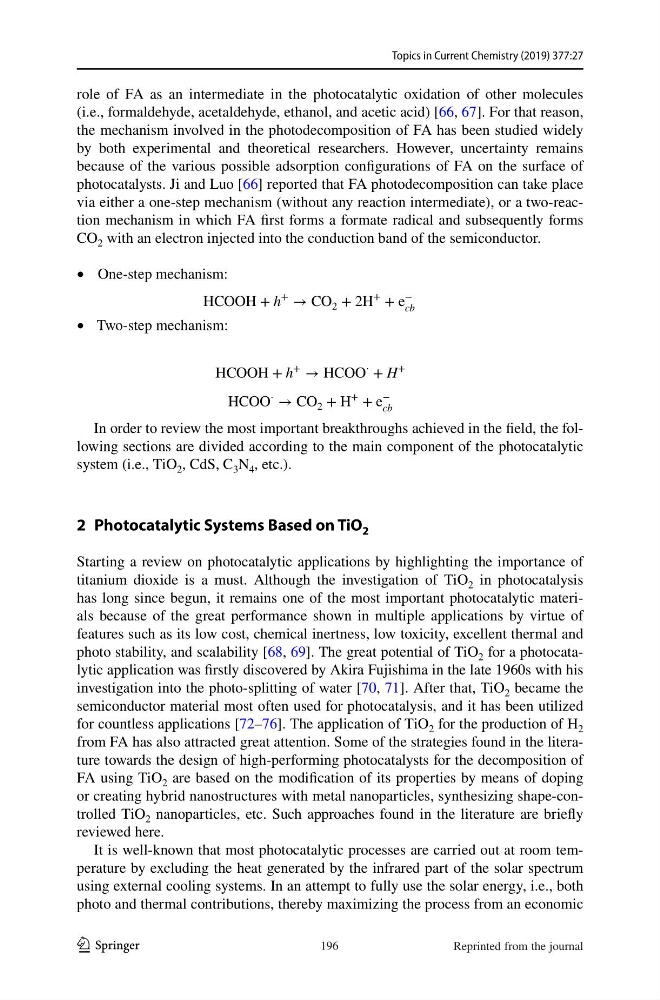
photocatalysts. Ji and Luo [66] reported that FA photodecomposition can take place
via either a one-step mechanism (without any reaction intermediate), or a two-reaction mechanism in which FA first forms a formate radical and subsequently forms
CO 2 with an electron injected into the conduction band of the semiconductor.
• One-step mechanism:
• Two-step mechanism:
In order to review the most important breakthroughs achieved in the field, the following sections are divided according to the main component of the photocatalytic
system (i.e., TiO 2 , CdS, C 3 N 4 , etc.).
2 Photocatalytic Systems Based on TiO 2
Starting a review on photocatalytic applications by highlighting the importance of
titanium dioxide is a must. Although the investigation of TiO 2 in photocatalysis
has long since begun, it remains one of the most important photocatalytic materials because of the great performance shown in multiple applications by virtue of
features such as its low cost, chemical inertness, low toxicity, excellent thermal and
photo stability, and scalability [68, 69]. The great potential of TiO 2 for a photocatalytic application was firstly discovered by Akira Fujishima in the late 1960s with his
investigation into the photo-splitting of water [70, 71]. After that, TiO 2 became the
semiconductor material most often used for photocatalysis, and it has been utilized
for countless applications [72–76]. The application of TiO 2 for the production of H 2
from FA has also attracted great attention. Some of the strategies found in the literature towards the design of high-performing photocatalysts for the decomposition of
FA using TiO 2 are based on the modification of its properties by means of doping
or creating hybrid nanostructures with metal nanoparticles, synthesizing shape-controlled TiO 2 nanoparticles, etc. Such approaches found in the literature are briefly
reviewed here.
It is well-known that most photocatalytic processes are carried out at room temperature by excluding the heat generated by the infrared part of the solar spectrum
using external cooling systems. In an attempt to fully use the solar energy, i.e., both
photo and thermal contributions, thereby maximizing the process from an economic
HCOOH + h
+ → CO 2 + 2H
+ + e
−
cb
HCOOH + h
+ → HCOO
⋅ + H
+
HCOO
⋅ → CO 2 + H
+ + e
−
cb
196
Reprinted from the journal
1 3
role of FA as an intermediate in the photocatalytic oxidation of other molecules
(i.e., formaldehyde, acetaldehyde, ethanol, and acetic acid) [66, 67]. For that reason,
the mechanism involved in the photodecomposition of FA has been studied widely
by both experimental and theoretical researchers. However, uncertainty remains
because of the various possible adsorption configurations of FA on the surface of
photocatalysts. Ji and Luo [66] reported that FA photodecomposition can take place
via either a one-step mechanism (without any reaction intermediate), or a two-reaction mechanism in which FA first forms a formate radical and subsequently forms
CO 2 with an electron injected into the conduction band of the semiconductor.
• One-step mechanism:
• Two-step mechanism:
In order to review the most important breakthroughs achieved in the field, the following sections are divided according to the main component of the photocatalytic
system (i.e., TiO 2 , CdS, C 3 N 4 , etc.).
2 Photocatalytic Systems Based on TiO 2
Starting a review on photocatalytic applications by highlighting the importance of
titanium dioxide is a must. Although the investigation of TiO 2 in photocatalysis
has long since begun, it remains one of the most important photocatalytic materials because of the great performance shown in multiple applications by virtue of
features such as its low cost, chemical inertness, low toxicity, excellent thermal and
photo stability, and scalability [68, 69]. The great potential of TiO 2 for a photocatalytic application was firstly discovered by Akira Fujishima in the late 1960s with his
investigation into the photo-splitting of water [70, 71]. After that, TiO 2 became the
semiconductor material most often used for photocatalysis, and it has been utilized
for countless applications [72–76]. The application of TiO 2 for the production of H 2
from FA has also attracted great attention. Some of the strategies found in the literature towards the design of high-performing photocatalysts for the decomposition of
FA using TiO 2 are based on the modification of its properties by means of doping
or creating hybrid nanostructures with metal nanoparticles, synthesizing shape-controlled TiO 2 nanoparticles, etc. Such approaches found in the literature are briefly
reviewed here.
It is well-known that most photocatalytic processes are carried out at room temperature by excluding the heat generated by the infrared part of the solar spectrum
using external cooling systems. In an attempt to fully use the solar energy, i.e., both
photo and thermal contributions, thereby maximizing the process from an economic
HCOOH + h
+ → CO 2 + 2H
+ + e
−
cb
HCOOH + h
+ → HCOO
⋅ + H
+
HCOO
⋅ → CO 2 + H
+ + e
−
cb
196
Reprinted from the journal