

Topics in Current Chemistry (2020) 378:29
1 3
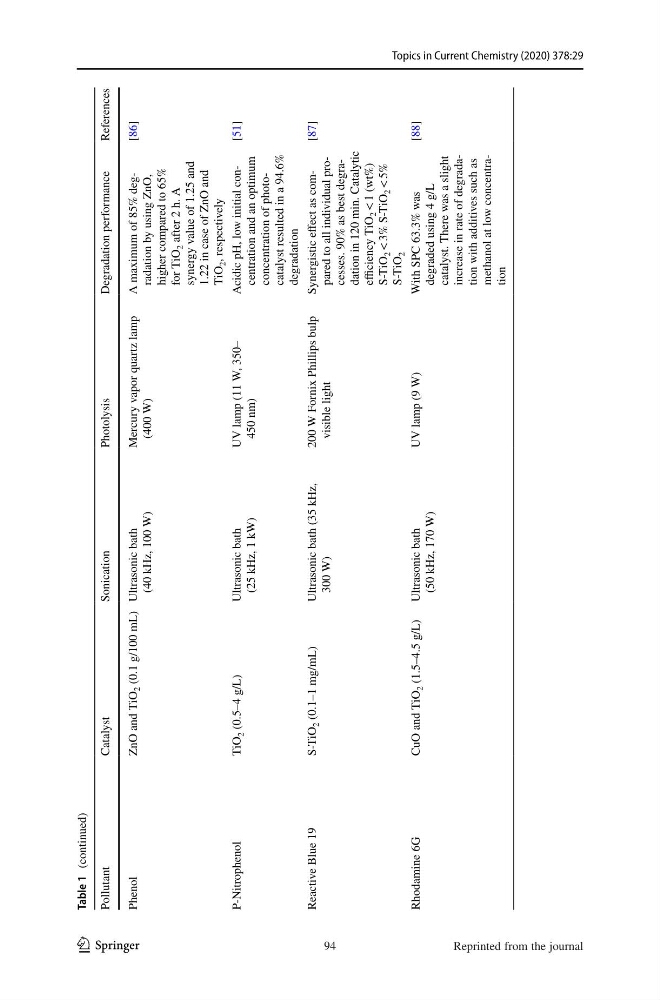
Table 1
(continued)
Pollutant
Catalyst
Sonication
Photolysis
Degradation performance
References
Phenol
ZnO and
TiO
2 (0.1 g/100 mL) Ultrasonic bath
(40 kHz, 100 W)
Mercury vapor quartz lamp
(400 W)
A maximum of 85% degradation by using ZnO,
higher compared to 65%
for TiO
2 after 2 h. A
synergy value of 1.25 and
1.22 in case of ZnO and
TiO
2 , respectively
[86]
P-Nitrophenol
TiO
2 (0.5–4 g/L)
Ultrasonic bath
(25 kHz, 1 kW)
UV lamp (11 W, 350–
450 nm)
Acidic pH, low initial concentration and an optimum
concentration of photocatalyst resulted in a 94.6%
degradation
[51]
Reactive Blue 19
S-TiO
2 (0.1–1 mg/mL)
Ultrasonic bath (35 kHz,
300 W)
200 W Fornix Phillips bulp
visible light
Synergistic effect as compared to all individual processes. 90% as best degradation in 120 min. Catalytic
efficiency TiO
2 < 1 (wt%)
S-TiO
2 < 3% S-TiO
2 < 5%
S-TiO
2
[87]
Rhodamine 6G
CuO and
TiO
2 (1.5–4.5 g/L) Ultrasonic bath
(50 kHz, 170 W)
UV lamp (9 W)
With SPC 63.3% was
degraded using 4 g/L
catalyst. There was a slight
increase in rate of degradation with additives such as
methanol at low concentration
[88]
94
Reprinted from the journal
1 3
Table 1
(continued)
Pollutant
Catalyst
Sonication
Photolysis
Degradation performance
References
Phenol
ZnO and
TiO
2 (0.1 g/100 mL) Ultrasonic bath
(40 kHz, 100 W)
Mercury vapor quartz lamp
(400 W)
A maximum of 85% degradation by using ZnO,
higher compared to 65%
for TiO
2 after 2 h. A
synergy value of 1.25 and
1.22 in case of ZnO and
TiO
2 , respectively
[86]
P-Nitrophenol
TiO
2 (0.5–4 g/L)
Ultrasonic bath
(25 kHz, 1 kW)
UV lamp (11 W, 350–
450 nm)
Acidic pH, low initial concentration and an optimum
concentration of photocatalyst resulted in a 94.6%
degradation
[51]
Reactive Blue 19
S-TiO
2 (0.1–1 mg/mL)
Ultrasonic bath (35 kHz,
300 W)
200 W Fornix Phillips bulp
visible light
Synergistic effect as compared to all individual processes. 90% as best degradation in 120 min. Catalytic
efficiency TiO
2 < 1 (wt%)
S-TiO
2 < 3% S-TiO
2 < 5%
S-TiO
2
[87]
Rhodamine 6G
CuO and
TiO
2 (1.5–4.5 g/L) Ultrasonic bath
(50 kHz, 170 W)
UV lamp (9 W)
With SPC 63.3% was
degraded using 4 g/L
catalyst. There was a slight
increase in rate of degradation with additives such as
methanol at low concentration
[88]
94
Reprinted from the journal