

1 3
Topics in Current Chemistry (2020) 378:29
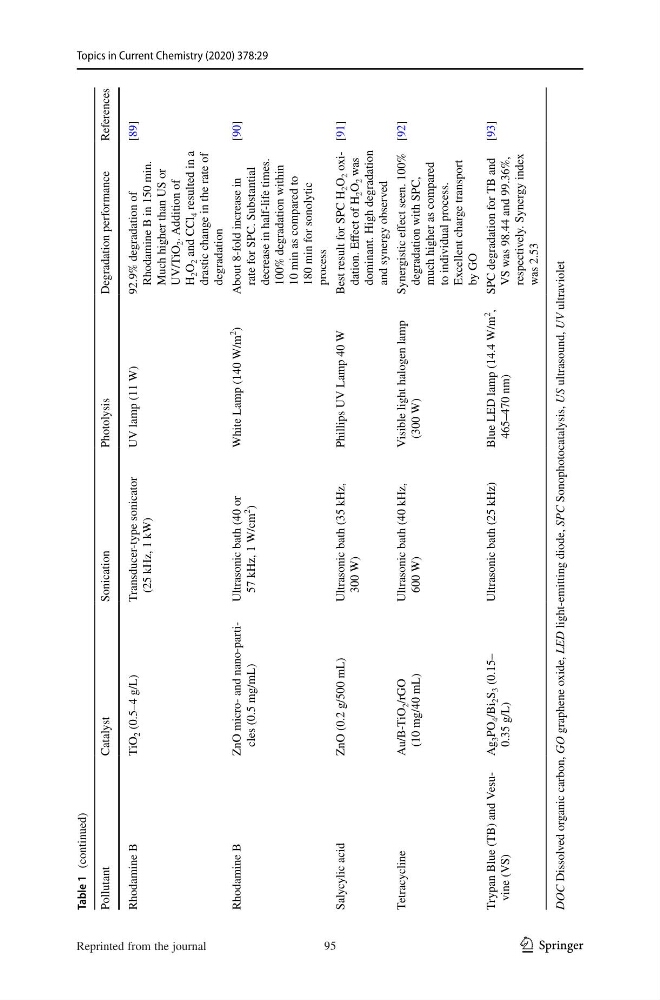
Table 1
(continued)
Pollutant
Catalyst
Sonication
Photolysis
Degradation performance
References
Rhodamine B
TiO
2 (0.5–4 g/L)
Transducer-type sonicator
(25 kHz, 1 kW)
UV lamp (11 W)
92.9% degradation of
Rhodamine B in 150 min.
Much higher than US or
UV/TiO
2 . Addition of
H
2 O
2 and CCl
4 resulted in a
drastic change in the rate of
degradation
[89]
Rhodamine B
ZnO micro- and nano-particles (0.5 mg/mL)
Ultrasonic bath (40 or
57 kHz, 1 W/cm
2
)
White Lamp (140 W/m
2
)
About 8-fold increase in
rate for SPC. Substantial
decrease in half-life times.
100% degradation within
10 min as compared to
180 min for sonolytic
process
[90]
Salycylic acid
ZnO (0.2 g/500 mL)
Ultrasonic bath (35 kHz,
300 W)
Phillips UV Lamp 40 W
Best result for SPC H
2 O
2 oxidation. Effect of H
2 O
2 was
dominant. High degradation
and synergy observed
[91]
Tetracycline
Au/B-TiO
2 /rGO
(10 mg/40 mL)
Ultrasonic bath (40 kHz,
600 W)
Visible light halogen lamp
(300 W)
Synergistic effect seen. 100%
degradation with SPC,
much higher as compared
to individual process.
Excellent charge transport
by GO
[92]
Trypan Blue (TB) and Vesuvine (VS)
Ag
3 PO
4 /Bi
2 S
3 (0.15–
0.35 g/L)
Ultrasonic bath (25 kHz)
Blue LED lamp (14.4 W/m
2
,
465–470 nm)
SPC degradation for TB and
VS was 98.44 and 99.36%,
respectively. Synergy index
was 2.53
[93]
DOC
Dissolved organic carbon, GO
graphene oxide, LED
light-emitting diode, SPC
Sonophotocatalysis, US
ultrasound, UV
ultraviolet
95
Reprinted from the journal
Topics in Current Chemistry (2020) 378:29
Table 1
(continued)
Pollutant
Catalyst
Sonication
Photolysis
Degradation performance
References
Rhodamine B
TiO
2 (0.5–4 g/L)
Transducer-type sonicator
(25 kHz, 1 kW)
UV lamp (11 W)
92.9% degradation of
Rhodamine B in 150 min.
Much higher than US or
UV/TiO
2 . Addition of
H
2 O
2 and CCl
4 resulted in a
drastic change in the rate of
degradation
[89]
Rhodamine B
ZnO micro- and nano-particles (0.5 mg/mL)
Ultrasonic bath (40 or
57 kHz, 1 W/cm
2
)
White Lamp (140 W/m
2
)
About 8-fold increase in
rate for SPC. Substantial
decrease in half-life times.
100% degradation within
10 min as compared to
180 min for sonolytic
process
[90]
Salycylic acid
ZnO (0.2 g/500 mL)
Ultrasonic bath (35 kHz,
300 W)
Phillips UV Lamp 40 W
Best result for SPC H
2 O
2 oxidation. Effect of H
2 O
2 was
dominant. High degradation
and synergy observed
[91]
Tetracycline
Au/B-TiO
2 /rGO
(10 mg/40 mL)
Ultrasonic bath (40 kHz,
600 W)
Visible light halogen lamp
(300 W)
Synergistic effect seen. 100%
degradation with SPC,
much higher as compared
to individual process.
Excellent charge transport
by GO
[92]
Trypan Blue (TB) and Vesuvine (VS)
Ag
3 PO
4 /Bi
2 S
3 (0.15–
0.35 g/L)
Ultrasonic bath (25 kHz)
Blue LED lamp (14.4 W/m
2
,
465–470 nm)
SPC degradation for TB and
VS was 98.44 and 99.36%,
respectively. Synergy index
was 2.53
[93]
DOC
Dissolved organic carbon, GO
graphene oxide, LED
light-emitting diode, SPC
Sonophotocatalysis, US
ultrasound, UV
ultraviolet
95
Reprinted from the journal