

Topics in Current Chemistry (2019) 377:5
1 3
mechanism, in which bi-molecular interaction between two neighboring adsorbed
species, i.e., CO ads and (presumably) any sort of activated water, as proposed by
Gilman [45], or incipient OH ads , react to form the CO 2 , which desorbs readily to
free up the active sites on the surface. The overall reaction of CO electro-oxidation
(disregarding any adsorption of anions, which certainly play an important role in the
process [46]) can be written as:
in which the terms α and γ stand for the number of Pt atoms involved in
the adsorption of each species. The standard potential for the reaction
CO (g) + H 2 O (l) ⇄ CO 2(g) + 2H
+
+ 2e
−
is E
0
≃ −0.104 V SHE .
In the catalytic process of electrochemical water dissociation to OH ads , protons
and electrons are expelled, i.e., H 2 O + * active sites → OH ads + H
+
+ e
−
. This reaction is
expected to occur on Pt electrodes, at least at high potentials. In acidic media (0.1 M
HF), Ueno et al. [47] using in situ infrared spectroscopy have provided evidence that
the reaction of OH ads formation, on stepped Pt surfaces [consisting of (111) terraces
separated by monoatomic (110) or (100) steps, as in Fig. 2] starts at ~ 0.3 V RHE . The
reaction of OH ads formation depends on the adsorption sites and the applied potential. At least at 0.9 V RHE , the OH ads on (111) terraces is dominant in comparison to
the OH ads on step sites; OH ads coverage, i.e., the band intensity of δ PtOH (in-plane
(1)
Pt − CO + Pt −
H 2 O
→ CO 2 + 2H
+ + 2e
− + ( + )Pt
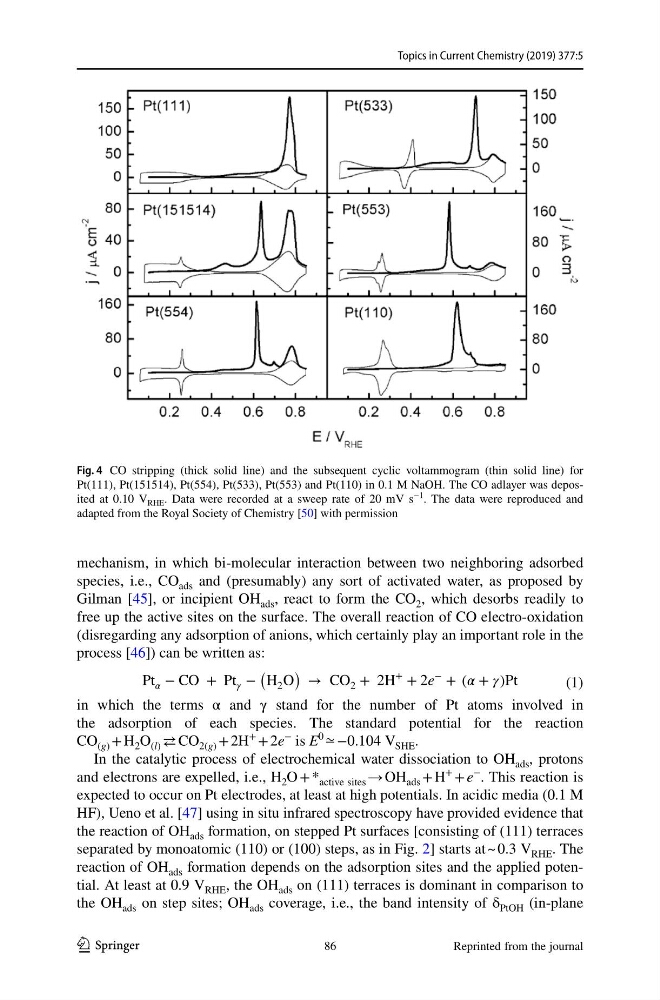
Fig. 4 CO stripping (thick solid line) and the subsequent cyclic voltammogram (thin solid line) for
Pt(111), Pt(151514), Pt(554), Pt(533), Pt(553) and Pt(110) in 0.1 M NaOH. The CO adlayer was deposited at 0.10 V RHE . Data were recorded at a sweep rate of 20 mV s
−1
. The data were reproduced and
adapted from the Royal Society of Chemistry [50] with permission
Reprinted from the journal
86
1 3
mechanism, in which bi-molecular interaction between two neighboring adsorbed
species, i.e., CO ads and (presumably) any sort of activated water, as proposed by
Gilman [45], or incipient OH ads , react to form the CO 2 , which desorbs readily to
free up the active sites on the surface. The overall reaction of CO electro-oxidation
(disregarding any adsorption of anions, which certainly play an important role in the
process [46]) can be written as:
in which the terms α and γ stand for the number of Pt atoms involved in
the adsorption of each species. The standard potential for the reaction
CO (g) + H 2 O (l) ⇄ CO 2(g) + 2H
+
+ 2e
−
is E
0
≃ −0.104 V SHE .
In the catalytic process of electrochemical water dissociation to OH ads , protons
and electrons are expelled, i.e., H 2 O + * active sites → OH ads + H
+
+ e
−
. This reaction is
expected to occur on Pt electrodes, at least at high potentials. In acidic media (0.1 M
HF), Ueno et al. [47] using in situ infrared spectroscopy have provided evidence that
the reaction of OH ads formation, on stepped Pt surfaces [consisting of (111) terraces
separated by monoatomic (110) or (100) steps, as in Fig. 2] starts at ~ 0.3 V RHE . The
reaction of OH ads formation depends on the adsorption sites and the applied potential. At least at 0.9 V RHE , the OH ads on (111) terraces is dominant in comparison to
the OH ads on step sites; OH ads coverage, i.e., the band intensity of δ PtOH (in-plane
(1)
Pt − CO + Pt −
H 2 O
→ CO 2 + 2H
+ + 2e
− + ( + )Pt
Fig. 4 CO stripping (thick solid line) and the subsequent cyclic voltammogram (thin solid line) for
Pt(111), Pt(151514), Pt(554), Pt(533), Pt(553) and Pt(110) in 0.1 M NaOH. The CO adlayer was deposited at 0.10 V RHE . Data were recorded at a sweep rate of 20 mV s
−1
. The data were reproduced and
adapted from the Royal Society of Chemistry [50] with permission
Reprinted from the journal
86