

1 3
Topics in Current Chemistry (2019) 377:5
electro-oxidation of a CO monolayer can serve as a parameter for quantitative estimation of “electrochemically active surface area” (EASA) of the catalyst surfaces.
Thus, the determination of EASA by CO stripping procedure has been revealed to
be more accurate than the use of the charge from the H UPD [40, 41], likely because
the latter is more sensitive to surface contamination. It should be noted, however,
that agreement is found if controlled experiments are performed [39]. On the other
hand, adsorbed CO appears as an intermediate in the electro-oxidation of carboncontaining compounds (such as alcohols and other organic species [42]), and from
the kinetics point of view, the self-generated CO ads species acts as a catalytic poison.
Studies on the electro-oxidation of CO adlayer by voltammetry employing
stepped Pt surfaces, as a general rule, revealed that the voltammetric stripping in
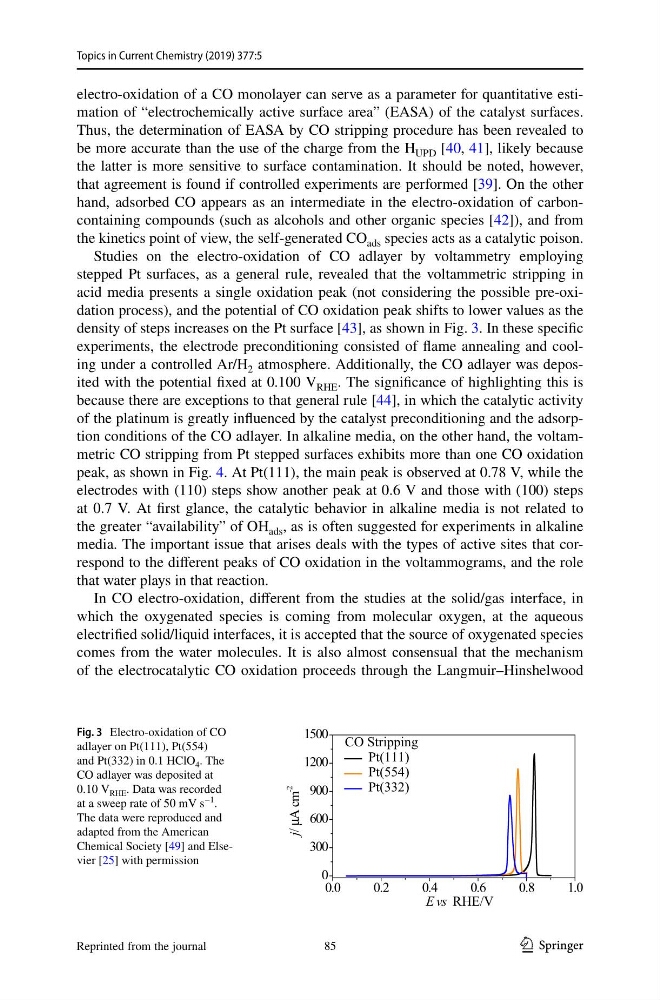
acid media presents a single oxidation peak (not considering the possible pre-oxidation process), and the potential of CO oxidation peak shifts to lower values as the
density of steps increases on the Pt surface [43], as shown in Fig. 3. In these specific
experiments, the electrode preconditioning consisted of flame annealing and cooling under a controlled Ar/H 2 atmosphere. Additionally, the CO adlayer was deposited with the potential fixed at 0.100 V RHE . The significance of highlighting this is
because there are exceptions to that general rule [44], in which the catalytic activity
of the platinum is greatly influenced by the catalyst preconditioning and the adsorption conditions of the CO adlayer. In alkaline media, on the other hand, the voltammetric CO stripping from Pt stepped surfaces exhibits more than one CO oxidation
peak, as shown in Fig. 4. At Pt(111), the main peak is observed at 0.78 V, while the
electrodes with (110) steps show another peak at 0.6 V and those with (100) steps
at 0.7 V. At first glance, the catalytic behavior in alkaline media is not related to
the greater “availability” of OH ads , as is often suggested for experiments in alkaline
media. The important issue that arises deals with the types of active sites that correspond to the different peaks of CO oxidation in the voltammograms, and the role
that water plays in that reaction.
In CO electro-oxidation, different from the studies at the solid/gas interface, in
which the oxygenated species is coming from molecular oxygen, at the aqueous
electrified solid/liquid interfaces, it is accepted that the source of oxygenated species
comes from the water molecules. It is also almost consensual that the mechanism
of the electrocatalytic CO oxidation proceeds through the Langmuir–Hinshelwood
Fig. 3 Electro-oxidation of CO
adlayer on Pt(111), Pt(554)
and Pt(332) in 0.1 HClO 4 . The
CO adlayer was deposited at
0.10 V RHE . Data was recorded
at a sweep rate of 50 mV s
−1
.
The data were reproduced and
adapted from the American
Chemical Society [49] and Elsevier [25] with permission
0.0
0 .2
0.4
0 .6
0.8
1 .0
0
300
600
900
1200
1500 CO Stripping
Pt(111)
Pt(554)
Pt(332)
j/ µA
cm
-2
E vs RHE/V
Reprinted from the journal
85
Topics in Current Chemistry (2019) 377:5
electro-oxidation of a CO monolayer can serve as a parameter for quantitative estimation of “electrochemically active surface area” (EASA) of the catalyst surfaces.
Thus, the determination of EASA by CO stripping procedure has been revealed to
be more accurate than the use of the charge from the H UPD [40, 41], likely because
the latter is more sensitive to surface contamination. It should be noted, however,
that agreement is found if controlled experiments are performed [39]. On the other
hand, adsorbed CO appears as an intermediate in the electro-oxidation of carboncontaining compounds (such as alcohols and other organic species [42]), and from
the kinetics point of view, the self-generated CO ads species acts as a catalytic poison.
Studies on the electro-oxidation of CO adlayer by voltammetry employing
stepped Pt surfaces, as a general rule, revealed that the voltammetric stripping in
acid media presents a single oxidation peak (not considering the possible pre-oxidation process), and the potential of CO oxidation peak shifts to lower values as the
density of steps increases on the Pt surface [43], as shown in Fig. 3. In these specific
experiments, the electrode preconditioning consisted of flame annealing and cooling under a controlled Ar/H 2 atmosphere. Additionally, the CO adlayer was deposited with the potential fixed at 0.100 V RHE . The significance of highlighting this is
because there are exceptions to that general rule [44], in which the catalytic activity
of the platinum is greatly influenced by the catalyst preconditioning and the adsorption conditions of the CO adlayer. In alkaline media, on the other hand, the voltammetric CO stripping from Pt stepped surfaces exhibits more than one CO oxidation
peak, as shown in Fig. 4. At Pt(111), the main peak is observed at 0.78 V, while the
electrodes with (110) steps show another peak at 0.6 V and those with (100) steps
at 0.7 V. At first glance, the catalytic behavior in alkaline media is not related to
the greater “availability” of OH ads , as is often suggested for experiments in alkaline
media. The important issue that arises deals with the types of active sites that correspond to the different peaks of CO oxidation in the voltammograms, and the role
that water plays in that reaction.
In CO electro-oxidation, different from the studies at the solid/gas interface, in
which the oxygenated species is coming from molecular oxygen, at the aqueous
electrified solid/liquid interfaces, it is accepted that the source of oxygenated species
comes from the water molecules. It is also almost consensual that the mechanism
of the electrocatalytic CO oxidation proceeds through the Langmuir–Hinshelwood
Fig. 3 Electro-oxidation of CO
adlayer on Pt(111), Pt(554)
and Pt(332) in 0.1 HClO 4 . The
CO adlayer was deposited at
0.10 V RHE . Data was recorded
at a sweep rate of 50 mV s
−1
.
The data were reproduced and
adapted from the American
Chemical Society [49] and Elsevier [25] with permission
0.0
0 .2
0.4
0 .6
0.8
1 .0
0
300
600
900
1200
1500 CO Stripping
Pt(111)
Pt(554)
Pt(332)
j/ µA
cm
-2
E vs RHE/V
Reprinted from the journal
85