

Topics in Current Chemistry (2019) 377:5
1 3
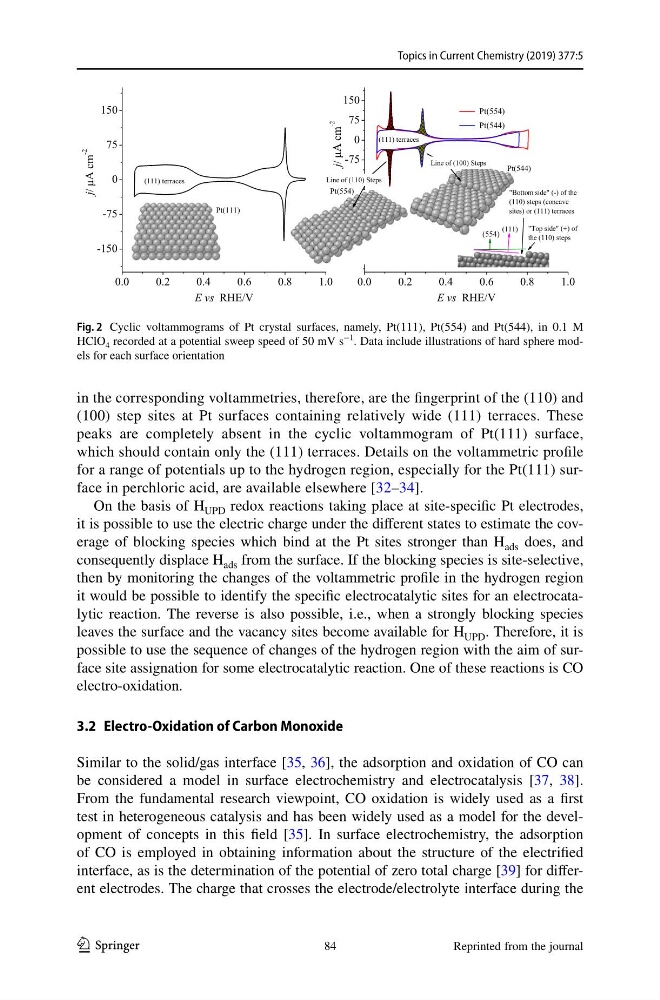
in the corresponding voltammetries, therefore, are the fingerprint of the (110) and
(100) step sites at Pt surfaces containing relatively wide (111) terraces. These
peaks are completely absent in the cyclic voltammogram of Pt(111) surface,
which should contain only the (111) terraces. Details on the voltammetric profile
for a range of potentials up to the hydrogen region, especially for the Pt(111) surface in perchloric acid, are available elsewhere [32–34].
On the basis of H UPD redox reactions taking place at site-specific Pt electrodes,
it is possible to use the electric charge under the different states to estimate the coverage of blocking species which bind at the Pt sites stronger than H ads does, and
consequently displace H ads from the surface. If the blocking species is site-selective,
then by monitoring the changes of the voltammetric profile in the hydrogen region
it would be possible to identify the specific electrocatalytic sites for an electrocatalytic reaction. The reverse is also possible, i.e., when a strongly blocking species
leaves the surface and the vacancy sites become available for H UPD . Therefore, it is
possible to use the sequence of changes of the hydrogen region with the aim of surface site assignation for some electrocatalytic reaction. One of these reactions is CO
electro-oxidation.
3.2 Electro‑Oxidation of Carbon Monoxide
Similar to the solid/gas interface [35, 36], the adsorption and oxidation of CO can
be considered a model in surface electrochemistry and electrocatalysis [37, 38].
From the fundamental research viewpoint, CO oxidation is widely used as a first
test in heterogeneous catalysis and has been widely used as a model for the development of concepts in this field [35]. In surface electrochemistry, the adsorption
of CO is employed in obtaining information about the structure of the electrified
interface, as is the determination of the potential of zero total charge [39] for different electrodes. The charge that crosses the electrode/electrolyte interface during the
0.0
0.2
0.4
0.6
0.8
1.0
-150
-75
0
75
150
0.0
0.2
0.4
0.6
0.8
1.0
-450
-375
-300
-225
-150
-75
0
75
150
j/ µA
cm
-2
E vs RHE/V
(111) terraces
Pt(111)
Pt(554)
Pt(544)
j/ µA
cm
-2
E vs RHE/V
(111) terraces
"Top side" (+) of
the (110) steps
"Bottom side" (-) of the
(110) steps (concave
sites) or (111) terraces
(554)
(111)
Pt(554)
Pt(544)
Line of (110) Steps
Line of (100) Steps
Fig. 2 Cyclic voltammograms of Pt crystal surfaces, namely, Pt(111), Pt(554) and Pt(544), in 0.1 M
HClO 4 recorded at a potential sweep speed of 50 mV s
−1 . Data include illustrations of hard sphere models for each surface orientation
Reprinted from the journal
84
1 3
in the corresponding voltammetries, therefore, are the fingerprint of the (110) and
(100) step sites at Pt surfaces containing relatively wide (111) terraces. These
peaks are completely absent in the cyclic voltammogram of Pt(111) surface,
which should contain only the (111) terraces. Details on the voltammetric profile
for a range of potentials up to the hydrogen region, especially for the Pt(111) surface in perchloric acid, are available elsewhere [32–34].
On the basis of H UPD redox reactions taking place at site-specific Pt electrodes,
it is possible to use the electric charge under the different states to estimate the coverage of blocking species which bind at the Pt sites stronger than H ads does, and
consequently displace H ads from the surface. If the blocking species is site-selective,
then by monitoring the changes of the voltammetric profile in the hydrogen region
it would be possible to identify the specific electrocatalytic sites for an electrocatalytic reaction. The reverse is also possible, i.e., when a strongly blocking species
leaves the surface and the vacancy sites become available for H UPD . Therefore, it is
possible to use the sequence of changes of the hydrogen region with the aim of surface site assignation for some electrocatalytic reaction. One of these reactions is CO
electro-oxidation.
3.2 Electro‑Oxidation of Carbon Monoxide
Similar to the solid/gas interface [35, 36], the adsorption and oxidation of CO can
be considered a model in surface electrochemistry and electrocatalysis [37, 38].
From the fundamental research viewpoint, CO oxidation is widely used as a first
test in heterogeneous catalysis and has been widely used as a model for the development of concepts in this field [35]. In surface electrochemistry, the adsorption
of CO is employed in obtaining information about the structure of the electrified
interface, as is the determination of the potential of zero total charge [39] for different electrodes. The charge that crosses the electrode/electrolyte interface during the
0.0
0.2
0.4
0.6
0.8
1.0
-150
-75
0
75
150
0.0
0.2
0.4
0.6
0.8
1.0
-450
-375
-300
-225
-150
-75
0
75
150
j/ µA
cm
-2
E vs RHE/V
(111) terraces
Pt(111)
Pt(554)
Pt(544)
j/ µA
cm
-2
E vs RHE/V
(111) terraces
"Top side" (+) of
the (110) steps
"Bottom side" (-) of the
(110) steps (concave
sites) or (111) terraces
(554)
(111)
Pt(554)
Pt(544)
Line of (110) Steps
Line of (100) Steps
Fig. 2 Cyclic voltammograms of Pt crystal surfaces, namely, Pt(111), Pt(554) and Pt(544), in 0.1 M
HClO 4 recorded at a potential sweep speed of 50 mV s
−1 . Data include illustrations of hard sphere models for each surface orientation
Reprinted from the journal
84