

1 3
Topics in Current Chemistry (2019) 377:5
bending mode of OH ads ), decreased with the increase in step density [47]. If this
(independent) reaction takes place in a step of the CO electro-oxidation, a possible
intermediate species formed during CO ads electro-oxidation would be the COOH ads
species, whose formation depends on the structure of the electrode, but its decomposition to CO 2 is potential-dependent, i.e., COOH ads → CO 2 + H
+
+ e
−
+ * active sites .
Santos et al. [48] had already proposed that COOH ads might be a reaction intermediate during the electro-oxidation of CO ads on Pt in acid media. However, the chemical
nature of the oxygenated species that react with CO ads remains an open question.
The identification of active sites in the CO electro-oxidation refers to experiments
of CO stripping, which is when there is no CO beyond that adsorbed on the catalyst
surface. The comparison between CO and H adsorption is useful because H cannot
adsorb on CO-covered sites. In a full CO adlayer at Pt stepped surfaces such as those
of Fig. 2, it is plausible to assume that all kind of sites are occupied by CO, i.e.,
either the (111) terrace sites and the step sites are blocked by CO. At this stage of
full CO coverage (and in absence of solution CO), we can partially remove the CO
adlayer and verify the kind of sites released after CO electro-oxidation. It is appropriate to anticipate that this experimental procedure is because the CO ads adlayer apparently behaves as a typical poison (“immobile”) layer during the CO ads oxidation. In
the last 5 years, we have conducted a series of experiments in this direction in the
entire pH range, and it was found that at stepped Pt surfaces the most active sites
consist of (111) terraces [25, 51, 52]. The intrinsic catalytic activity of step and kink
sites is lower compared to the catalytic activity at the (111) terraces of those kinds of
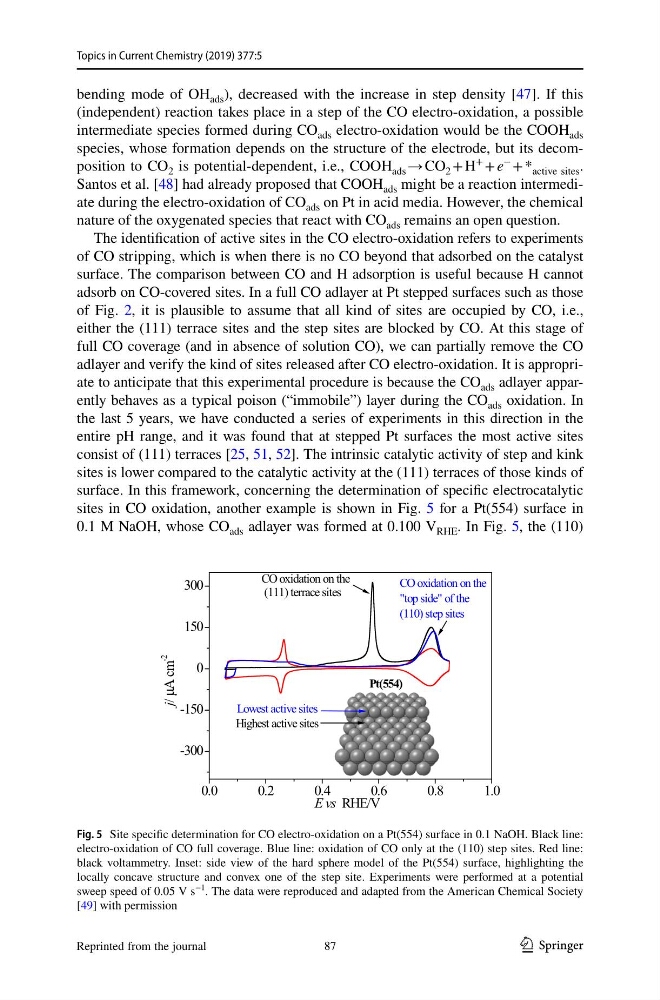
surface. In this framework, concerning the determination of specific electrocatalytic
sites in CO oxidation, another example is shown in Fig. 5 for a Pt(554) surface in
0.1 M NaOH, whose CO ads adlayer was formed at 0.100 V RHE . In Fig. 5, the (110)
0.0
0 .2
0.4
0 .6
0.8
1 .0
-300
-150
0
150
300
j/ µA
cm
-2
E vs RHE/V
CO oxidation on the
(111) terrace sites
CO oxidation on the
"top side" of the
(110) step sites
Highest active sites
Lowest active sites
Pt(554)
Fig. 5 Site specific determination for CO electro-oxidation on a Pt(554) surface in 0.1 NaOH. Black line:
electro-oxidation of CO full coverage. Blue line: oxidation of CO only at the (110) step sites. Red line:
black voltammetry. Inset: side view of the hard sphere model of the Pt(554) surface, highlighting the
locally concave structure and convex one of the step site. Experiments were performed at a potential
sweep speed of 0.05 V s
−1
. The data were reproduced and adapted from the American Chemical Society
[49] with permission
Reprinted from the journal
87
Topics in Current Chemistry (2019) 377:5
bending mode of OH ads ), decreased with the increase in step density [47]. If this
(independent) reaction takes place in a step of the CO electro-oxidation, a possible
intermediate species formed during CO ads electro-oxidation would be the COOH ads
species, whose formation depends on the structure of the electrode, but its decomposition to CO 2 is potential-dependent, i.e., COOH ads → CO 2 + H
+
+ e
−
+ * active sites .
Santos et al. [48] had already proposed that COOH ads might be a reaction intermediate during the electro-oxidation of CO ads on Pt in acid media. However, the chemical
nature of the oxygenated species that react with CO ads remains an open question.
The identification of active sites in the CO electro-oxidation refers to experiments
of CO stripping, which is when there is no CO beyond that adsorbed on the catalyst
surface. The comparison between CO and H adsorption is useful because H cannot
adsorb on CO-covered sites. In a full CO adlayer at Pt stepped surfaces such as those
of Fig. 2, it is plausible to assume that all kind of sites are occupied by CO, i.e.,
either the (111) terrace sites and the step sites are blocked by CO. At this stage of
full CO coverage (and in absence of solution CO), we can partially remove the CO
adlayer and verify the kind of sites released after CO electro-oxidation. It is appropriate to anticipate that this experimental procedure is because the CO ads adlayer apparently behaves as a typical poison (“immobile”) layer during the CO ads oxidation. In
the last 5 years, we have conducted a series of experiments in this direction in the
entire pH range, and it was found that at stepped Pt surfaces the most active sites
consist of (111) terraces [25, 51, 52]. The intrinsic catalytic activity of step and kink
sites is lower compared to the catalytic activity at the (111) terraces of those kinds of
surface. In this framework, concerning the determination of specific electrocatalytic
sites in CO oxidation, another example is shown in Fig. 5 for a Pt(554) surface in
0.1 M NaOH, whose CO ads adlayer was formed at 0.100 V RHE . In Fig. 5, the (110)
0.0
0 .2
0.4
0 .6
0.8
1 .0
-300
-150
0
150
300
j/ µA
cm
-2
E vs RHE/V
CO oxidation on the
(111) terrace sites
CO oxidation on the
"top side" of the
(110) step sites
Highest active sites
Lowest active sites
Pt(554)
Fig. 5 Site specific determination for CO electro-oxidation on a Pt(554) surface in 0.1 NaOH. Black line:
electro-oxidation of CO full coverage. Blue line: oxidation of CO only at the (110) step sites. Red line:
black voltammetry. Inset: side view of the hard sphere model of the Pt(554) surface, highlighting the
locally concave structure and convex one of the step site. Experiments were performed at a potential
sweep speed of 0.05 V s
−1
. The data were reproduced and adapted from the American Chemical Society
[49] with permission
Reprinted from the journal
87