

Topics in Current Chemistry (2018) 376:42
1 3
4.5 Supported Nickel‑Based Compounds
It is out of doubt that conventional carbon or non-carbon catalyst carriers (mainly
referring to nickel foam, carbon fiber cloth, titanium mesh, etc.) have been proven
as excellent stable current collectors for alkaline urea electro-oxidation. Nevertheless, novel catalyst supports such as graphene have strongly promoted the electrochemical reaction rate due to their superior electrochemical activities and favorable
synergy between the catalyst and support, thereby attracting more attention in recent
years. It is generally believed that suitable electrocatalyst supports should have good
electrical conductivity, large specific surface area, reasonable pore structure, and
good corrosion resistance. In view of the shortcomings of traditional conductive carbon black carriers, other advanced carbon materials (for instance: carbon nanotubes
or graphene) and non-carbon materials are considered to be reliable urea electrooxidation catalyst carriers. Briefly, the supported catalysts can be distinguished from
several types of carriers as follows.
Graphene is defined as a 2D honeycomb crystal consisting of carbon atoms
only one layer thick. The spheroidal arrangement between these carbon atoms can
form a honeycomb-like framework, which commonly provides excellent mechanical properties, thermodynamic properties, electrical conductivity, chemical stability,
and large surface area, respectively, and is therefore widely employed as the catalyst carrier [119, 120]. Wang et al. [121] prepared a Ni-graphene composite catalyst
via the electrochemical reduction method and obtained the twice current density as
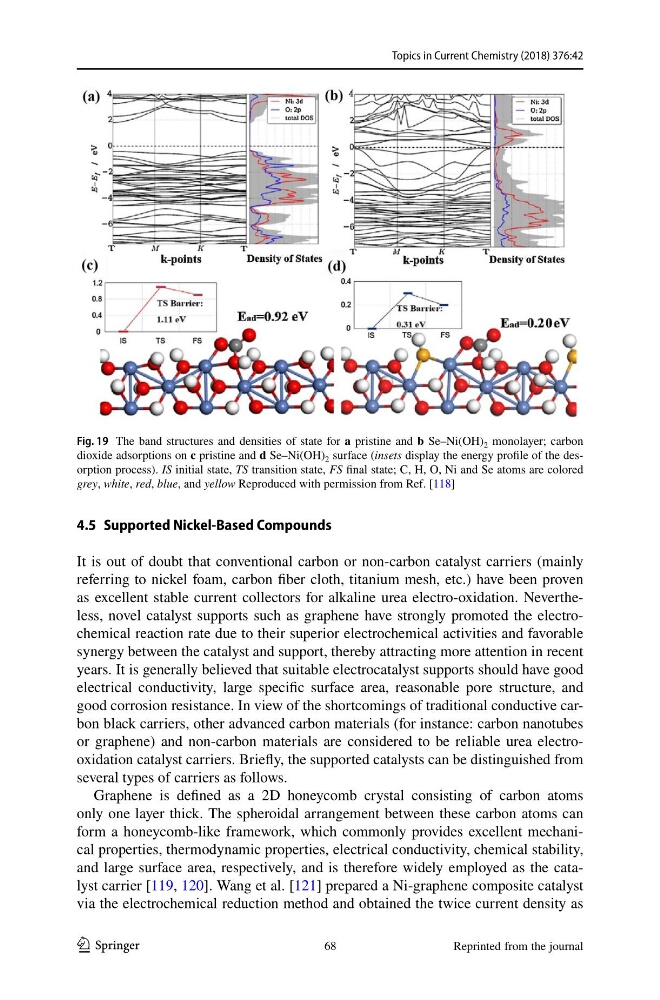
Fig. 19 The band structures and densities of state for a pristine and b Se–Ni(OH) 2 monolayer; carbon
dioxide adsorptions on c pristine and d Se–Ni(OH) 2 surface (insets display the energy profile of the desorption process). IS initial state, TS transition state, FS final state; C, H, O, Ni and Se atoms are colored
grey, white, red, blue, and yellow Reproduced with permission from Ref. [118]
Reprinted from the journal
68
1 3
4.5 Supported Nickel‑Based Compounds
It is out of doubt that conventional carbon or non-carbon catalyst carriers (mainly
referring to nickel foam, carbon fiber cloth, titanium mesh, etc.) have been proven
as excellent stable current collectors for alkaline urea electro-oxidation. Nevertheless, novel catalyst supports such as graphene have strongly promoted the electrochemical reaction rate due to their superior electrochemical activities and favorable
synergy between the catalyst and support, thereby attracting more attention in recent
years. It is generally believed that suitable electrocatalyst supports should have good
electrical conductivity, large specific surface area, reasonable pore structure, and
good corrosion resistance. In view of the shortcomings of traditional conductive carbon black carriers, other advanced carbon materials (for instance: carbon nanotubes
or graphene) and non-carbon materials are considered to be reliable urea electrooxidation catalyst carriers. Briefly, the supported catalysts can be distinguished from
several types of carriers as follows.
Graphene is defined as a 2D honeycomb crystal consisting of carbon atoms
only one layer thick. The spheroidal arrangement between these carbon atoms can
form a honeycomb-like framework, which commonly provides excellent mechanical properties, thermodynamic properties, electrical conductivity, chemical stability,
and large surface area, respectively, and is therefore widely employed as the catalyst carrier [119, 120]. Wang et al. [121] prepared a Ni-graphene composite catalyst
via the electrochemical reduction method and obtained the twice current density as
Fig. 19 The band structures and densities of state for a pristine and b Se–Ni(OH) 2 monolayer; carbon
dioxide adsorptions on c pristine and d Se–Ni(OH) 2 surface (insets display the energy profile of the desorption process). IS initial state, TS transition state, FS final state; C, H, O, Ni and Se atoms are colored
grey, white, red, blue, and yellow Reproduced with permission from Ref. [118]
Reprinted from the journal
68