

1 3
Topics in Current Chemistry (2018) 376:42
species, indicating a similar E-C mechanism of nickel-based phosphides to the pervious literature. More importantly, the voltage performance of Ni 2 P for urea-based
water spitting is better than that of the nano-sheet NiCoP arrays on carbon cloth
(noted as NiCoP NS/CC) prepared by Xie et al. [115]. The two-electrode voltage of
Ni 2 P is durable with 1.45 V to afford 50 mA cm
−2
.
Simultaneously, studies on sulfides and selenides are also emerging in the last 2
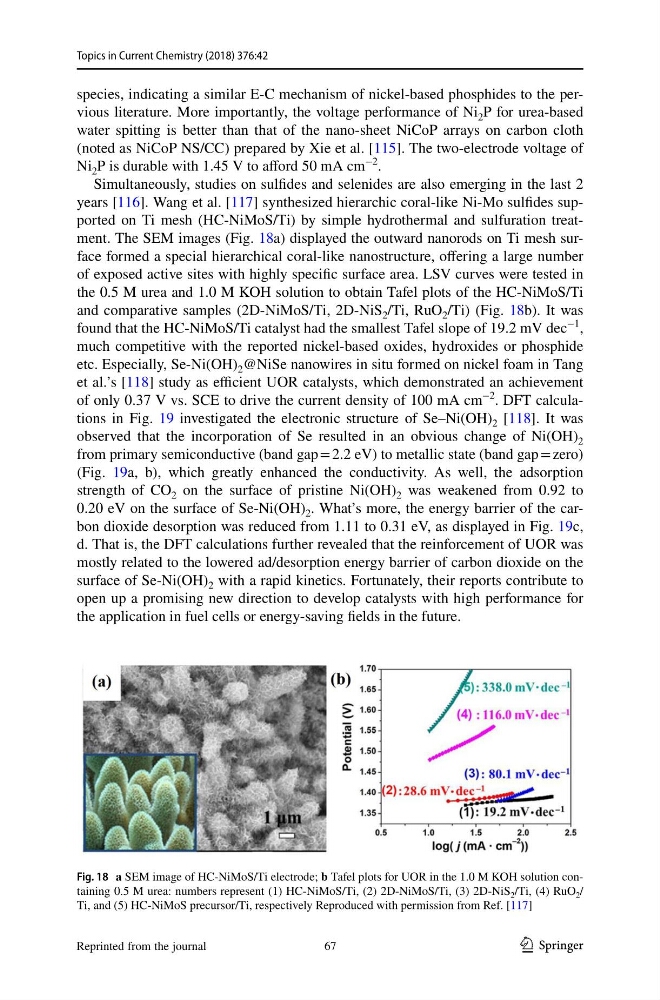
years [116]. Wang et al. [117] synthesized hierarchic coral-like Ni-Mo sulfides supported on Ti mesh (HC-NiMoS/Ti) by simple hydrothermal and sulfuration treatment. The SEM images (Fig. 18a) displayed the outward nanorods on Ti mesh surface formed a special hierarchical coral-like nanostructure, offering a large number
of exposed active sites with highly specific surface area. LSV curves were tested in
the 0.5 M urea and 1.0 M KOH solution to obtain Tafel plots of the HC-NiMoS/Ti
and comparative samples (2D-NiMoS/Ti, 2D-NiS 2 /Ti, RuO 2 /Ti) (Fig. 18b). It was
found that the HC-NiMoS/Ti catalyst had the smallest Tafel slope of 19.2 mV dec
−1
,
much competitive with the reported nickel-based oxides, hydroxides or phosphide
etc. Especially, Se-Ni(OH) 2 @NiSe nanowires in situ formed on nickel foam in Tang
et al.’s [118] study as efficient UOR catalysts, which demonstrated an achievement
of only 0.37 V vs. SCE to drive the current density of 100 mA cm
−2
. DFT calculations in Fig. 19 investigated the electronic structure of Se–Ni(OH) 2 [118]. It was
observed that the incorporation of Se resulted in an obvious change of Ni(OH) 2
from primary semiconductive (band gap = 2.2 eV) to metallic state (band gap = zero)
(Fig. 19a, b), which greatly enhanced the conductivity. As well, the adsorption
strength of CO 2 on the surface of pristine Ni(OH) 2 was weakened from 0.92 to
0.20 eV on the surface of Se-Ni(OH) 2 . What’s more, the energy barrier of the carbon dioxide desorption was reduced from 1.11 to 0.31 eV, as displayed in Fig. 19c,
d. That is, the DFT calculations further revealed that the reinforcement of UOR was
mostly related to the lowered ad/desorption energy barrier of carbon dioxide on the
surface of Se-Ni(OH) 2 with a rapid kinetics. Fortunately, their reports contribute to
open up a promising new direction to develop catalysts with high performance for
the application in fuel cells or energy-saving fields in the future.
Fig. 18 a SEM image of HC-NiMoS/Ti electrode; b Tafel plots for UOR in the 1.0 M KOH solution containing 0.5 M urea: numbers represent (1) HC-NiMoS/Ti, (2) 2D-NiMoS/Ti, (3) 2D-NiS 2 /Ti, (4) RuO 2 /
Ti, and (5) HC-NiMoS precursor/Ti, respectively Reproduced with permission from Ref. [117]
Reprinted from the journal
67
Topics in Current Chemistry (2018) 376:42
species, indicating a similar E-C mechanism of nickel-based phosphides to the pervious literature. More importantly, the voltage performance of Ni 2 P for urea-based
water spitting is better than that of the nano-sheet NiCoP arrays on carbon cloth
(noted as NiCoP NS/CC) prepared by Xie et al. [115]. The two-electrode voltage of
Ni 2 P is durable with 1.45 V to afford 50 mA cm
−2
.
Simultaneously, studies on sulfides and selenides are also emerging in the last 2
years [116]. Wang et al. [117] synthesized hierarchic coral-like Ni-Mo sulfides supported on Ti mesh (HC-NiMoS/Ti) by simple hydrothermal and sulfuration treatment. The SEM images (Fig. 18a) displayed the outward nanorods on Ti mesh surface formed a special hierarchical coral-like nanostructure, offering a large number
of exposed active sites with highly specific surface area. LSV curves were tested in
the 0.5 M urea and 1.0 M KOH solution to obtain Tafel plots of the HC-NiMoS/Ti
and comparative samples (2D-NiMoS/Ti, 2D-NiS 2 /Ti, RuO 2 /Ti) (Fig. 18b). It was
found that the HC-NiMoS/Ti catalyst had the smallest Tafel slope of 19.2 mV dec
−1
,
much competitive with the reported nickel-based oxides, hydroxides or phosphide
etc. Especially, Se-Ni(OH) 2 @NiSe nanowires in situ formed on nickel foam in Tang
et al.’s [118] study as efficient UOR catalysts, which demonstrated an achievement
of only 0.37 V vs. SCE to drive the current density of 100 mA cm
−2
. DFT calculations in Fig. 19 investigated the electronic structure of Se–Ni(OH) 2 [118]. It was
observed that the incorporation of Se resulted in an obvious change of Ni(OH) 2
from primary semiconductive (band gap = 2.2 eV) to metallic state (band gap = zero)
(Fig. 19a, b), which greatly enhanced the conductivity. As well, the adsorption
strength of CO 2 on the surface of pristine Ni(OH) 2 was weakened from 0.92 to
0.20 eV on the surface of Se-Ni(OH) 2 . What’s more, the energy barrier of the carbon dioxide desorption was reduced from 1.11 to 0.31 eV, as displayed in Fig. 19c,
d. That is, the DFT calculations further revealed that the reinforcement of UOR was
mostly related to the lowered ad/desorption energy barrier of carbon dioxide on the
surface of Se-Ni(OH) 2 with a rapid kinetics. Fortunately, their reports contribute to
open up a promising new direction to develop catalysts with high performance for
the application in fuel cells or energy-saving fields in the future.
Fig. 18 a SEM image of HC-NiMoS/Ti electrode; b Tafel plots for UOR in the 1.0 M KOH solution containing 0.5 M urea: numbers represent (1) HC-NiMoS/Ti, (2) 2D-NiMoS/Ti, (3) 2D-NiS 2 /Ti, (4) RuO 2 /
Ti, and (5) HC-NiMoS precursor/Ti, respectively Reproduced with permission from Ref. [117]
Reprinted from the journal
67