

1 3
Topics in Current Chemistry (2018) 376:42
high as that of the pure nickel catalyst. On the one hand, it was due to the synergy
between nickel and graphene that greatly increased the anti-CO poisoning ability of
the active component. On the other hand, the large specific surface area and high
electrical conductivity of graphene are in favor of the growth of more active sites for
catalytic process. In turn, the catalytic performance was optimized.
Carbon nanotubes (CNT) as a type of one-dimensional hollow tubular carbon
material equipped with good conductivity, stable chemical properties, and high
mechanical strength, are also promising catalyst carriers for the employment in urea
electro-oxidation [41, 56, 122, 123]. Wang et al. [124] fabricated the Ni-WC catalysts utilizing multi-walled carbon nanotubes (MWCNT) and activated carbon as
carriers, respectively. It was found that the surface area of Ni-WC/MWCNT catalyst
was nearly 1.5 times that of the WC/C catalyst under the premise of uniform carrier
content. As a result, in the 0.33 M urea and 1 M KOH solution, the oxidant current on Ni-WC/MWCNT catalyst was three times that of the WC/C catalyst, and the
resistance of the former was 4 Ω less than that of the latter, simultaneously. Kakati
et al. [125] adopted a facile microwave-assisted method to design the MWCNT-supported sodium nickel fluoride with hollow nano-cube structures (SNF–MWCNT),
according to an in situ template mechanism. The dispersed MWCNTs in the reaction
medium provided amounts of attaching space for the adsorption of [BMIM]
+
ions
and thereby anchored cubic NaF deposits on the surface of MWCNT. An interaction between F and Ni and the Ni
2+
/Ni
3+
oxidation–reduction couple enriched Ni
3+
surface was identified as the as-prepared SNF–MWCNT. Consequently, the hollow
and porous SNF attached on MWCNT with the superior catalytic activity of 3.12 A
cm
−2
mg
−1
demonstrates a potential candidate for the urea electro-catalysts.
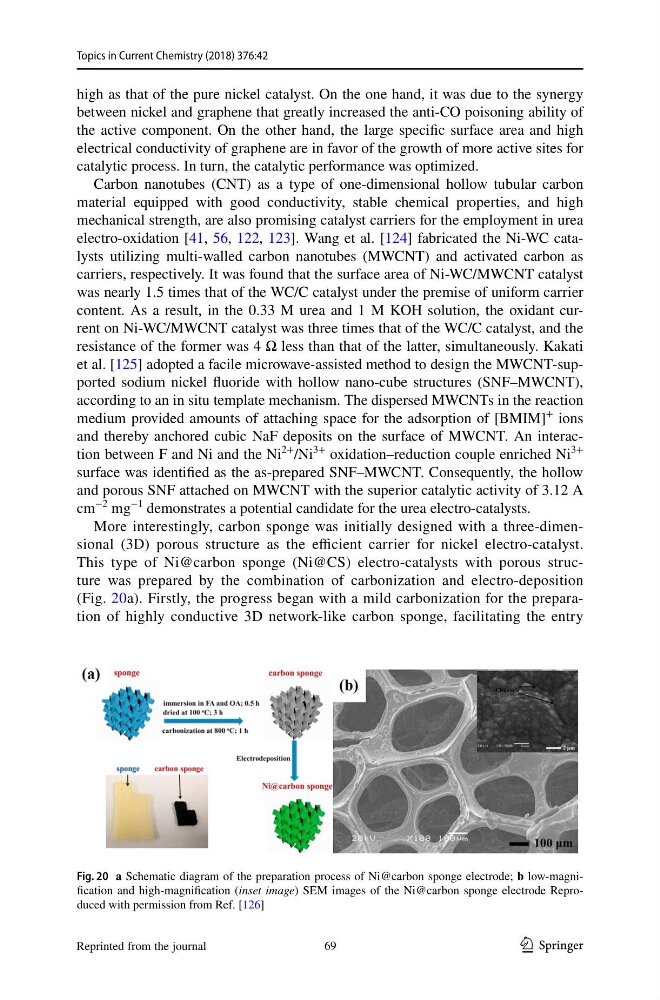
More interestingly, carbon sponge was initially designed with a three-dimensional (3D) porous structure as the efficient carrier for nickel electro-catalyst.
This type of Ni@carbon sponge (Ni@CS) electro-catalysts with porous structure was prepared by the combination of carbonization and electro-deposition
(Fig. 20a). Firstly, the progress began with a mild carbonization for the preparation of highly conductive 3D network-like carbon sponge, facilitating the entry
Fig. 20 a Schematic diagram of the preparation process of Ni@carbon sponge electrode; b low-magnification and high-magnification (inset image) SEM images of the Ni@carbon sponge electrode Reproduced with permission from Ref. [126]
Reprinted from the journal
69
Topics in Current Chemistry (2018) 376:42
high as that of the pure nickel catalyst. On the one hand, it was due to the synergy
between nickel and graphene that greatly increased the anti-CO poisoning ability of
the active component. On the other hand, the large specific surface area and high
electrical conductivity of graphene are in favor of the growth of more active sites for
catalytic process. In turn, the catalytic performance was optimized.
Carbon nanotubes (CNT) as a type of one-dimensional hollow tubular carbon
material equipped with good conductivity, stable chemical properties, and high
mechanical strength, are also promising catalyst carriers for the employment in urea
electro-oxidation [41, 56, 122, 123]. Wang et al. [124] fabricated the Ni-WC catalysts utilizing multi-walled carbon nanotubes (MWCNT) and activated carbon as
carriers, respectively. It was found that the surface area of Ni-WC/MWCNT catalyst
was nearly 1.5 times that of the WC/C catalyst under the premise of uniform carrier
content. As a result, in the 0.33 M urea and 1 M KOH solution, the oxidant current on Ni-WC/MWCNT catalyst was three times that of the WC/C catalyst, and the
resistance of the former was 4 Ω less than that of the latter, simultaneously. Kakati
et al. [125] adopted a facile microwave-assisted method to design the MWCNT-supported sodium nickel fluoride with hollow nano-cube structures (SNF–MWCNT),
according to an in situ template mechanism. The dispersed MWCNTs in the reaction
medium provided amounts of attaching space for the adsorption of [BMIM]
+
ions
and thereby anchored cubic NaF deposits on the surface of MWCNT. An interaction between F and Ni and the Ni
2+
/Ni
3+
oxidation–reduction couple enriched Ni
3+
surface was identified as the as-prepared SNF–MWCNT. Consequently, the hollow
and porous SNF attached on MWCNT with the superior catalytic activity of 3.12 A
cm
−2
mg
−1
demonstrates a potential candidate for the urea electro-catalysts.
More interestingly, carbon sponge was initially designed with a three-dimensional (3D) porous structure as the efficient carrier for nickel electro-catalyst.
This type of Ni@carbon sponge (Ni@CS) electro-catalysts with porous structure was prepared by the combination of carbonization and electro-deposition
(Fig. 20a). Firstly, the progress began with a mild carbonization for the preparation of highly conductive 3D network-like carbon sponge, facilitating the entry
Fig. 20 a Schematic diagram of the preparation process of Ni@carbon sponge electrode; b low-magnification and high-magnification (inset image) SEM images of the Ni@carbon sponge electrode Reproduced with permission from Ref. [126]
Reprinted from the journal
69