

1 3
Topics in Current Chemistry (2018) 376:42
Since H
+
is produced and discharged into the solution, acid-resistant precious
metal catalysts are used as the anode catalysts. Previous reports based on neutral
NaCl medium have confirmed that urea (less than 0.2 M) can be degraded with a
nearly equal molar amount of chloride ion on the noble-metal oxide catalysts such as
IrO 2 , RuO 2 , and PtO 2 [12, 60–62]. For instance, Wright et al. [63] decomposed urea
into CO 2 and N 2 accompanied with forming the chlorourea and subsequent dichlorourea on the surface of RuO 2 –TiO 2 –coated titanium electrode. In this electrochemical process, OCl
−
and HOCl of free reactive species formed as a primary oxidant
that can promote the decomposition of urea, and chloramines usually appeared as
the reactive intermediates. In recent studies, chlorine radicals generated by electrochemical reaction was proved to be able to effectively reduce the demanding chemical oxygen in human urine or industrial waste water [64, 65]. Under this condition,
reactive chlorine species (RCS) was raised out as the total name of free chlorines
(as Cl
·
) and chlorine radicals (as Cl 2
−·
), while the most common RCS in typical urea
degradation might be NaOCl. Based on these analyses, Cho et al. [66, 67] point out
a further chloride-mediated mechanism of the electro-oxidation of urea in neutral
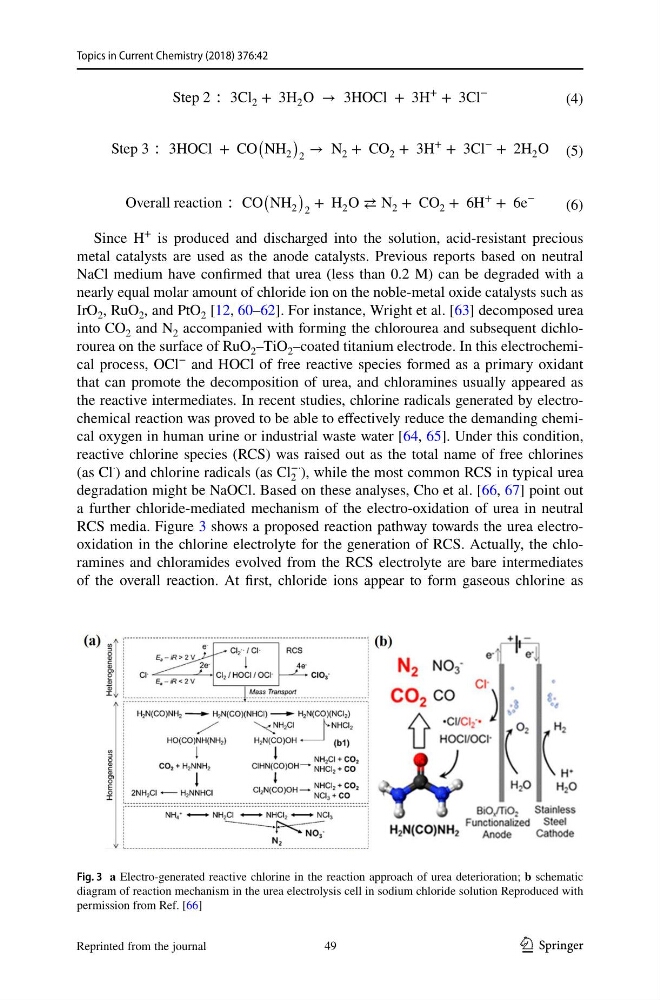
RCS media. Figure 3 shows a proposed reaction pathway towards the urea electrooxidation in the chlorine electrolyte for the generation of RCS. Actually, the chloramines and chloramides evolved from the RCS electrolyte are bare intermediates
of the overall reaction. At first, chloride ions appear to form gaseous chlorine as
(4)
Step 2 ∶ 3Cl 2 + 3H 2 O → 3HOCl + 3H
+ + 3Cl
−
(5)
Step 3 ∶ 3HOCl + CO
NH 2
2
→ N 2 + CO 2 + 3H
+ + 3Cl
− + 2H 2 O
(6)
Overall reaction ∶ CO
NH 2
2
+ H 2 O ⇄ N 2 + CO 2 + 6H
+ + 6e
−
Fig. 3 a Electro-generated reactive chlorine in the reaction approach of urea deterioration; b schematic
diagram of reaction mechanism in the urea electrolysis cell in sodium chloride solution Reproduced with
permission from Ref. [66]
Reprinted from the journal
49
Topics in Current Chemistry (2018) 376:42
Since H
+
is produced and discharged into the solution, acid-resistant precious
metal catalysts are used as the anode catalysts. Previous reports based on neutral
NaCl medium have confirmed that urea (less than 0.2 M) can be degraded with a
nearly equal molar amount of chloride ion on the noble-metal oxide catalysts such as
IrO 2 , RuO 2 , and PtO 2 [12, 60–62]. For instance, Wright et al. [63] decomposed urea
into CO 2 and N 2 accompanied with forming the chlorourea and subsequent dichlorourea on the surface of RuO 2 –TiO 2 –coated titanium electrode. In this electrochemical process, OCl
−
and HOCl of free reactive species formed as a primary oxidant
that can promote the decomposition of urea, and chloramines usually appeared as
the reactive intermediates. In recent studies, chlorine radicals generated by electrochemical reaction was proved to be able to effectively reduce the demanding chemical oxygen in human urine or industrial waste water [64, 65]. Under this condition,
reactive chlorine species (RCS) was raised out as the total name of free chlorines
(as Cl
·
) and chlorine radicals (as Cl 2
−·
), while the most common RCS in typical urea
degradation might be NaOCl. Based on these analyses, Cho et al. [66, 67] point out
a further chloride-mediated mechanism of the electro-oxidation of urea in neutral
RCS media. Figure 3 shows a proposed reaction pathway towards the urea electrooxidation in the chlorine electrolyte for the generation of RCS. Actually, the chloramines and chloramides evolved from the RCS electrolyte are bare intermediates
of the overall reaction. At first, chloride ions appear to form gaseous chlorine as
(4)
Step 2 ∶ 3Cl 2 + 3H 2 O → 3HOCl + 3H
+ + 3Cl
−
(5)
Step 3 ∶ 3HOCl + CO
NH 2
2
→ N 2 + CO 2 + 3H
+ + 3Cl
− + 2H 2 O
(6)
Overall reaction ∶ CO
NH 2
2
+ H 2 O ⇄ N 2 + CO 2 + 6H
+ + 6e
−
Fig. 3 a Electro-generated reactive chlorine in the reaction approach of urea deterioration; b schematic
diagram of reaction mechanism in the urea electrolysis cell in sodium chloride solution Reproduced with
permission from Ref. [66]
Reprinted from the journal
49