

Topics in Current Chemistry (2018) 376:42
1 3
the potential is more positive than 2 V (vs. NHE) or to form chlorine radicals when
lower than 2 V (vs. NHE). Because the electron receptor effect of substitutional
chlorine will weaken bond strength of adjacent amido H, the first step of chlorate
evolution tends to be a rate-determining procedure. At the same time in the first step,
the other reaction of the OCl
−
electro-oxidation might generate the ClO 2
−
through a
four-electron transfer. Afterwards, the reaction productions between urea and chlorate will undergo a rapid hydrolysis and convert to CO 2 , NHCl, and NH 2 Cl through
the chlorinated carbamic acid route or to CO 2 and NCl 3 through the chlorinated
hydrazine route, while CO appears as a minor product, respectively. In the final step,
the inorganic chloramine undergoes a breakage chlorination route to primarily form
nitrogen or otherwise oxidization to a small amount of nitrate.
3.2 Mechanism in Alkaline OH
–
Medium
Unfortunately, the electro-oxidation of urea under a neutral medium suffers from
some disadvantages. Firstly, the anodic catalyst should be a noble metal, which
increases the cost of urea-degradation technology. Secondly, the Cl 2 released by the
oxidation reaction pollutes the atmosphere and is harmful to human health. Thirdly,
the standard electrode potential of Cl 2 evolution is 1.36 V, which is higher than that
of oxygen evolution (1.23 V). Therefore, there may exist a side reaction of oxygen evolution, which might greatly reduce the current efficiency. If urea is electrooxidized in alkaline solution, non-precious metals can be used. Overviewing the
amounts of reported literature, it can be concluded that compared to platinum, palladium and other precious metal catalysts, nickel metal, nickel hydroxide (or oxide),
or nickel-based composites have behaved more excellent electro-catalytic performance for urea electro-oxidation. This characteristic of nickel-based catalysts can be
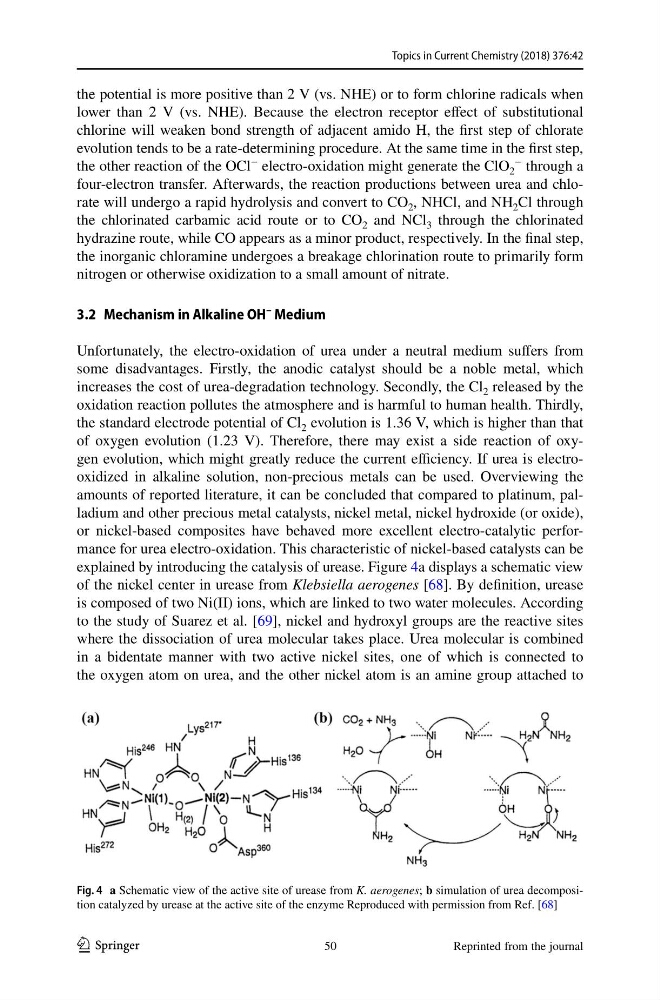
explained by introducing the catalysis of urease. Figure 4a displays a schematic view
of the nickel center in urease from Klebsiella aerogenes [68]. By definition, urease
is composed of two Ni(II) ions, which are linked to two water molecules. According
to the study of Suarez et al. [69], nickel and hydroxyl groups are the reactive sites
where the dissociation of urea molecular takes place. Urea molecular is combined
in a bidentate manner with two active nickel sites, one of which is connected to
the oxygen atom on urea, and the other nickel atom is an amine group attached to
Fig. 4 a Schematic view of the active site of urease from K. aerogenes; b simulation of urea decomposition catalyzed by urease at the active site of the enzyme Reproduced with permission from Ref. [68]
Reprinted from the journal
50
1 3
the potential is more positive than 2 V (vs. NHE) or to form chlorine radicals when
lower than 2 V (vs. NHE). Because the electron receptor effect of substitutional
chlorine will weaken bond strength of adjacent amido H, the first step of chlorate
evolution tends to be a rate-determining procedure. At the same time in the first step,
the other reaction of the OCl
−
electro-oxidation might generate the ClO 2
−
through a
four-electron transfer. Afterwards, the reaction productions between urea and chlorate will undergo a rapid hydrolysis and convert to CO 2 , NHCl, and NH 2 Cl through
the chlorinated carbamic acid route or to CO 2 and NCl 3 through the chlorinated
hydrazine route, while CO appears as a minor product, respectively. In the final step,
the inorganic chloramine undergoes a breakage chlorination route to primarily form
nitrogen or otherwise oxidization to a small amount of nitrate.
3.2 Mechanism in Alkaline OH
–
Medium
Unfortunately, the electro-oxidation of urea under a neutral medium suffers from
some disadvantages. Firstly, the anodic catalyst should be a noble metal, which
increases the cost of urea-degradation technology. Secondly, the Cl 2 released by the
oxidation reaction pollutes the atmosphere and is harmful to human health. Thirdly,
the standard electrode potential of Cl 2 evolution is 1.36 V, which is higher than that
of oxygen evolution (1.23 V). Therefore, there may exist a side reaction of oxygen evolution, which might greatly reduce the current efficiency. If urea is electrooxidized in alkaline solution, non-precious metals can be used. Overviewing the
amounts of reported literature, it can be concluded that compared to platinum, palladium and other precious metal catalysts, nickel metal, nickel hydroxide (or oxide),
or nickel-based composites have behaved more excellent electro-catalytic performance for urea electro-oxidation. This characteristic of nickel-based catalysts can be
explained by introducing the catalysis of urease. Figure 4a displays a schematic view
of the nickel center in urease from Klebsiella aerogenes [68]. By definition, urease
is composed of two Ni(II) ions, which are linked to two water molecules. According
to the study of Suarez et al. [69], nickel and hydroxyl groups are the reactive sites
where the dissociation of urea molecular takes place. Urea molecular is combined
in a bidentate manner with two active nickel sites, one of which is connected to
the oxygen atom on urea, and the other nickel atom is an amine group attached to
Fig. 4 a Schematic view of the active site of urease from K. aerogenes; b simulation of urea decomposition catalyzed by urease at the active site of the enzyme Reproduced with permission from Ref. [68]
Reprinted from the journal
50