

1 3
Topics in Current Chemistry (2018) 376:42
in the high demands of technologic devices, especially a series of biofilters with
non-selective bacterial strain, accordingly difficult to widely operate or achieve
industrialization [19, 57, 58].
Boggs et al. [56] investigated the urea electrolysis for the production of hydrogen.
They pointed out that not only urea or urine can be degraded when it is electrolyzed
under the alkaline condition but also hydrogen was obtained at the other compartment of electrolytic cell in the meantime. The urea molecules as raw materials are
dissociated by imputing electrical energy, and H 2 is produced through hydrolysis of
water molecules. In order to break the urea molecules, a standard voltage of 0.37 V
needs to be applied across the alkaline cell, where urea electro-oxidized in anodic
part at − 0.46 V (vs. SHE) and water reduced in cathodic part at the required −
0.83 V (vs. SHE). The voltage of urea electrolysis for hydrogen production (Eq. 1)
is obviously smaller than that required to directly split the water molecules (1.23 V,
Eq. 2). From the perspective of economic cost and energy consumption, Boggs et al.
gave a comparison of the energy consumption for hydrogen production between the
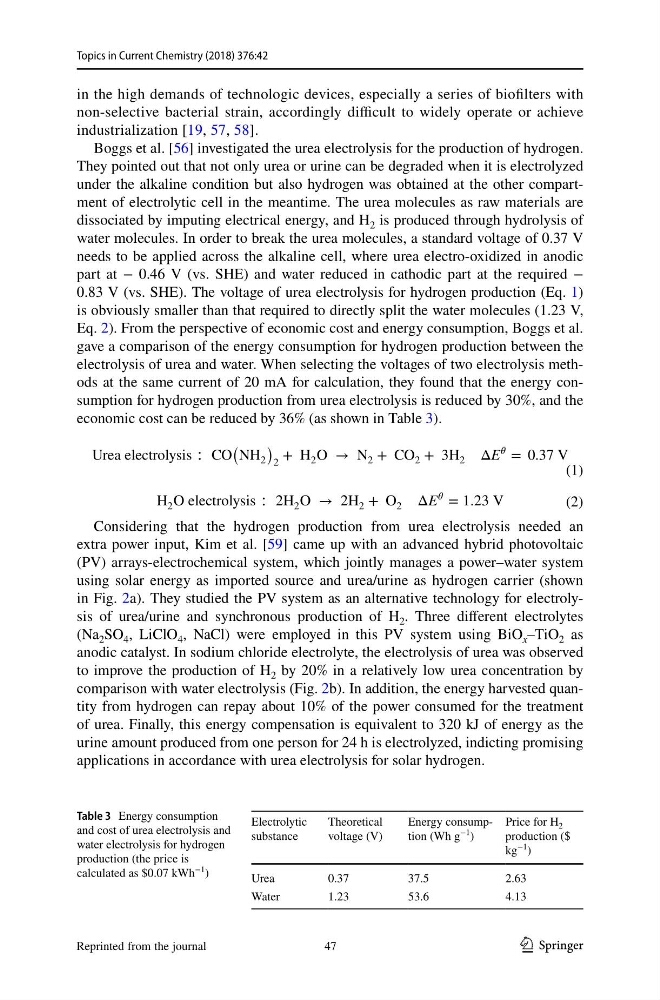
electrolysis of urea and water. When selecting the voltages of two electrolysis methods at the same current of 20 mA for calculation, they found that the energy consumption for hydrogen production from urea electrolysis is reduced by 30%, and the
economic cost can be reduced by 36% (as shown in Table 3).
Considering that the hydrogen production from urea electrolysis needed an
extra power input, Kim et al. [59] came up with an advanced hybrid photovoltaic
(PV) arrays-electrochemical system, which jointly manages a power–water system
using solar energy as imported source and urea/urine as hydrogen carrier (shown
in Fig. 2a). They studied the PV system as an alternative technology for electrolysis of urea/urine and synchronous production of H 2 . Three different electrolytes
(Na 2 SO 4 , LiClO 4 , NaCl) were employed in this PV system using BiO x –TiO 2 as
anodic catalyst. In sodium chloride electrolyte, the electrolysis of urea was observed
to improve the production of H 2 by 20% in a relatively low urea concentration by
comparison with water electrolysis (Fig. 2b). In addition, the energy harvested quantity from hydrogen can repay about 10% of the power consumed for the treatment
of urea. Finally, this energy compensation is equivalent to 320 kJ of energy as the
urine amount produced from one person for 24 h is electrolyzed, indicting promising
applications in accordance with urea electrolysis for solar hydrogen.
(1)
Urea electrolysis ∶ CO
NH 2
2
+ H 2 O → N 2 + CO 2 + 3H 2 ΔE
= 0.37 V
(2)
H 2 O electrolysis ∶ 2H 2 O → 2H 2 + O 2 ΔE
= 1.23 V
Table 3 Energy consumption
and cost of urea electrolysis and
water electrolysis for hydrogen
production (the price is
calculated as $0.07 kWh
−1 )
Electrolytic
substance
Theoretical
voltage (V)
Energy consumption (Wh g
−1
)
Price for H 2
production ($
kg
−1
)
Urea
0.37
37.5
2.63
Water
1.23
53.6
4.13
Reprinted from the journal
47
Topics in Current Chemistry (2018) 376:42
in the high demands of technologic devices, especially a series of biofilters with
non-selective bacterial strain, accordingly difficult to widely operate or achieve
industrialization [19, 57, 58].
Boggs et al. [56] investigated the urea electrolysis for the production of hydrogen.
They pointed out that not only urea or urine can be degraded when it is electrolyzed
under the alkaline condition but also hydrogen was obtained at the other compartment of electrolytic cell in the meantime. The urea molecules as raw materials are
dissociated by imputing electrical energy, and H 2 is produced through hydrolysis of
water molecules. In order to break the urea molecules, a standard voltage of 0.37 V
needs to be applied across the alkaline cell, where urea electro-oxidized in anodic
part at − 0.46 V (vs. SHE) and water reduced in cathodic part at the required −
0.83 V (vs. SHE). The voltage of urea electrolysis for hydrogen production (Eq. 1)
is obviously smaller than that required to directly split the water molecules (1.23 V,
Eq. 2). From the perspective of economic cost and energy consumption, Boggs et al.
gave a comparison of the energy consumption for hydrogen production between the
electrolysis of urea and water. When selecting the voltages of two electrolysis methods at the same current of 20 mA for calculation, they found that the energy consumption for hydrogen production from urea electrolysis is reduced by 30%, and the
economic cost can be reduced by 36% (as shown in Table 3).
Considering that the hydrogen production from urea electrolysis needed an
extra power input, Kim et al. [59] came up with an advanced hybrid photovoltaic
(PV) arrays-electrochemical system, which jointly manages a power–water system
using solar energy as imported source and urea/urine as hydrogen carrier (shown
in Fig. 2a). They studied the PV system as an alternative technology for electrolysis of urea/urine and synchronous production of H 2 . Three different electrolytes
(Na 2 SO 4 , LiClO 4 , NaCl) were employed in this PV system using BiO x –TiO 2 as
anodic catalyst. In sodium chloride electrolyte, the electrolysis of urea was observed
to improve the production of H 2 by 20% in a relatively low urea concentration by
comparison with water electrolysis (Fig. 2b). In addition, the energy harvested quantity from hydrogen can repay about 10% of the power consumed for the treatment
of urea. Finally, this energy compensation is equivalent to 320 kJ of energy as the
urine amount produced from one person for 24 h is electrolyzed, indicting promising
applications in accordance with urea electrolysis for solar hydrogen.
(1)
Urea electrolysis ∶ CO
NH 2
2
+ H 2 O → N 2 + CO 2 + 3H 2 ΔE
= 0.37 V
(2)
H 2 O electrolysis ∶ 2H 2 O → 2H 2 + O 2 ΔE
= 1.23 V
Table 3 Energy consumption
and cost of urea electrolysis and
water electrolysis for hydrogen
production (the price is
calculated as $0.07 kWh
−1 )
Electrolytic
substance
Theoretical
voltage (V)
Energy consumption (Wh g
−1
)
Price for H 2
production ($
kg
−1
)
Urea
0.37
37.5
2.63
Water
1.23
53.6
4.13
Reprinted from the journal
47