

Topics in Current Chemistry (2018) 376:42
1 3
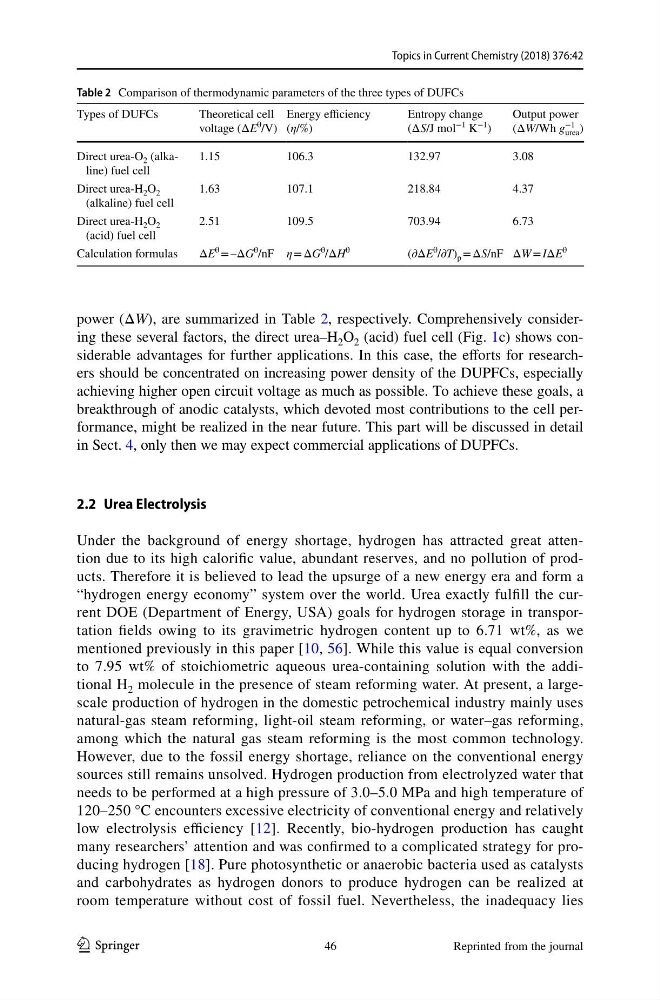
power (ΔW), are summarized in Table 2, respectively. Comprehensively considering these several factors, the direct urea–H 2 O 2 (acid) fuel cell (Fig. 1c) shows considerable advantages for further applications. In this case, the efforts for researchers should be concentrated on increasing power density of the DUPFCs, especially
achieving higher open circuit voltage as much as possible. To achieve these goals, a
breakthrough of anodic catalysts, which devoted most contributions to the cell performance, might be realized in the near future. This part will be discussed in detail
in Sect. 4, only then we may expect commercial applications of DUPFCs.
2.2 Urea Electrolysis
Under the background of energy shortage, hydrogen has attracted great attention due to its high calorific value, abundant reserves, and no pollution of products. Therefore it is believed to lead the upsurge of a new energy era and form a
“hydrogen energy economy” system over the world. Urea exactly fulfill the current DOE (Department of Energy, USA) goals for hydrogen storage in transportation fields owing to its gravimetric hydrogen content up to 6.71 wt%, as we
mentioned previously in this paper [10, 56]. While this value is equal conversion
to 7.95 wt% of stoichiometric aqueous urea-containing solution with the additional H 2 molecule in the presence of steam reforming water. At present, a largescale production of hydrogen in the domestic petrochemical industry mainly uses
natural-gas steam reforming, light-oil steam reforming, or water–gas reforming,
among which the natural gas steam reforming is the most common technology.
However, due to the fossil energy shortage, reliance on the conventional energy
sources still remains unsolved. Hydrogen production from electrolyzed water that
needs to be performed at a high pressure of 3.0–5.0 MPa and high temperature of
120–250 °C encounters excessive electricity of conventional energy and relatively
low electrolysis efficiency [12]. Recently, bio-hydrogen production has caught
many researchers’ attention and was confirmed to a complicated strategy for producing hydrogen [18]. Pure photosynthetic or anaerobic bacteria used as catalysts
and carbohydrates as hydrogen donors to produce hydrogen can be realized at
room temperature without cost of fossil fuel. Nevertheless, the inadequacy lies
Table 2 Comparison of thermodynamic parameters of the three types of DUFCs
Types of DUFCs
Theoretical cell
voltage (ΔE
θ
/V)
Energy efficiency
(η/%)
Entropy change
(ΔS/J mol
−1 K
−1
)
Output power
(ΔW/Wh g
−1
urea )
Direct urea-O 2 (alkaline) fuel cell
1.15
106.3
132.97
3.08
Direct urea-H 2 O 2
(alkaline) fuel cell
1.63
107.1
218.84
4.37
Direct urea-H 2 O 2
(acid) fuel cell
2.51
109.5
703.94
6.73
Calculation formulas
ΔE
θ = –ΔG
θ /nF η = ΔG
θ
/ΔH
θ
(∂ΔE
θ
/∂T) p = ΔS/nF ΔW = IΔE
θ
Reprinted from the journal
46
1 3
power (ΔW), are summarized in Table 2, respectively. Comprehensively considering these several factors, the direct urea–H 2 O 2 (acid) fuel cell (Fig. 1c) shows considerable advantages for further applications. In this case, the efforts for researchers should be concentrated on increasing power density of the DUPFCs, especially
achieving higher open circuit voltage as much as possible. To achieve these goals, a
breakthrough of anodic catalysts, which devoted most contributions to the cell performance, might be realized in the near future. This part will be discussed in detail
in Sect. 4, only then we may expect commercial applications of DUPFCs.
2.2 Urea Electrolysis
Under the background of energy shortage, hydrogen has attracted great attention due to its high calorific value, abundant reserves, and no pollution of products. Therefore it is believed to lead the upsurge of a new energy era and form a
“hydrogen energy economy” system over the world. Urea exactly fulfill the current DOE (Department of Energy, USA) goals for hydrogen storage in transportation fields owing to its gravimetric hydrogen content up to 6.71 wt%, as we
mentioned previously in this paper [10, 56]. While this value is equal conversion
to 7.95 wt% of stoichiometric aqueous urea-containing solution with the additional H 2 molecule in the presence of steam reforming water. At present, a largescale production of hydrogen in the domestic petrochemical industry mainly uses
natural-gas steam reforming, light-oil steam reforming, or water–gas reforming,
among which the natural gas steam reforming is the most common technology.
However, due to the fossil energy shortage, reliance on the conventional energy
sources still remains unsolved. Hydrogen production from electrolyzed water that
needs to be performed at a high pressure of 3.0–5.0 MPa and high temperature of
120–250 °C encounters excessive electricity of conventional energy and relatively
low electrolysis efficiency [12]. Recently, bio-hydrogen production has caught
many researchers’ attention and was confirmed to a complicated strategy for producing hydrogen [18]. Pure photosynthetic or anaerobic bacteria used as catalysts
and carbohydrates as hydrogen donors to produce hydrogen can be realized at
room temperature without cost of fossil fuel. Nevertheless, the inadequacy lies
Table 2 Comparison of thermodynamic parameters of the three types of DUFCs
Types of DUFCs
Theoretical cell
voltage (ΔE
θ
/V)
Energy efficiency
(η/%)
Entropy change
(ΔS/J mol
−1 K
−1
)
Output power
(ΔW/Wh g
−1
urea )
Direct urea-O 2 (alkaline) fuel cell
1.15
106.3
132.97
3.08
Direct urea-H 2 O 2
(alkaline) fuel cell
1.63
107.1
218.84
4.37
Direct urea-H 2 O 2
(acid) fuel cell
2.51
109.5
703.94
6.73
Calculation formulas
ΔE
θ = –ΔG
θ /nF η = ΔG
θ
/ΔH
θ
(∂ΔE
θ
/∂T) p = ΔS/nF ΔW = IΔE
θ
Reprinted from the journal
46