

1 3
Topics in Current Chemistry (2018) 376:41
Pd electrode at pH of 6.7. The authors also demonstrated the reversible interconversion between CO 2 and formate by CV scanning around the equilibrium potential, suggesting that catalysts for formic acid oxidation should also be active for CO 2
reduction. The same group also developed a Pd–Pt/C bimetallic nano-catalyst for
CO 2 RR [66]. This nanocatalyst had an onset potential of − 0.4 V vs. RHE, close
to the theoretical equilibrium potential of 0.02 V. The Pd 70 Pt 30 nanocatalyst also
showed a very high FE of 88% at − 0.4 V vs. RHE. Mixing Pd and Pt should alter
the d-band center and reduce the numbers of neighboring Pt sites where CO poisoning happens, leading to high FE with high current density.
Additionally, Pd–Pt NPs with a Pd rich surface were also studied by Cai et al.
[65]. Formate production was reached at relatively low overpotentials and the current density was dramatically increased. The author attributed the enhancement to
the ease of H generation from the sublayer Pt.
AgPd nanodendrite-modified Au nanoprisms were reported as CO 2 RR catalysts by increasing the H coverage to facilitate the interaction between H and
*CO/*COOH [77]. The author explained that Ag was the first electron donor and Pd
was the H source. The catalyst produced formate at low overpotential (-0.18 V) with
up to 49% FE.
Another interesting catalyst is AgSn/SnO x core/shell bimetallic catalyst
reported by Luc et al. [64]. By galvanically displacing a Sn nanosphere with Ag,
AgSn with an ultra-thin SnO x shell was formed (Fig. 7a). The bulk and surface
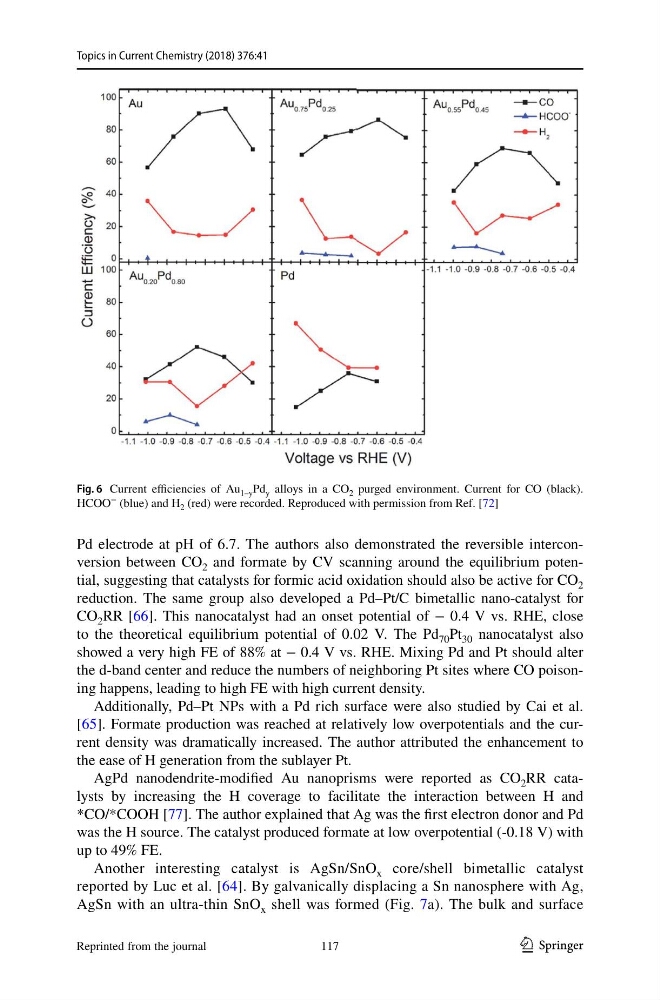
Fig. 6 Current efficiencies of Au 1–y Pd y alloys in a CO 2 purged environment. Current for CO (black).
HCOO
− (blue) and H 2 (red) were recorded. Reproduced with permission from Ref. [72]
Reprinted from the journal
117
Topics in Current Chemistry (2018) 376:41
Pd electrode at pH of 6.7. The authors also demonstrated the reversible interconversion between CO 2 and formate by CV scanning around the equilibrium potential, suggesting that catalysts for formic acid oxidation should also be active for CO 2
reduction. The same group also developed a Pd–Pt/C bimetallic nano-catalyst for
CO 2 RR [66]. This nanocatalyst had an onset potential of − 0.4 V vs. RHE, close
to the theoretical equilibrium potential of 0.02 V. The Pd 70 Pt 30 nanocatalyst also
showed a very high FE of 88% at − 0.4 V vs. RHE. Mixing Pd and Pt should alter
the d-band center and reduce the numbers of neighboring Pt sites where CO poisoning happens, leading to high FE with high current density.
Additionally, Pd–Pt NPs with a Pd rich surface were also studied by Cai et al.
[65]. Formate production was reached at relatively low overpotentials and the current density was dramatically increased. The author attributed the enhancement to
the ease of H generation from the sublayer Pt.
AgPd nanodendrite-modified Au nanoprisms were reported as CO 2 RR catalysts by increasing the H coverage to facilitate the interaction between H and
*CO/*COOH [77]. The author explained that Ag was the first electron donor and Pd
was the H source. The catalyst produced formate at low overpotential (-0.18 V) with
up to 49% FE.
Another interesting catalyst is AgSn/SnO x core/shell bimetallic catalyst
reported by Luc et al. [64]. By galvanically displacing a Sn nanosphere with Ag,
AgSn with an ultra-thin SnO x shell was formed (Fig. 7a). The bulk and surface
Fig. 6 Current efficiencies of Au 1–y Pd y alloys in a CO 2 purged environment. Current for CO (black).
HCOO
− (blue) and H 2 (red) were recorded. Reproduced with permission from Ref. [72]
Reprinted from the journal
117