

Topics in Current Chemistry (2018) 376:41
1 3
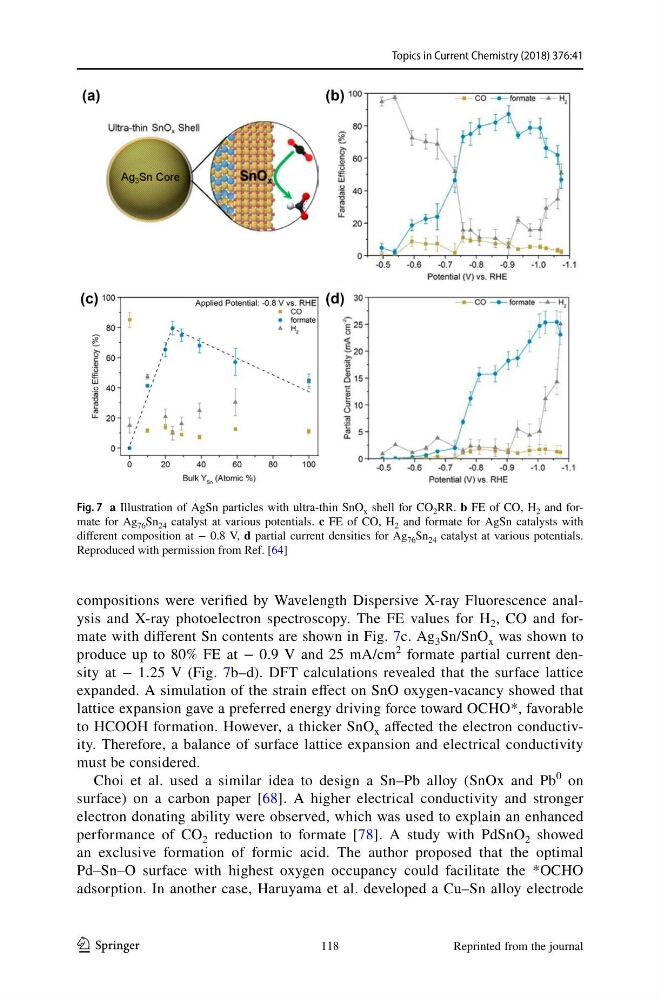
compositions were verified by Wavelength Dispersive X-ray Fluorescence analysis and X-ray photoelectron spectroscopy. The FE values for H 2 , CO and formate with different Sn contents are shown in Fig. 7c. Ag 3 Sn/SnO x was shown to
produce up to 80% FE at − 0.9 V and 25 mA/cm
2
formate partial current density at − 1.25 V (Fig. 7b–d). DFT calculations revealed that the surface lattice
expanded. A simulation of the strain effect on SnO oxygen-vacancy showed that
lattice expansion gave a preferred energy driving force toward OCHO*, favorable
to HCOOH formation. However, a thicker SnO x affected the electron conductivity. Therefore, a balance of surface lattice expansion and electrical conductivity
must be considered.
Choi et al. used a similar idea to design a Sn–Pb alloy (SnOx and Pb
0
on
surface) on a carbon paper [68]. A higher electrical conductivity and stronger
electron donating ability were observed, which was used to explain an enhanced
performance of CO 2 reduction to formate [78]. A study with PdSnO 2 showed
an exclusive formation of formic acid. The author proposed that the optimal
Pd–Sn–O surface with highest oxygen occupancy could facilitate the *OCHO
adsorption. In another case, Haruyama et al. developed a Cu–Sn alloy electrode
Fig. 7 a Illustration of AgSn particles with ultra-thin SnO x shell for CO 2 RR. b FE of CO, H 2 and formate for Ag 76 Sn 24 catalyst at various potentials. c FE of CO, H 2 and formate for AgSn catalysts with
different composition at − 0.8 V, d partial current densities for Ag 76 Sn 24 catalyst at various potentials.
Reproduced with permission from Ref. [64]
Reprinted from the journal
118
1 3
compositions were verified by Wavelength Dispersive X-ray Fluorescence analysis and X-ray photoelectron spectroscopy. The FE values for H 2 , CO and formate with different Sn contents are shown in Fig. 7c. Ag 3 Sn/SnO x was shown to
produce up to 80% FE at − 0.9 V and 25 mA/cm
2
formate partial current density at − 1.25 V (Fig. 7b–d). DFT calculations revealed that the surface lattice
expanded. A simulation of the strain effect on SnO oxygen-vacancy showed that
lattice expansion gave a preferred energy driving force toward OCHO*, favorable
to HCOOH formation. However, a thicker SnO x affected the electron conductivity. Therefore, a balance of surface lattice expansion and electrical conductivity
must be considered.
Choi et al. used a similar idea to design a Sn–Pb alloy (SnOx and Pb
0
on
surface) on a carbon paper [68]. A higher electrical conductivity and stronger
electron donating ability were observed, which was used to explain an enhanced
performance of CO 2 reduction to formate [78]. A study with PdSnO 2 showed
an exclusive formation of formic acid. The author proposed that the optimal
Pd–Sn–O surface with highest oxygen occupancy could facilitate the *OCHO
adsorption. In another case, Haruyama et al. developed a Cu–Sn alloy electrode
Fig. 7 a Illustration of AgSn particles with ultra-thin SnO x shell for CO 2 RR. b FE of CO, H 2 and formate for Ag 76 Sn 24 catalyst at various potentials. c FE of CO, H 2 and formate for AgSn catalysts with
different composition at − 0.8 V, d partial current densities for Ag 76 Sn 24 catalyst at various potentials.
Reproduced with permission from Ref. [64]
Reprinted from the journal
118