

reactivity with aryl chlorides, and (b) no inhibitory effect was observed from
the addition of excess t-Bu 3 P on the outcome of the cross-coupling products.
Both electron-poor and electron-rich substrates gave good yields with high
selectivities. The reaction proved to be selective toward aryl bromides, as aryl
and benzylic chlorides present within the substrate remained untouched. Sensitive
functional groups, including those bearing acidic protons, are unreactive, such
as phenols, epoxides, and silyl protected pyrroles. This method was applied to
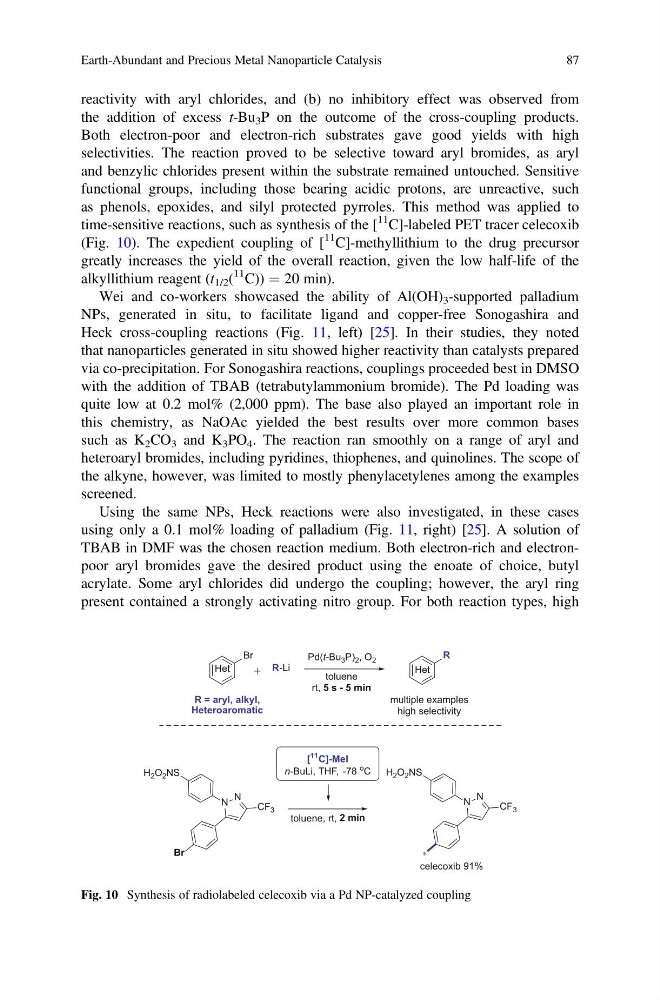
time-sensitive reactions, such as synthesis of the [
11 C]-labeled PET tracer celecoxib
(Fig. 10). The expedient coupling of [
11
C]-methyllithium to the drug precursor
greatly increases the yield of the overall reaction, given the low half-life of the
alkyllithium reagent (t 1/2 (
11 C)) ¼ 20 min).
Wei and co-workers showcased the ability of Al(OH) 3 -supported palladium
NPs, generated in situ, to facilitate ligand and copper-free Sonogashira and
Heck cross-coupling reactions (Fig. 11, left) [25]. In their studies, they noted
that nanoparticles generated in situ showed higher reactivity than catalysts prepared
via co-precipitation. For Sonogashira reactions, couplings proceeded best in DMSO
with the addition of TBAB (tetrabutylammonium bromide). The Pd loading was
quite low at 0.2 mol% (2,000 ppm). The base also played an important role in
this chemistry, as NaOAc yielded the best results over more common bases
such as K 2 CO 3 and K 3 PO 4 . The reaction ran smoothly on a range of aryl and
heteroaryl bromides, including pyridines, thiophenes, and quinolines. The scope of
the alkyne, however, was limited to mostly phenylacetylenes among the examples
screened.
Using the same NPs, Heck reactions were also investigated, in these cases
using only a 0.1 mol% loading of palladium (Fig. 11, right) [25]. A solution of
TBAB in DMF was the chosen reaction medium. Both electron-rich and electronpoor aryl bromides gave the desired product using the enoate of choice, butyl
acrylate. Some aryl chlorides did undergo the coupling; however, the aryl ring
present contained a strongly activating nitro group. For both reaction types, high
Br
Het
R-Li
Pd(t-Bu 3 P) 2 , O 2
toluene
rt, 5 s - 5 min
R
Het
R = aryl, alkyl,
Heteroaromatic
multiple examples
high selectivity
N
N
Br
H 2 O 2 NS
CF 3
[
11 C]-MeI
n-BuLi, THF, -78
o
C
toluene, rt, 2 min
N
N
H 2 O 2 NS
CF 3
∗
celecoxib 91%
Fig. 10 Synthesis of radiolabeled celecoxib via a Pd NP-catalyzed coupling
Earth-Abundant and Precious Metal Nanoparticle Catalysis
87
the addition of excess t-Bu 3 P on the outcome of the cross-coupling products.
Both electron-poor and electron-rich substrates gave good yields with high
selectivities. The reaction proved to be selective toward aryl bromides, as aryl
and benzylic chlorides present within the substrate remained untouched. Sensitive
functional groups, including those bearing acidic protons, are unreactive, such
as phenols, epoxides, and silyl protected pyrroles. This method was applied to
time-sensitive reactions, such as synthesis of the [
11 C]-labeled PET tracer celecoxib
(Fig. 10). The expedient coupling of [
11
C]-methyllithium to the drug precursor
greatly increases the yield of the overall reaction, given the low half-life of the
alkyllithium reagent (t 1/2 (
11 C)) ¼ 20 min).
Wei and co-workers showcased the ability of Al(OH) 3 -supported palladium
NPs, generated in situ, to facilitate ligand and copper-free Sonogashira and
Heck cross-coupling reactions (Fig. 11, left) [25]. In their studies, they noted
that nanoparticles generated in situ showed higher reactivity than catalysts prepared
via co-precipitation. For Sonogashira reactions, couplings proceeded best in DMSO
with the addition of TBAB (tetrabutylammonium bromide). The Pd loading was
quite low at 0.2 mol% (2,000 ppm). The base also played an important role in
this chemistry, as NaOAc yielded the best results over more common bases
such as K 2 CO 3 and K 3 PO 4 . The reaction ran smoothly on a range of aryl and
heteroaryl bromides, including pyridines, thiophenes, and quinolines. The scope of
the alkyne, however, was limited to mostly phenylacetylenes among the examples
screened.
Using the same NPs, Heck reactions were also investigated, in these cases
using only a 0.1 mol% loading of palladium (Fig. 11, right) [25]. A solution of
TBAB in DMF was the chosen reaction medium. Both electron-rich and electronpoor aryl bromides gave the desired product using the enoate of choice, butyl
acrylate. Some aryl chlorides did undergo the coupling; however, the aryl ring
present contained a strongly activating nitro group. For both reaction types, high
Br
Het
R-Li
Pd(t-Bu 3 P) 2 , O 2
toluene
rt, 5 s - 5 min
R
Het
R = aryl, alkyl,
Heteroaromatic
multiple examples
high selectivity
N
N
Br
H 2 O 2 NS
CF 3
[
11 C]-MeI
n-BuLi, THF, -78
o
C
toluene, rt, 2 min
N
N
H 2 O 2 NS
CF 3
∗
celecoxib 91%
Fig. 10 Synthesis of radiolabeled celecoxib via a Pd NP-catalyzed coupling
Earth-Abundant and Precious Metal Nanoparticle Catalysis
87