

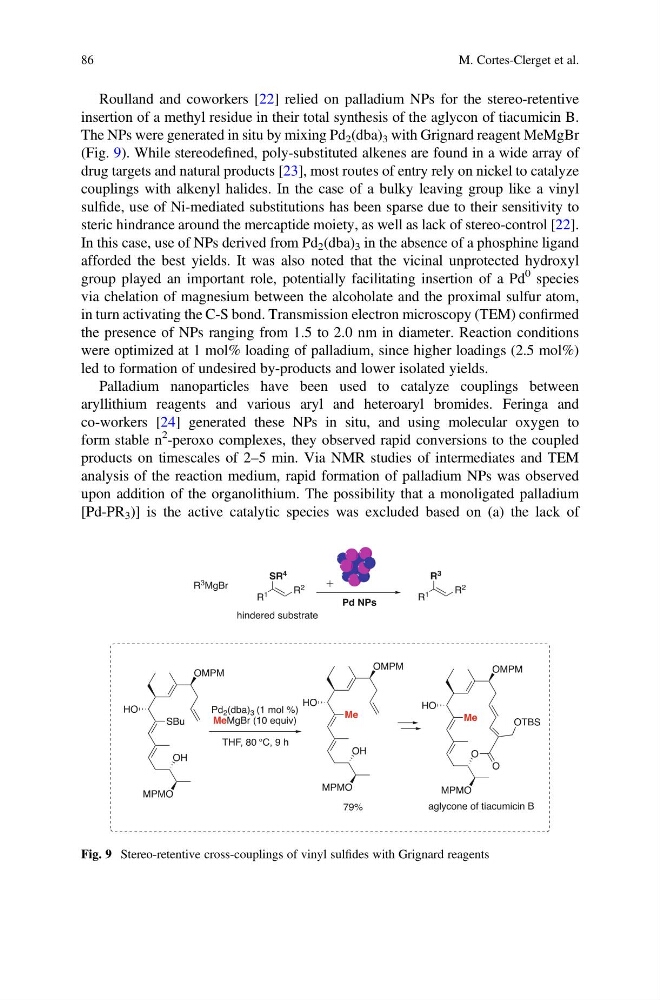
Roulland and coworkers [22] relied on palladium NPs for the stereo-retentive
insertion of a methyl residue in their total synthesis of the aglycon of tiacumicin B.
The NPs were generated in situ by mixing Pd 2 (dba) 3 with Grignard reagent MeMgBr
(Fig. 9). While stereodefined, poly-substituted alkenes are found in a wide array of
drug targets and natural products [23], most routes of entry rely on nickel to catalyze
couplings with alkenyl halides. In the case of a bulky leaving group like a vinyl
sulfide, use of Ni-mediated substitutions has been sparse due to their sensitivity to
steric hindrance around the mercaptide moiety, as well as lack of stereo-control [22].
In this case, use of NPs derived from Pd 2 (dba) 3 in the absence of a phosphine ligand
afforded the best yields. It was also noted that the vicinal unprotected hydroxyl
group played an important role, potentially facilitating insertion of a Pd
0 species
via chelation of magnesium between the alcoholate and the proximal sulfur atom,
in turn activating the C-S bond. Transmission electron microscopy (TEM) confirmed
the presence of NPs ranging from 1.5 to 2.0 nm in diameter. Reaction conditions
were optimized at 1 mol% loading of palladium, since higher loadings (2.5 mol%)
led to formation of undesired by-products and lower isolated yields.
Palladium nanoparticles have been used to catalyze couplings between
aryllithium reagents and various aryl and heteroaryl bromides. Feringa and
co-workers [24] generated these NPs in situ, and using molecular oxygen to
form stable n
2 -peroxo complexes, they observed rapid conversions to the coupled
products on timescales of 2–5 min. Via NMR studies of intermediates and TEM
analysis of the reaction medium, rapid formation of palladium NPs was observed
upon addition of the organolithium. The possibility that a monoligated palladium
[Pd-PR 3 )] is the active catalytic species was excluded based on (a) the lack of
Fig. 9 Stereo-retentive cross-couplings of vinyl sulfides with Grignard reagents
86
M. Cortes-Clerget et al.
insertion of a methyl residue in their total synthesis of the aglycon of tiacumicin B.
The NPs were generated in situ by mixing Pd 2 (dba) 3 with Grignard reagent MeMgBr
(Fig. 9). While stereodefined, poly-substituted alkenes are found in a wide array of
drug targets and natural products [23], most routes of entry rely on nickel to catalyze
couplings with alkenyl halides. In the case of a bulky leaving group like a vinyl
sulfide, use of Ni-mediated substitutions has been sparse due to their sensitivity to
steric hindrance around the mercaptide moiety, as well as lack of stereo-control [22].
In this case, use of NPs derived from Pd 2 (dba) 3 in the absence of a phosphine ligand
afforded the best yields. It was also noted that the vicinal unprotected hydroxyl
group played an important role, potentially facilitating insertion of a Pd
0 species
via chelation of magnesium between the alcoholate and the proximal sulfur atom,
in turn activating the C-S bond. Transmission electron microscopy (TEM) confirmed
the presence of NPs ranging from 1.5 to 2.0 nm in diameter. Reaction conditions
were optimized at 1 mol% loading of palladium, since higher loadings (2.5 mol%)
led to formation of undesired by-products and lower isolated yields.
Palladium nanoparticles have been used to catalyze couplings between
aryllithium reagents and various aryl and heteroaryl bromides. Feringa and
co-workers [24] generated these NPs in situ, and using molecular oxygen to
form stable n
2 -peroxo complexes, they observed rapid conversions to the coupled
products on timescales of 2–5 min. Via NMR studies of intermediates and TEM
analysis of the reaction medium, rapid formation of palladium NPs was observed
upon addition of the organolithium. The possibility that a monoligated palladium
[Pd-PR 3 )] is the active catalytic species was excluded based on (a) the lack of
Fig. 9 Stereo-retentive cross-couplings of vinyl sulfides with Grignard reagents
86
M. Cortes-Clerget et al.