

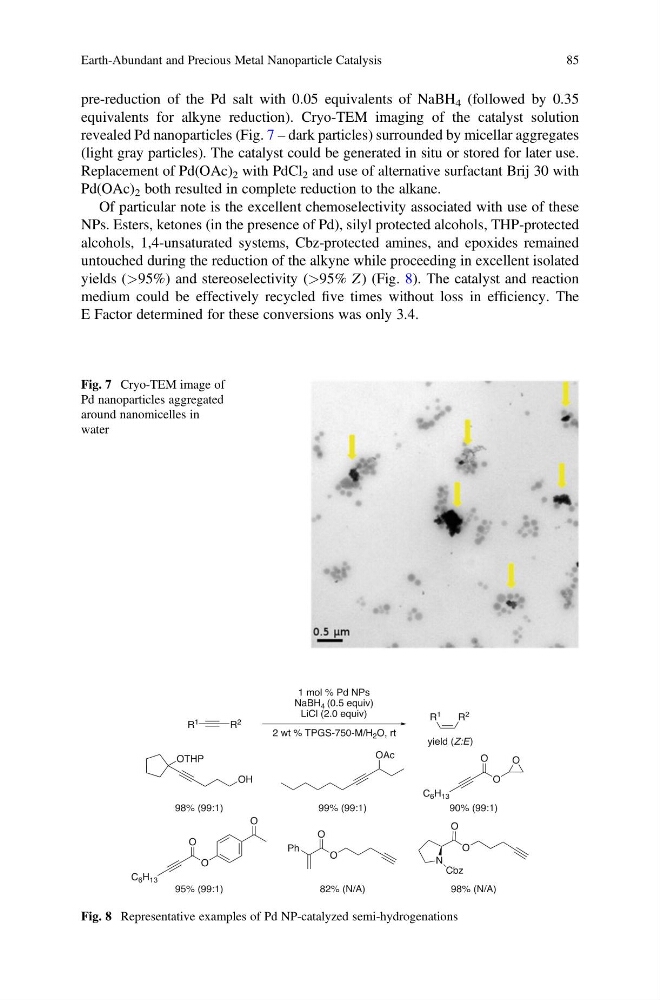
pre-reduction of the Pd salt with 0.05 equivalents of NaBH 4 (followed by 0.35
equivalents for alkyne reduction). Cryo-TEM imaging of the catalyst solution
revealed Pd nanoparticles (Fig. 7 – dark particles) surrounded by micellar aggregates
(light gray particles). The catalyst could be generated in situ or stored for later use.
Replacement of Pd(OAc) 2 with PdCl 2 and use of alternative surfactant Brij 30 with
Pd(OAc) 2 both resulted in complete reduction to the alkane.
Of particular note is the excellent chemoselectivity associated with use of these
NPs. Esters, ketones (in the presence of Pd), silyl protected alcohols, THP-protected
alcohols, 1,4-unsaturated systems, Cbz-protected amines, and epoxides remained
untouched during the reduction of the alkyne while proceeding in excellent isolated
yields (>95%) and stereoselectivity (>95% Z ) (Fig. 8). The catalyst and reaction
medium could be effectively recycled five times without loss in efficiency. The
E Factor determined for these conversions was only 3.4.
Fig. 7 Cryo-TEM image of
Pd nanoparticles aggregated
around nanomicelles in
water
Fig. 8 Representative examples of Pd NP-catalyzed semi-hydrogenations
Earth-Abundant and Precious Metal Nanoparticle Catalysis
85
equivalents for alkyne reduction). Cryo-TEM imaging of the catalyst solution
revealed Pd nanoparticles (Fig. 7 – dark particles) surrounded by micellar aggregates
(light gray particles). The catalyst could be generated in situ or stored for later use.
Replacement of Pd(OAc) 2 with PdCl 2 and use of alternative surfactant Brij 30 with
Pd(OAc) 2 both resulted in complete reduction to the alkane.
Of particular note is the excellent chemoselectivity associated with use of these
NPs. Esters, ketones (in the presence of Pd), silyl protected alcohols, THP-protected
alcohols, 1,4-unsaturated systems, Cbz-protected amines, and epoxides remained
untouched during the reduction of the alkyne while proceeding in excellent isolated
yields (>95%) and stereoselectivity (>95% Z ) (Fig. 8). The catalyst and reaction
medium could be effectively recycled five times without loss in efficiency. The
E Factor determined for these conversions was only 3.4.
Fig. 7 Cryo-TEM image of
Pd nanoparticles aggregated
around nanomicelles in
water
Fig. 8 Representative examples of Pd NP-catalyzed semi-hydrogenations
Earth-Abundant and Precious Metal Nanoparticle Catalysis
85