

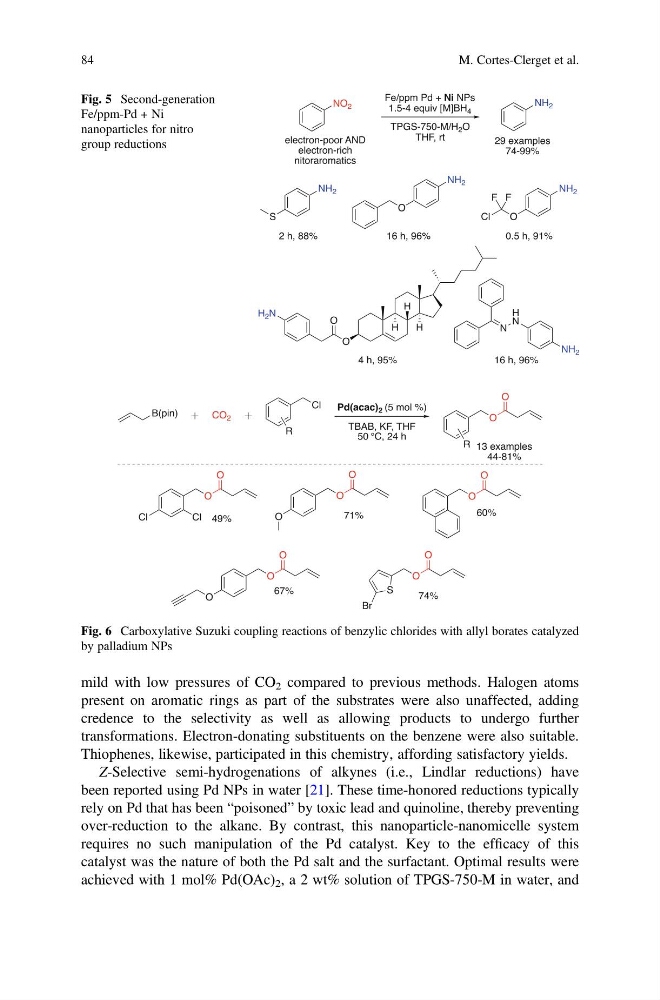
mild with low pressures of CO 2 compared to previous methods. Halogen atoms
present on aromatic rings as part of the substrates were also unaffected, adding
credence to the selectivity as well as allowing products to undergo further
transformations. Electron-donating substituents on the benzene were also suitable.
Thiophenes, likewise, participated in this chemistry, affording satisfactory yields.
Z-Selective semi-hydrogenations of alkynes (i.e., Lindlar reductions) have
been reported using Pd NPs in water [21]. These time-honored reductions typically
rely on Pd that has been “poisoned” by toxic lead and quinoline, thereby preventing
over-reduction to the alkane. By contrast, this nanoparticle-nanomicelle system
requires no such manipulation of the Pd catalyst. Key to the efficacy of this
catalyst was the nature of both the Pd salt and the surfactant. Optimal results were
achieved with 1 mol% Pd(OAc) 2 , a 2 wt% solution of TPGS-750-M in water, and
Fig. 5 Second-generation
Fe/ppm-Pd + Ni
nanoparticles for nitro
group reductions
Fig. 6 Carboxylative Suzuki coupling reactions of benzylic chlorides with allyl borates catalyzed
by palladium NPs
84
M. Cortes-Clerget et al.
present on aromatic rings as part of the substrates were also unaffected, adding
credence to the selectivity as well as allowing products to undergo further
transformations. Electron-donating substituents on the benzene were also suitable.
Thiophenes, likewise, participated in this chemistry, affording satisfactory yields.
Z-Selective semi-hydrogenations of alkynes (i.e., Lindlar reductions) have
been reported using Pd NPs in water [21]. These time-honored reductions typically
rely on Pd that has been “poisoned” by toxic lead and quinoline, thereby preventing
over-reduction to the alkane. By contrast, this nanoparticle-nanomicelle system
requires no such manipulation of the Pd catalyst. Key to the efficacy of this
catalyst was the nature of both the Pd salt and the surfactant. Optimal results were
achieved with 1 mol% Pd(OAc) 2 , a 2 wt% solution of TPGS-750-M in water, and
Fig. 5 Second-generation
Fe/ppm-Pd + Ni
nanoparticles for nitro
group reductions
Fig. 6 Carboxylative Suzuki coupling reactions of benzylic chlorides with allyl borates catalyzed
by palladium NPs
84
M. Cortes-Clerget et al.