

3.3 Base Metal NP-Catalyzed Alcohol Oxidation
From an economic efficiency standpoint, some non-noble transitional metals catalysts, such as Co [72–75], Mn [76, 77], Fe [78–80], V [81], and Cu [82, 83], have
been explored in the aerobic oxidation of alcohols. Yingwei et al. reported that Co
NPs stabilized by N-doped carbon composite (Co/C–N) acted as highly efficient
heterogeneous catalysts for the synthesis of carbonyl compounds from the aerobic
oxidation of alcohols [84]. Co/C–N could be synthesized by the one-pot thermal
decomposition of Co-containing metal–organic frameworks (MOFs). Co NPs with a
particle size of 9.8 Æ 2.6 nm were highly dispersed on N-doped carbon. Importantly,
N-doping into Co/C–N played a dual role, not only in enhancing the basic properties,
which is crucial for promoting the activity of the liquid-phase aerobic oxidation of
alcohols, but also in reducing the Co particle size. The Co/C–N catalyst showed a
broad substrate scope for both aryl and alkyl alcohols in water under an atmospheric
pressure of air and base-free conditions. Furthermore, the Co/C–N catalyst could be
separated from the reaction system using an external magnetic field and reused. The
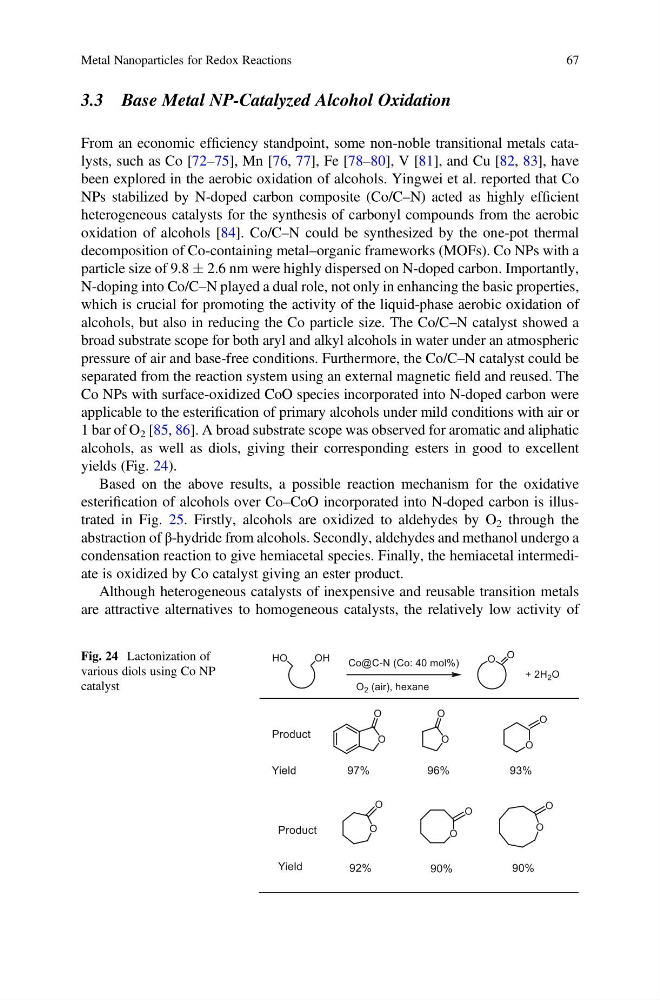
Co NPs with surface-oxidized CoO species incorporated into N-doped carbon were
applicable to the esterification of primary alcohols under mild conditions with air or
1 bar of O 2 [85, 86]. A broad substrate scope was observed for aromatic and aliphatic
alcohols, as well as diols, giving their corresponding esters in good to excellent
yields (Fig. 24).
Based on the above results, a possible reaction mechanism for the oxidative
esterification of alcohols over Co–CoO incorporated into N-doped carbon is illustrated in Fig. 25. Firstly, alcohols are oxidized to aldehydes by O 2 through the
abstraction of β-hydride from alcohols. Secondly, aldehydes and methanol undergo a
condensation reaction to give hemiacetal species. Finally, the hemiacetal intermediate is oxidized by Co catalyst giving an ester product.
Although heterogeneous catalysts of inexpensive and reusable transition metals
are attractive alternatives to homogeneous catalysts, the relatively low activity of
Fig. 24 Lactonization of
various diols using Co NP
catalyst
Metal Nanoparticles for Redox Reactions
67
From an economic efficiency standpoint, some non-noble transitional metals catalysts, such as Co [72–75], Mn [76, 77], Fe [78–80], V [81], and Cu [82, 83], have
been explored in the aerobic oxidation of alcohols. Yingwei et al. reported that Co
NPs stabilized by N-doped carbon composite (Co/C–N) acted as highly efficient
heterogeneous catalysts for the synthesis of carbonyl compounds from the aerobic
oxidation of alcohols [84]. Co/C–N could be synthesized by the one-pot thermal
decomposition of Co-containing metal–organic frameworks (MOFs). Co NPs with a
particle size of 9.8 Æ 2.6 nm were highly dispersed on N-doped carbon. Importantly,
N-doping into Co/C–N played a dual role, not only in enhancing the basic properties,
which is crucial for promoting the activity of the liquid-phase aerobic oxidation of
alcohols, but also in reducing the Co particle size. The Co/C–N catalyst showed a
broad substrate scope for both aryl and alkyl alcohols in water under an atmospheric
pressure of air and base-free conditions. Furthermore, the Co/C–N catalyst could be
separated from the reaction system using an external magnetic field and reused. The
Co NPs with surface-oxidized CoO species incorporated into N-doped carbon were
applicable to the esterification of primary alcohols under mild conditions with air or
1 bar of O 2 [85, 86]. A broad substrate scope was observed for aromatic and aliphatic
alcohols, as well as diols, giving their corresponding esters in good to excellent
yields (Fig. 24).
Based on the above results, a possible reaction mechanism for the oxidative
esterification of alcohols over Co–CoO incorporated into N-doped carbon is illustrated in Fig. 25. Firstly, alcohols are oxidized to aldehydes by O 2 through the
abstraction of β-hydride from alcohols. Secondly, aldehydes and methanol undergo a
condensation reaction to give hemiacetal species. Finally, the hemiacetal intermediate is oxidized by Co catalyst giving an ester product.
Although heterogeneous catalysts of inexpensive and reusable transition metals
are attractive alternatives to homogeneous catalysts, the relatively low activity of
Fig. 24 Lactonization of
various diols using Co NP
catalyst
Metal Nanoparticles for Redox Reactions
67