

scope with high TOFs in the aerobic oxidation, in which the choice of metal oxide
support significantly influenced the product distribution in the oxidation of benzyl
alcohol [68]. The side reaction, involving disproportionation of two molecules of
benzyl alcohol to produce benzaldehyde and toluene, occurred when using TiO 2 -,
Nb 2 O 5 -, and activated carbon-supported Au–Pd NPs. In contrast, MgO- and
ZnO-supported Au–Pd NPs were superior to the above catalysts for the selective
oxidation of benzyl alcohol, giving benzaldehyde in more than 99% selectivity.
Similarly, Kobayashi et al. reported that polymer-incarcerated Au–Pt alloyed bimetallic NPs (PI Pt/Au) exhibited higher catalytic activity than single metal Au or Pt
NPs in the aerobic oxidation of alcohols [69]. PI Pt/Au worked well without
additional base in water at room temperature, although PI Au, as a single metal
species, required a large amount of K 2 CO 3 to promote oxidation, in which water
acted as a hydrogen transporter in the hydrophobic polystyrene surroundings,
therefore aiding α-hydrogen abstraction.
The same group also developed carbon black-stabilized polymer-incarcerated
bimetallic catalysts (PI-CB catalysts) [70]. Notably, PI-CB containing Au and Pt
NP catalysts (PI-CB/Au–Pt) showed high catalytic activity and selectivity in the
oxidation of primary aliphatic alcohols to the corresponding aldehydes under mild
reaction conditions. This high catalytic activity could not be obtained using monometallic PI-CB catalysts, such as PI-CB/Au and PI-CB/Pt. The reactivity and
selectivity were strongly dependent on the combination of metals and solvent
system, with the overoxidation of 1-octanol to octanoic acid suppressed under
neutral conditions. Furthermore, PI-CB/Au–Pd showed completely different activity
and selectivity compared with PI-CB/Au–Pt, with direct oxidative methyl ester
formation catalyzed by PI-CB/Au–Pd proceeding in methanol/H 2 O in the presence
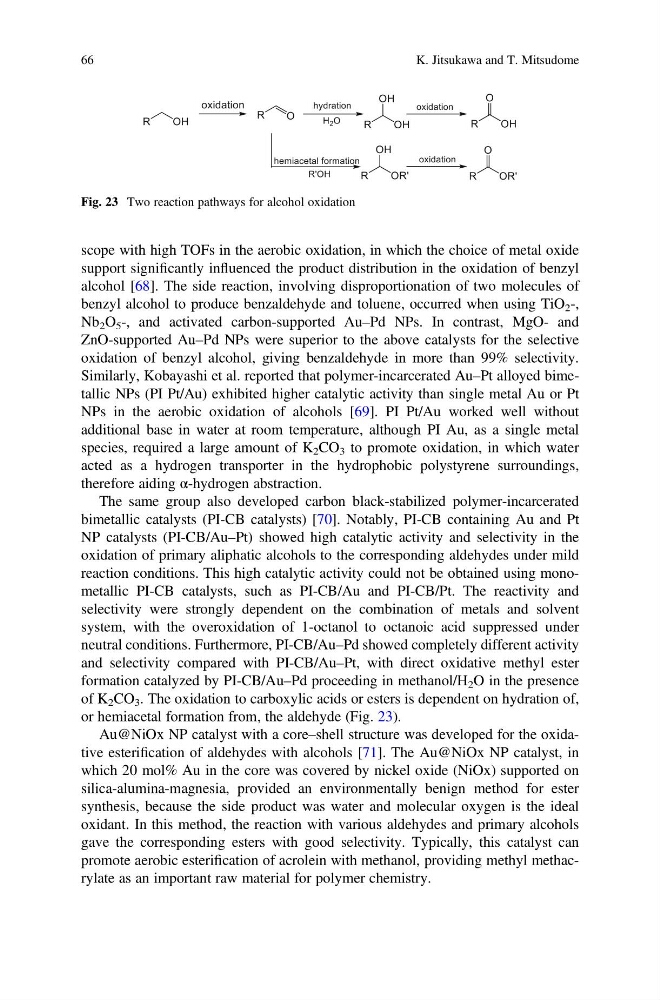
of K 2 CO 3 . The oxidation to carboxylic acids or esters is dependent on hydration of,
or hemiacetal formation from, the aldehyde (Fig. 23).
Au@NiOx NP catalyst with a core–shell structure was developed for the oxidative esterification of aldehydes with alcohols [71]. The Au@NiOx NP catalyst, in
which 20 mol% Au in the core was covered by nickel oxide (NiOx) supported on
silica-alumina-magnesia, provided an environmentally benign method for ester
synthesis, because the side product was water and molecular oxygen is the ideal
oxidant. In this method, the reaction with various aldehydes and primary alcohols
gave the corresponding esters with good selectivity. Typically, this catalyst can
promote aerobic esterification of acrolein with methanol, providing methyl methacrylate as an important raw material for polymer chemistry.
Fig. 23 Two reaction pathways for alcohol oxidation
66
K. Jitsukawa and T. Mitsudome
support significantly influenced the product distribution in the oxidation of benzyl
alcohol [68]. The side reaction, involving disproportionation of two molecules of
benzyl alcohol to produce benzaldehyde and toluene, occurred when using TiO 2 -,
Nb 2 O 5 -, and activated carbon-supported Au–Pd NPs. In contrast, MgO- and
ZnO-supported Au–Pd NPs were superior to the above catalysts for the selective
oxidation of benzyl alcohol, giving benzaldehyde in more than 99% selectivity.
Similarly, Kobayashi et al. reported that polymer-incarcerated Au–Pt alloyed bimetallic NPs (PI Pt/Au) exhibited higher catalytic activity than single metal Au or Pt
NPs in the aerobic oxidation of alcohols [69]. PI Pt/Au worked well without
additional base in water at room temperature, although PI Au, as a single metal
species, required a large amount of K 2 CO 3 to promote oxidation, in which water
acted as a hydrogen transporter in the hydrophobic polystyrene surroundings,
therefore aiding α-hydrogen abstraction.
The same group also developed carbon black-stabilized polymer-incarcerated
bimetallic catalysts (PI-CB catalysts) [70]. Notably, PI-CB containing Au and Pt
NP catalysts (PI-CB/Au–Pt) showed high catalytic activity and selectivity in the
oxidation of primary aliphatic alcohols to the corresponding aldehydes under mild
reaction conditions. This high catalytic activity could not be obtained using monometallic PI-CB catalysts, such as PI-CB/Au and PI-CB/Pt. The reactivity and
selectivity were strongly dependent on the combination of metals and solvent
system, with the overoxidation of 1-octanol to octanoic acid suppressed under
neutral conditions. Furthermore, PI-CB/Au–Pd showed completely different activity
and selectivity compared with PI-CB/Au–Pt, with direct oxidative methyl ester
formation catalyzed by PI-CB/Au–Pd proceeding in methanol/H 2 O in the presence
of K 2 CO 3 . The oxidation to carboxylic acids or esters is dependent on hydration of,
or hemiacetal formation from, the aldehyde (Fig. 23).
Au@NiOx NP catalyst with a core–shell structure was developed for the oxidative esterification of aldehydes with alcohols [71]. The Au@NiOx NP catalyst, in
which 20 mol% Au in the core was covered by nickel oxide (NiOx) supported on
silica-alumina-magnesia, provided an environmentally benign method for ester
synthesis, because the side product was water and molecular oxygen is the ideal
oxidant. In this method, the reaction with various aldehydes and primary alcohols
gave the corresponding esters with good selectivity. Typically, this catalyst can
promote aerobic esterification of acrolein with methanol, providing methyl methacrylate as an important raw material for polymer chemistry.
Fig. 23 Two reaction pathways for alcohol oxidation
66
K. Jitsukawa and T. Mitsudome