

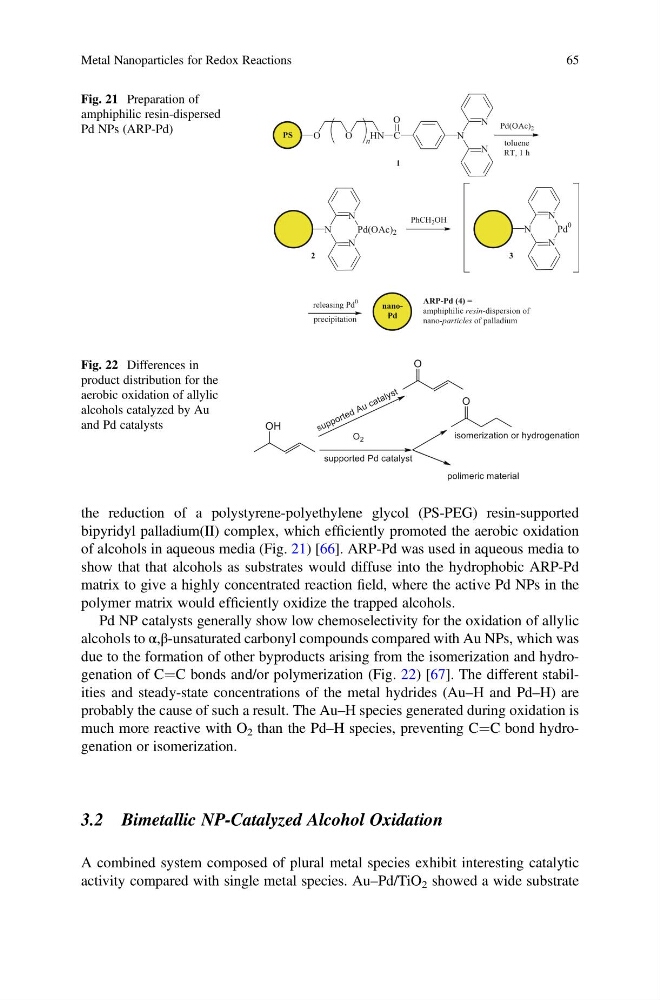
the reduction of a polystyrene-polyethylene glycol (PS-PEG) resin-supported
bipyridyl palladium(II) complex, which efficiently promoted the aerobic oxidation
of alcohols in aqueous media (Fig. 21) [66]. ARP-Pd was used in aqueous media to
show that that alcohols as substrates would diffuse into the hydrophobic ARP-Pd
matrix to give a highly concentrated reaction field, where the active Pd NPs in the
polymer matrix would efficiently oxidize the trapped alcohols.
Pd NP catalysts generally show low chemoselectivity for the oxidation of allylic
alcohols to α,β-unsaturated carbonyl compounds compared with Au NPs, which was
due to the formation of other byproducts arising from the isomerization and hydrogenation of C¼C bonds and/or polymerization (Fig. 22) [67]. The different stabilities and steady-state concentrations of the metal hydrides (Au–H and Pd–H) are
probably the cause of such a result. The Au–H species generated during oxidation is
much more reactive with O 2 than the Pd–H species, preventing C¼C bond hydrogenation or isomerization.
3.2 Bimetallic NP-Catalyzed Alcohol Oxidation
A combined system composed of plural metal species exhibit interesting catalytic
activity compared with single metal species. Au–Pd/TiO 2 showed a wide substrate
Fig. 22 Differences in
product distribution for the
aerobic oxidation of allylic
alcohols catalyzed by Au
and Pd catalysts
PhCH 2 OH
N
N
N
Pd
0
3
N
N
N
Pd(OAc) 2
toluene
RT, 1 h
Pd(OAc) 2
PS
O
O
H N C
N
N
N
O
n
1
2
releasing Pd
0
precipitation
nanoPd
ARP-Pd (4) =
amphiphilic resin-dispersion of
nano-particles of palladium
Fig. 21 Preparation of
amphiphilic resin-dispersed
Pd NPs (ARP-Pd)
Metal Nanoparticles for Redox Reactions
65
bipyridyl palladium(II) complex, which efficiently promoted the aerobic oxidation
of alcohols in aqueous media (Fig. 21) [66]. ARP-Pd was used in aqueous media to
show that that alcohols as substrates would diffuse into the hydrophobic ARP-Pd
matrix to give a highly concentrated reaction field, where the active Pd NPs in the
polymer matrix would efficiently oxidize the trapped alcohols.
Pd NP catalysts generally show low chemoselectivity for the oxidation of allylic
alcohols to α,β-unsaturated carbonyl compounds compared with Au NPs, which was
due to the formation of other byproducts arising from the isomerization and hydrogenation of C¼C bonds and/or polymerization (Fig. 22) [67]. The different stabilities and steady-state concentrations of the metal hydrides (Au–H and Pd–H) are
probably the cause of such a result. The Au–H species generated during oxidation is
much more reactive with O 2 than the Pd–H species, preventing C¼C bond hydrogenation or isomerization.
3.2 Bimetallic NP-Catalyzed Alcohol Oxidation
A combined system composed of plural metal species exhibit interesting catalytic
activity compared with single metal species. Au–Pd/TiO 2 showed a wide substrate
Fig. 22 Differences in
product distribution for the
aerobic oxidation of allylic
alcohols catalyzed by Au
and Pd catalysts
PhCH 2 OH
N
N
N
Pd
0
3
N
N
N
Pd(OAc) 2
toluene
RT, 1 h
Pd(OAc) 2
PS
O
O
H N C
N
N
N
O
n
1
2
releasing Pd
0
precipitation
nanoPd
ARP-Pd (4) =
amphiphilic resin-dispersion of
nano-particles of palladium
Fig. 21 Preparation of
amphiphilic resin-dispersed
Pd NPs (ARP-Pd)
Metal Nanoparticles for Redox Reactions
65