

affords a Pd-alcoholate species, which undergoes β-hydride elimination to produce
the corresponding carbonyl compounds and Pd-hydride species. The hydride species
mediated on the Pd NPs was oxidized by O 2 along with the formation of O 2 and H 2 O
through H 2 O 2 as an intermediate. The kinetic isotope effect for the intramolecular
competitive oxidation of α-deuterio-p-methylbenzyl alcohol gave a k H /k D value of
2.0, indicating that the elimination of β-hydride from the Pd-alcoholate species
might be the rate-determining step.
Interestingly, the PdHAP catalyst also promoted dehydrogenation of various
indolines to indole, which serves as an important and versatile intermediate for the
synthesis of pharmaceuticals and agrochemicals [59]. The applicability of PdHAP
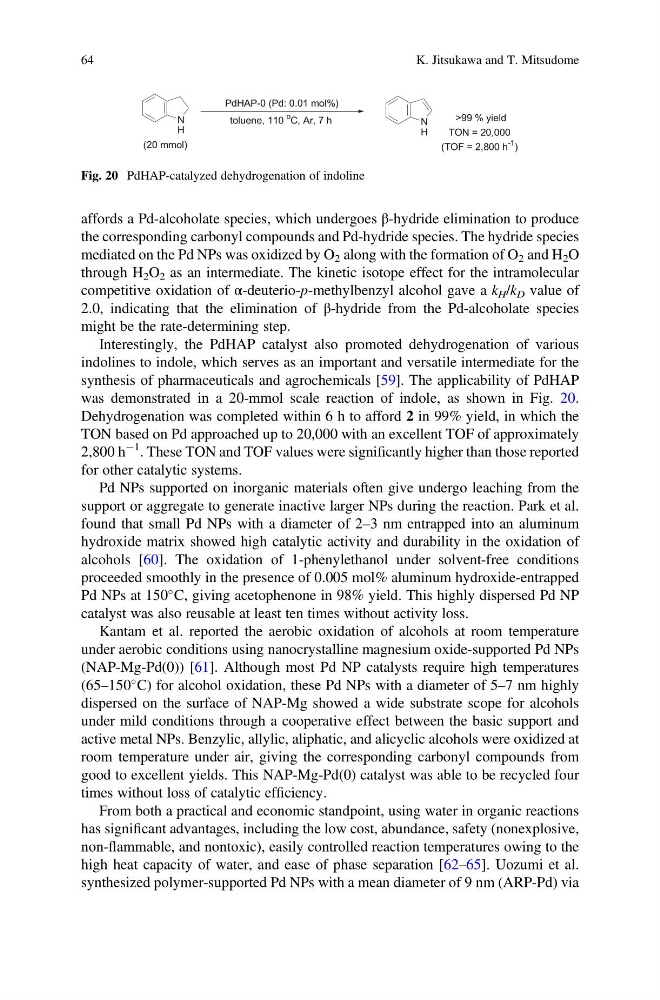
was demonstrated in a 20-mmol scale reaction of indole, as shown in Fig. 20.
Dehydrogenation was completed within 6 h to afford 2 in 99% yield, in which the
TON based on Pd approached up to 20,000 with an excellent TOF of approximately
2,800 h
À1 . These TON and TOF values were significantly higher than those reported
for other catalytic systems.
Pd NPs supported on inorganic materials often give undergo leaching from the
support or aggregate to generate inactive larger NPs during the reaction. Park et al.
found that small Pd NPs with a diameter of 2–3 nm entrapped into an aluminum
hydroxide matrix showed high catalytic activity and durability in the oxidation of
alcohols [60]. The oxidation of 1-phenylethanol under solvent-free conditions
proceeded smoothly in the presence of 0.005 mol% aluminum hydroxide-entrapped
Pd NPs at 150
C, giving acetophenone in 98% yield. This highly dispersed Pd NP
catalyst was also reusable at least ten times without activity loss.
Kantam et al. reported the aerobic oxidation of alcohols at room temperature
under aerobic conditions using nanocrystalline magnesium oxide-supported Pd NPs
(NAP-Mg-Pd(0)) [61]. Although most Pd NP catalysts require high temperatures
(65–150
C) for alcohol oxidation, these Pd NPs with a diameter of 5–7 nm highly
dispersed on the surface of NAP-Mg showed a wide substrate scope for alcohols
under mild conditions through a cooperative effect between the basic support and
active metal NPs. Benzylic, allylic, aliphatic, and alicyclic alcohols were oxidized at
room temperature under air, giving the corresponding carbonyl compounds from
good to excellent yields. This NAP-Mg-Pd(0) catalyst was able to be recycled four
times without loss of catalytic efficiency.
From both a practical and economic standpoint, using water in organic reactions
has significant advantages, including the low cost, abundance, safety (nonexplosive,
non-flammable, and nontoxic), easily controlled reaction temperatures owing to the
high heat capacity of water, and ease of phase separation [62–65]. Uozumi et al.
synthesized polymer-supported Pd NPs with a mean diameter of 9 nm (ARP-Pd) via
N
H
N
H
PdHAP-0 (Pd: 0.01 mol%)
toluene, 110
o
C, Ar, 7 h
(20 mmol)
>99 % yield
TON = 20,000
(TOF = 2,800 h
-1 )
Fig. 20 PdHAP-catalyzed dehydrogenation of indoline
64
K. Jitsukawa and T. Mitsudome
the corresponding carbonyl compounds and Pd-hydride species. The hydride species
mediated on the Pd NPs was oxidized by O 2 along with the formation of O 2 and H 2 O
through H 2 O 2 as an intermediate. The kinetic isotope effect for the intramolecular
competitive oxidation of α-deuterio-p-methylbenzyl alcohol gave a k H /k D value of
2.0, indicating that the elimination of β-hydride from the Pd-alcoholate species
might be the rate-determining step.
Interestingly, the PdHAP catalyst also promoted dehydrogenation of various
indolines to indole, which serves as an important and versatile intermediate for the
synthesis of pharmaceuticals and agrochemicals [59]. The applicability of PdHAP
was demonstrated in a 20-mmol scale reaction of indole, as shown in Fig. 20.
Dehydrogenation was completed within 6 h to afford 2 in 99% yield, in which the
TON based on Pd approached up to 20,000 with an excellent TOF of approximately
2,800 h
À1 . These TON and TOF values were significantly higher than those reported
for other catalytic systems.
Pd NPs supported on inorganic materials often give undergo leaching from the
support or aggregate to generate inactive larger NPs during the reaction. Park et al.
found that small Pd NPs with a diameter of 2–3 nm entrapped into an aluminum
hydroxide matrix showed high catalytic activity and durability in the oxidation of
alcohols [60]. The oxidation of 1-phenylethanol under solvent-free conditions
proceeded smoothly in the presence of 0.005 mol% aluminum hydroxide-entrapped
Pd NPs at 150
C, giving acetophenone in 98% yield. This highly dispersed Pd NP
catalyst was also reusable at least ten times without activity loss.
Kantam et al. reported the aerobic oxidation of alcohols at room temperature
under aerobic conditions using nanocrystalline magnesium oxide-supported Pd NPs
(NAP-Mg-Pd(0)) [61]. Although most Pd NP catalysts require high temperatures
(65–150
C) for alcohol oxidation, these Pd NPs with a diameter of 5–7 nm highly
dispersed on the surface of NAP-Mg showed a wide substrate scope for alcohols
under mild conditions through a cooperative effect between the basic support and
active metal NPs. Benzylic, allylic, aliphatic, and alicyclic alcohols were oxidized at
room temperature under air, giving the corresponding carbonyl compounds from
good to excellent yields. This NAP-Mg-Pd(0) catalyst was able to be recycled four
times without loss of catalytic efficiency.
From both a practical and economic standpoint, using water in organic reactions
has significant advantages, including the low cost, abundance, safety (nonexplosive,
non-flammable, and nontoxic), easily controlled reaction temperatures owing to the
high heat capacity of water, and ease of phase separation [62–65]. Uozumi et al.
synthesized polymer-supported Pd NPs with a mean diameter of 9 nm (ARP-Pd) via
N
H
N
H
PdHAP-0 (Pd: 0.01 mol%)
toluene, 110
o
C, Ar, 7 h
(20 mmol)
>99 % yield
TON = 20,000
(TOF = 2,800 h
-1 )
Fig. 20 PdHAP-catalyzed dehydrogenation of indoline
64
K. Jitsukawa and T. Mitsudome