

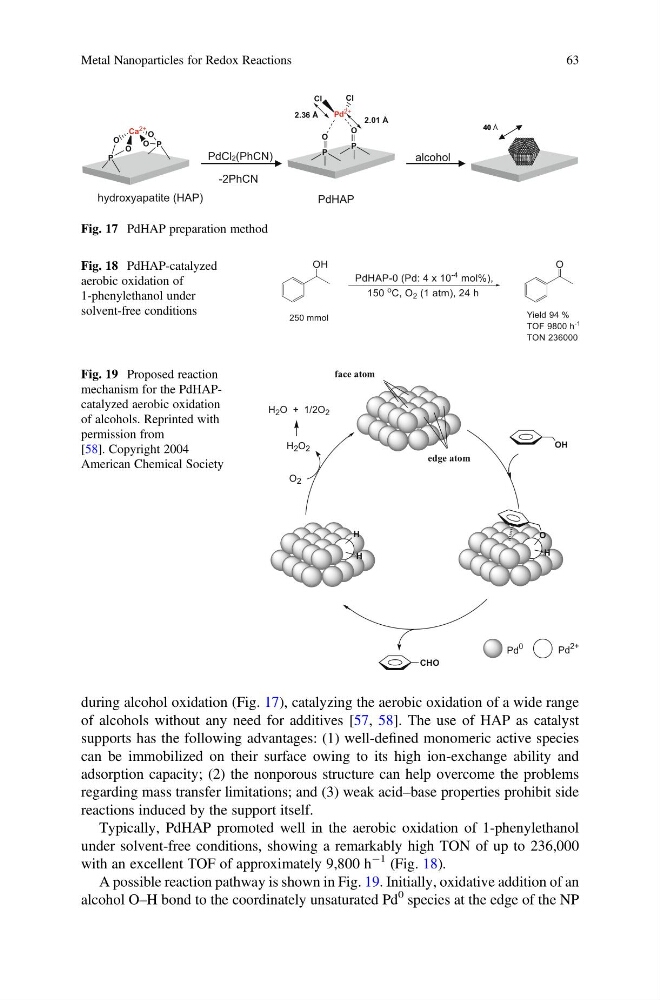
during alcohol oxidation (Fig. 17), catalyzing the aerobic oxidation of a wide range
of alcohols without any need for additives [57, 58]. The use of HAP as catalyst
supports has the following advantages: (1) well-defined monomeric active species
can be immobilized on their surface owing to its high ion-exchange ability and
adsorption capacity; (2) the nonporous structure can help overcome the problems
regarding mass transfer limitations; and (3) weak acid–base properties prohibit side
reactions induced by the support itself.
Typically, PdHAP promoted well in the aerobic oxidation of 1-phenylethanol
under solvent-free conditions, showing a remarkably high TON of up to 236,000
with an excellent TOF of approximately 9,800 h
À1 (Fig. 18).
A possible reaction pathway is shown in Fig. 19. Initially, oxidative addition of an
alcohol O–H bond to the coordinately unsaturated Pd
0 species at the edge of the NP
40 40
O
P
O
P
Pd
2+
Cl
Cl
2.01 Å
Å
2.36 Å
hydroxyapatite (HAP)
O
P
O
O
P
O
Ca
2+
PdCl2(PhCN)
-2PhCN
PdHAP
alcohol
Fig. 17 PdHAP preparation method
Fig. 18 PdHAP-catalyzed
aerobic oxidation of
1-phenylethanol under
solvent-free conditions
CHO
Pd
2+
O 2
H 2 O 2
Pd
0
edge atom
face atom
H 2 O + 1/2O 2
OH
O
H
H
H
Fig. 19 Proposed reaction
mechanism for the PdHAPcatalyzed aerobic oxidation
of alcohols. Reprinted with
permission from
[58]. Copyright 2004
American Chemical Society
Metal Nanoparticles for Redox Reactions
63
of alcohols without any need for additives [57, 58]. The use of HAP as catalyst
supports has the following advantages: (1) well-defined monomeric active species
can be immobilized on their surface owing to its high ion-exchange ability and
adsorption capacity; (2) the nonporous structure can help overcome the problems
regarding mass transfer limitations; and (3) weak acid–base properties prohibit side
reactions induced by the support itself.
Typically, PdHAP promoted well in the aerobic oxidation of 1-phenylethanol
under solvent-free conditions, showing a remarkably high TON of up to 236,000
with an excellent TOF of approximately 9,800 h
À1 (Fig. 18).
A possible reaction pathway is shown in Fig. 19. Initially, oxidative addition of an
alcohol O–H bond to the coordinately unsaturated Pd
0 species at the edge of the NP
40 40
O
P
O
P
Pd
2+
Cl
Cl
2.01 Å
Å
2.36 Å
hydroxyapatite (HAP)
O
P
O
O
P
O
Ca
2+
PdCl2(PhCN)
-2PhCN
PdHAP
alcohol
Fig. 17 PdHAP preparation method
Fig. 18 PdHAP-catalyzed
aerobic oxidation of
1-phenylethanol under
solvent-free conditions
CHO
Pd
2+
O 2
H 2 O 2
Pd
0
edge atom
face atom
H 2 O + 1/2O 2
OH
O
H
H
H
Fig. 19 Proposed reaction
mechanism for the PdHAPcatalyzed aerobic oxidation
of alcohols. Reprinted with
permission from
[58]. Copyright 2004
American Chemical Society
Metal Nanoparticles for Redox Reactions
63