

[29, 30]. Although Lindlar catalyst (Pb(OAc) 2 -treated Pd/CaCO 3 with large amounts
of quinoline) has been widely used in these reactions [31], this method has serious
drawbacks, including requiring a toxic Pb salt and large amounts of quinoline to
suppress overhydrogenation of alkenes. Furthermore, when applied to terminal
alkynes, Lindlar catalyst causes rapid overhydrogenation of the terminal alkene
products. To establish more environmentally benign catalyst systems, a number of
Pb-free catalysts involving Pd [32, 33], Fe [34, 35], Ni [36–38], Cu [39], and Ru [40]
metals have been reported. Among the reported Pd NP catalysts, the addition of
dimethylsulfoxide (DMSO) is a simple and effective approach alternative to Lindlar
catalyst, in which DMSO drastically suppresses the overhydrogenation and isomerization of the alkene products [41]. This is caused by the suitable coordination ability
of DMSO with Pd NPs, where DMSO adsorbed on the Pd NP surface inhibits the
coordination of alkenes to Pd NPs, while alkynes can adsorb onto the Pd NP surfaces
due to their higher coordination ability compared with that of DMSO.
Based on the above DMSO effect, Mitsudome et al. designed core–shell
nanocomposites of SiO 2 -supported Pd NPs covered with a DMSO-like matrix of
methyl-3-trimethoxysilylpropylsulfoxide
(MPSO)
(Pd@MPSO/SiO 2 )
[42]. Pd@MPSO/SiO 2 had Pd NPs with a mean diameter of 17 nm covered by a
MPSO matrix shell with a thickness of 4 nm (Pd@MPSO/SiO 2 -1) or 19 nm
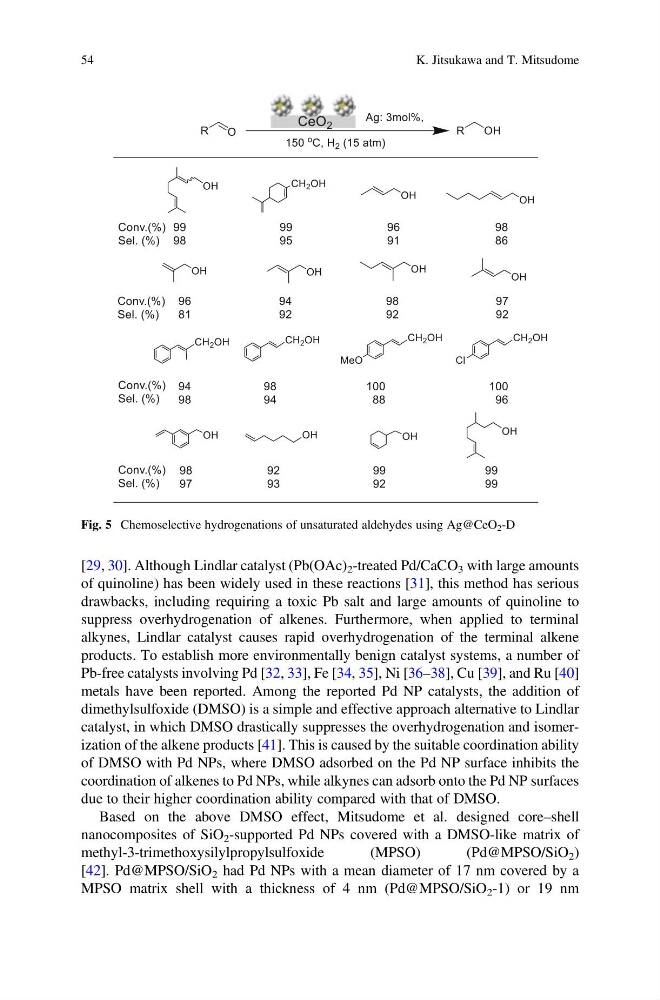
Fig. 5 Chemoselective hydrogenations of unsaturated aldehydes using Ag@CeO 2 -D
54
K. Jitsukawa and T. Mitsudome
of quinoline) has been widely used in these reactions [31], this method has serious
drawbacks, including requiring a toxic Pb salt and large amounts of quinoline to
suppress overhydrogenation of alkenes. Furthermore, when applied to terminal
alkynes, Lindlar catalyst causes rapid overhydrogenation of the terminal alkene
products. To establish more environmentally benign catalyst systems, a number of
Pb-free catalysts involving Pd [32, 33], Fe [34, 35], Ni [36–38], Cu [39], and Ru [40]
metals have been reported. Among the reported Pd NP catalysts, the addition of
dimethylsulfoxide (DMSO) is a simple and effective approach alternative to Lindlar
catalyst, in which DMSO drastically suppresses the overhydrogenation and isomerization of the alkene products [41]. This is caused by the suitable coordination ability
of DMSO with Pd NPs, where DMSO adsorbed on the Pd NP surface inhibits the
coordination of alkenes to Pd NPs, while alkynes can adsorb onto the Pd NP surfaces
due to their higher coordination ability compared with that of DMSO.
Based on the above DMSO effect, Mitsudome et al. designed core–shell
nanocomposites of SiO 2 -supported Pd NPs covered with a DMSO-like matrix of
methyl-3-trimethoxysilylpropylsulfoxide
(MPSO)
(Pd@MPSO/SiO 2 )
[42]. Pd@MPSO/SiO 2 had Pd NPs with a mean diameter of 17 nm covered by a
MPSO matrix shell with a thickness of 4 nm (Pd@MPSO/SiO 2 -1) or 19 nm
Fig. 5 Chemoselective hydrogenations of unsaturated aldehydes using Ag@CeO 2 -D
54
K. Jitsukawa and T. Mitsudome