

selectivity without alkene hydrogenation occurring. Interestingly, the C¼C bond of
3-aminostyrene showed no hydrogenation when the reaction time was prolonged.
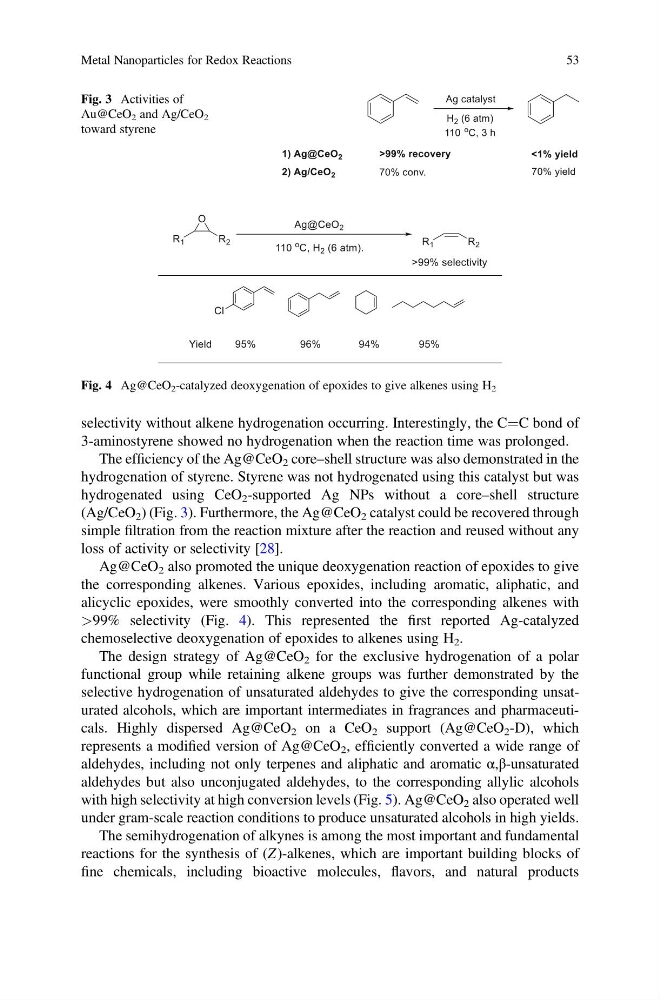
The efficiency of the Ag@CeO 2 core–shell structure was also demonstrated in the
hydrogenation of styrene. Styrene was not hydrogenated using this catalyst but was
hydrogenated using CeO 2 -supported Ag NPs without a core–shell structure
(Ag/CeO 2 ) (Fig. 3). Furthermore, the Ag@CeO 2 catalyst could be recovered through
simple filtration from the reaction mixture after the reaction and reused without any
loss of activity or selectivity [28].
Ag@CeO 2 also promoted the unique deoxygenation reaction of epoxides to give
the corresponding alkenes. Various epoxides, including aromatic, aliphatic, and
alicyclic epoxides, were smoothly converted into the corresponding alkenes with
>99% selectivity (Fig. 4). This represented the first reported Ag-catalyzed
chemoselective deoxygenation of epoxides to alkenes using H 2 .
The design strategy of Ag@CeO 2 for the exclusive hydrogenation of a polar
functional group while retaining alkene groups was further demonstrated by the
selective hydrogenation of unsaturated aldehydes to give the corresponding unsaturated alcohols, which are important intermediates in fragrances and pharmaceuticals. Highly dispersed Ag@CeO 2 on a CeO 2 support (Ag@CeO 2 -D), which
represents a modified version of Ag@CeO 2 , efficiently converted a wide range of
aldehydes, including not only terpenes and aliphatic and aromatic α,β-unsaturated
aldehydes but also unconjugated aldehydes, to the corresponding allylic alcohols
with high selectivity at high conversion levels (Fig. 5). Ag@CeO 2 also operated well
under gram-scale reaction conditions to produce unsaturated alcohols in high yields.
The semihydrogenation of alkynes is among the most important and fundamental
reactions for the synthesis of (Z )-alkenes, which are important building blocks of
fine chemicals, including bioactive molecules, flavors, and natural products
Fig. 4 Ag@CeO 2 -catalyzed deoxygenation of epoxides to give alkenes using H 2
Fig. 3 Activities of
Au@CeO 2 and Ag/CeO 2
toward styrene
Metal Nanoparticles for Redox Reactions
53
3-aminostyrene showed no hydrogenation when the reaction time was prolonged.
The efficiency of the Ag@CeO 2 core–shell structure was also demonstrated in the
hydrogenation of styrene. Styrene was not hydrogenated using this catalyst but was
hydrogenated using CeO 2 -supported Ag NPs without a core–shell structure
(Ag/CeO 2 ) (Fig. 3). Furthermore, the Ag@CeO 2 catalyst could be recovered through
simple filtration from the reaction mixture after the reaction and reused without any
loss of activity or selectivity [28].
Ag@CeO 2 also promoted the unique deoxygenation reaction of epoxides to give
the corresponding alkenes. Various epoxides, including aromatic, aliphatic, and
alicyclic epoxides, were smoothly converted into the corresponding alkenes with
>99% selectivity (Fig. 4). This represented the first reported Ag-catalyzed
chemoselective deoxygenation of epoxides to alkenes using H 2 .
The design strategy of Ag@CeO 2 for the exclusive hydrogenation of a polar
functional group while retaining alkene groups was further demonstrated by the
selective hydrogenation of unsaturated aldehydes to give the corresponding unsaturated alcohols, which are important intermediates in fragrances and pharmaceuticals. Highly dispersed Ag@CeO 2 on a CeO 2 support (Ag@CeO 2 -D), which
represents a modified version of Ag@CeO 2 , efficiently converted a wide range of
aldehydes, including not only terpenes and aliphatic and aromatic α,β-unsaturated
aldehydes but also unconjugated aldehydes, to the corresponding allylic alcohols
with high selectivity at high conversion levels (Fig. 5). Ag@CeO 2 also operated well
under gram-scale reaction conditions to produce unsaturated alcohols in high yields.
The semihydrogenation of alkynes is among the most important and fundamental
reactions for the synthesis of (Z )-alkenes, which are important building blocks of
fine chemicals, including bioactive molecules, flavors, and natural products
Fig. 4 Ag@CeO 2 -catalyzed deoxygenation of epoxides to give alkenes using H 2
Fig. 3 Activities of
Au@CeO 2 and Ag/CeO 2
toward styrene
Metal Nanoparticles for Redox Reactions
53