

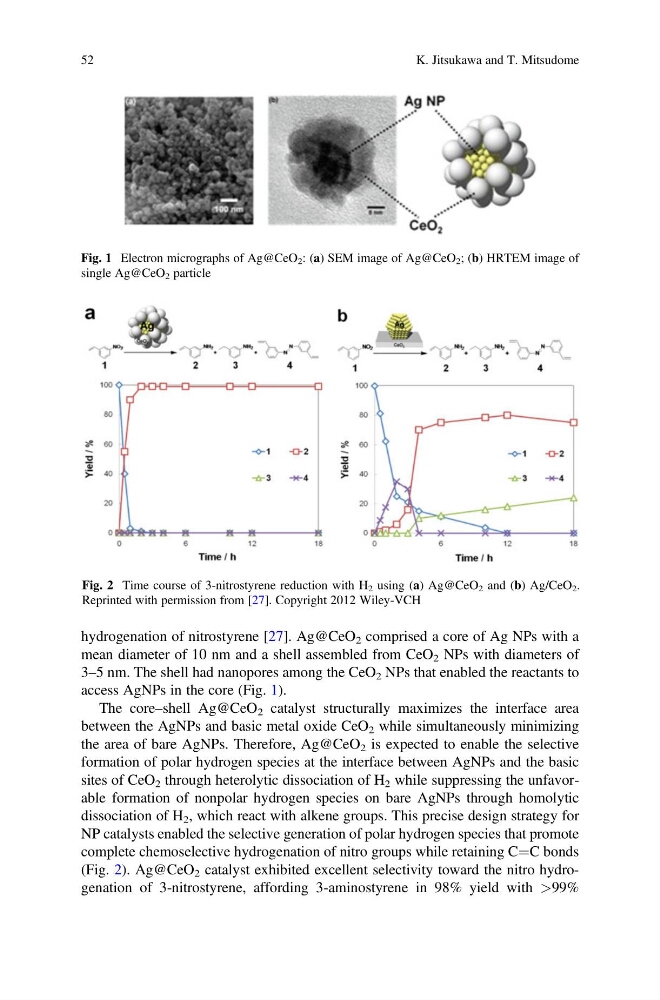
hydrogenation of nitrostyrene [27]. Ag@CeO 2 comprised a core of Ag NPs with a
mean diameter of 10 nm and a shell assembled from CeO 2 NPs with diameters of
3–5 nm. The shell had nanopores among the CeO 2 NPs that enabled the reactants to
access AgNPs in the core (Fig. 1).
The core–shell Ag@CeO 2 catalyst structurally maximizes the interface area
between the AgNPs and basic metal oxide CeO 2 while simultaneously minimizing
the area of bare AgNPs. Therefore, Ag@CeO 2 is expected to enable the selective
formation of polar hydrogen species at the interface between AgNPs and the basic
sites of CeO 2 through heterolytic dissociation of H 2 while suppressing the unfavorable formation of nonpolar hydrogen species on bare AgNPs through homolytic
dissociation of H 2 , which react with alkene groups. This precise design strategy for
NP catalysts enabled the selective generation of polar hydrogen species that promote
complete chemoselective hydrogenation of nitro groups while retaining C¼C bonds
(Fig. 2). Ag@CeO 2 catalyst exhibited excellent selectivity toward the nitro hydrogenation of 3-nitrostyrene, affording 3-aminostyrene in 98% yield with >99%
Fig. 1 Electron micrographs of Ag@CeO 2 : (a) SEM image of Ag@CeO 2 ; (b) HRTEM image of
single Ag@CeO 2 particle
Fig. 2 Time course of 3-nitrostyrene reduction with H 2 using (a) Ag@CeO 2 and (b) Ag/CeO 2 .
Reprinted with permission from [27]. Copyright 2012 Wiley-VCH
52
K. Jitsukawa and T. Mitsudome
mean diameter of 10 nm and a shell assembled from CeO 2 NPs with diameters of
3–5 nm. The shell had nanopores among the CeO 2 NPs that enabled the reactants to
access AgNPs in the core (Fig. 1).
The core–shell Ag@CeO 2 catalyst structurally maximizes the interface area
between the AgNPs and basic metal oxide CeO 2 while simultaneously minimizing
the area of bare AgNPs. Therefore, Ag@CeO 2 is expected to enable the selective
formation of polar hydrogen species at the interface between AgNPs and the basic
sites of CeO 2 through heterolytic dissociation of H 2 while suppressing the unfavorable formation of nonpolar hydrogen species on bare AgNPs through homolytic
dissociation of H 2 , which react with alkene groups. This precise design strategy for
NP catalysts enabled the selective generation of polar hydrogen species that promote
complete chemoselective hydrogenation of nitro groups while retaining C¼C bonds
(Fig. 2). Ag@CeO 2 catalyst exhibited excellent selectivity toward the nitro hydrogenation of 3-nitrostyrene, affording 3-aminostyrene in 98% yield with >99%
Fig. 1 Electron micrographs of Ag@CeO 2 : (a) SEM image of Ag@CeO 2 ; (b) HRTEM image of
single Ag@CeO 2 particle
Fig. 2 Time course of 3-nitrostyrene reduction with H 2 using (a) Ag@CeO 2 and (b) Ag/CeO 2 .
Reprinted with permission from [27]. Copyright 2012 Wiley-VCH
52
K. Jitsukawa and T. Mitsudome