

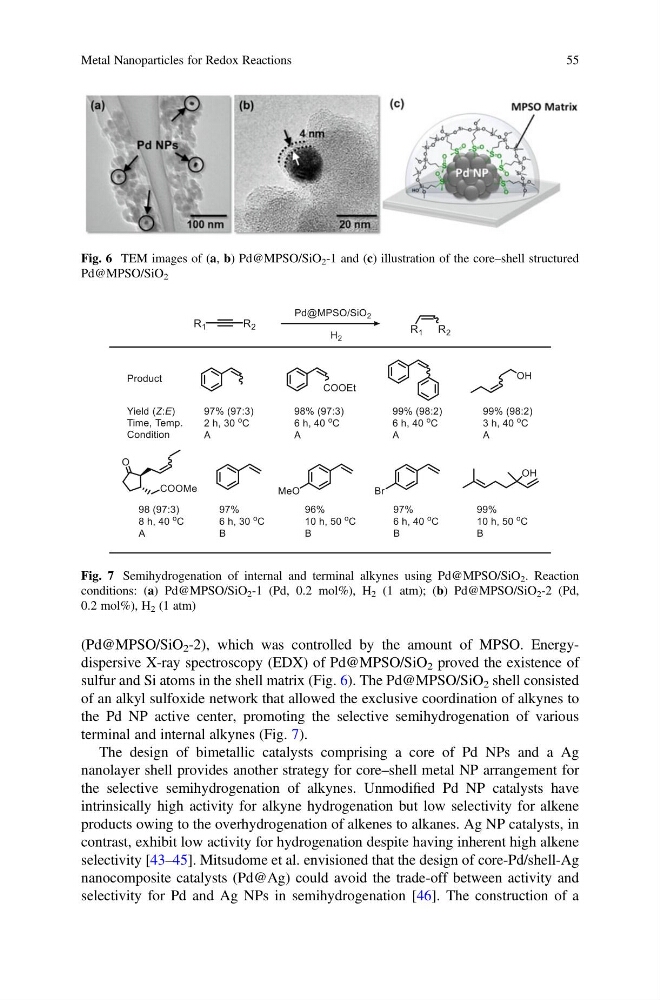
(Pd@MPSO/SiO 2 -2), which was controlled by the amount of MPSO. Energydispersive X-ray spectroscopy (EDX) of Pd@MPSO/SiO 2 proved the existence of
sulfur and Si atoms in the shell matrix (Fig. 6). The Pd@MPSO/SiO 2 shell consisted
of an alkyl sulfoxide network that allowed the exclusive coordination of alkynes to
the Pd NP active center, promoting the selective semihydrogenation of various
terminal and internal alkynes (Fig. 7).
The design of bimetallic catalysts comprising a core of Pd NPs and a Ag
nanolayer shell provides another strategy for core–shell metal NP arrangement for
the selective semihydrogenation of alkynes. Unmodified Pd NP catalysts have
intrinsically high activity for alkyne hydrogenation but low selectivity for alkene
products owing to the overhydrogenation of alkenes to alkanes. Ag NP catalysts, in
contrast, exhibit low activity for hydrogenation despite having inherent high alkene
selectivity [43–45]. Mitsudome et al. envisioned that the design of core-Pd/shell-Ag
nanocomposite catalysts (Pd@Ag) could avoid the trade-off between activity and
selectivity for Pd and Ag NPs in semihydrogenation [46]. The construction of a
Fig. 7 Semihydrogenation of internal and terminal alkynes using Pd@MPSO/SiO 2 . Reaction
conditions: (a) Pd@MPSO/SiO 2 -1 (Pd, 0.2 mol%), H 2 (1 atm); (b) Pd@MPSO/SiO 2 -2 (Pd,
0.2 mol%), H 2 (1 atm)
Fig. 6 TEM images of (a, b) Pd@MPSO/SiO 2 -1 and (c) illustration of the core–shell structured
Pd@MPSO/SiO 2
Metal Nanoparticles for Redox Reactions
55
sulfur and Si atoms in the shell matrix (Fig. 6). The Pd@MPSO/SiO 2 shell consisted
of an alkyl sulfoxide network that allowed the exclusive coordination of alkynes to
the Pd NP active center, promoting the selective semihydrogenation of various
terminal and internal alkynes (Fig. 7).
The design of bimetallic catalysts comprising a core of Pd NPs and a Ag
nanolayer shell provides another strategy for core–shell metal NP arrangement for
the selective semihydrogenation of alkynes. Unmodified Pd NP catalysts have
intrinsically high activity for alkyne hydrogenation but low selectivity for alkene
products owing to the overhydrogenation of alkenes to alkanes. Ag NP catalysts, in
contrast, exhibit low activity for hydrogenation despite having inherent high alkene
selectivity [43–45]. Mitsudome et al. envisioned that the design of core-Pd/shell-Ag
nanocomposite catalysts (Pd@Ag) could avoid the trade-off between activity and
selectivity for Pd and Ag NPs in semihydrogenation [46]. The construction of a
Fig. 7 Semihydrogenation of internal and terminal alkynes using Pd@MPSO/SiO 2 . Reaction
conditions: (a) Pd@MPSO/SiO 2 -1 (Pd, 0.2 mol%), H 2 (1 atm); (b) Pd@MPSO/SiO 2 -2 (Pd,
0.2 mol%), H 2 (1 atm)
Fig. 6 TEM images of (a, b) Pd@MPSO/SiO 2 -1 and (c) illustration of the core–shell structured
Pd@MPSO/SiO 2
Metal Nanoparticles for Redox Reactions
55