

cyclohexenyl radicals is formed to give cyclohexenyl hydroperoxide (Cy-OOH, A)
as a major product under solvent-free conditions (Scheme 8). Therefore, the active
sites for cyclohexene oxidation were the metallic Au particles, while the styrene
oxidation requires Au clusters where O 2 is dissociated [159].
7 Oxidation of Alkanes
Oxidation of cyclohexane into the mixture of cyclohexanone and cyclohexanol (K/A
oil) is an important reaction in chemical industry and currently produced by homogeneous catalysts such as Co salts under 1–2 MPa of O 2 at 150
C, affording ~4%
conversion and 70–85% selectivity of K/A oil. Au catalysts have been also reported
for the cyclohexane oxidation. For example, Au/Fe 2 O 3 produced K/A oil in 14%
yield with the K/A ratio of 1/99 in the presence of H 2 O 2 as a radical initiator
[160]. Au 38 (SCH 2 CH 2 Ph) 24 clusters supported on CeO 2 gave 39% conversion at
250
C with 79% K/A oil selectivity (K/A ratio of 57/22) but also produced
cyclohexanethiol in 15% selectivity in which the sulfur came from thiolate
ligands [161].
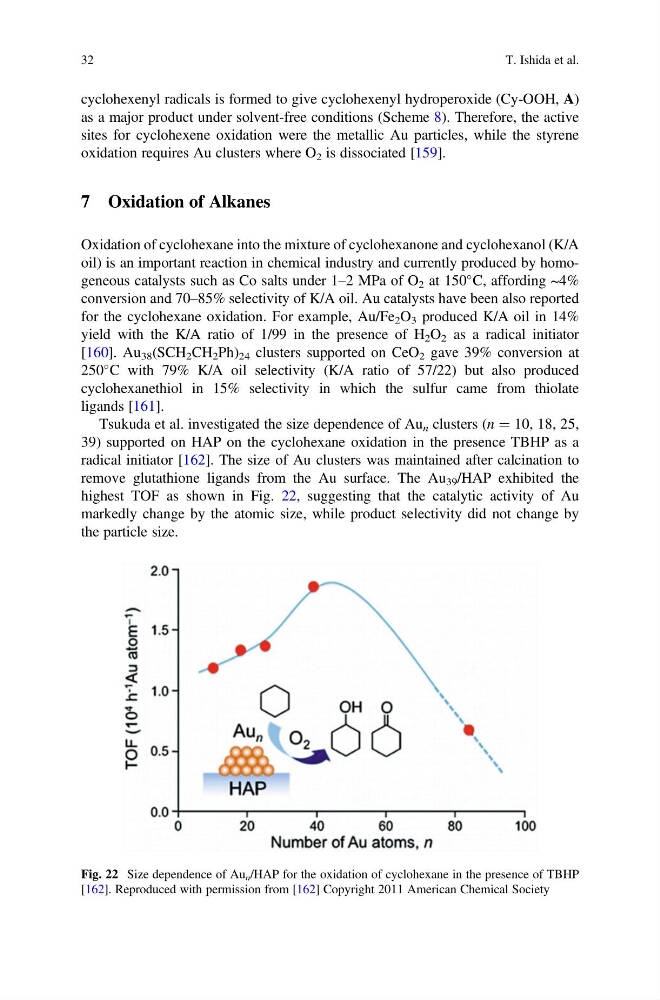
Tsukuda et al. investigated the size dependence of Au n clusters (n ¼ 10, 18, 25,
39) supported on HAP on the cyclohexane oxidation in the presence TBHP as a
radical initiator [162]. The size of Au clusters was maintained after calcination to
remove glutathione ligands from the Au surface. The Au 39 /HAP exhibited the
highest TOF as shown in Fig. 22, suggesting that the catalytic activity of Au
markedly change by the atomic size, while product selectivity did not change by
the particle size.
Fig. 22 Size dependence of Au n /HAP for the oxidation of cyclohexane in the presence of TBHP
[162]. Reproduced with permission from [162] Copyright 2011 American Chemical Society
32
T. Ishida et al.
as a major product under solvent-free conditions (Scheme 8). Therefore, the active
sites for cyclohexene oxidation were the metallic Au particles, while the styrene
oxidation requires Au clusters where O 2 is dissociated [159].
7 Oxidation of Alkanes
Oxidation of cyclohexane into the mixture of cyclohexanone and cyclohexanol (K/A
oil) is an important reaction in chemical industry and currently produced by homogeneous catalysts such as Co salts under 1–2 MPa of O 2 at 150
C, affording ~4%
conversion and 70–85% selectivity of K/A oil. Au catalysts have been also reported
for the cyclohexane oxidation. For example, Au/Fe 2 O 3 produced K/A oil in 14%
yield with the K/A ratio of 1/99 in the presence of H 2 O 2 as a radical initiator
[160]. Au 38 (SCH 2 CH 2 Ph) 24 clusters supported on CeO 2 gave 39% conversion at
250
C with 79% K/A oil selectivity (K/A ratio of 57/22) but also produced
cyclohexanethiol in 15% selectivity in which the sulfur came from thiolate
ligands [161].
Tsukuda et al. investigated the size dependence of Au n clusters (n ¼ 10, 18, 25,
39) supported on HAP on the cyclohexane oxidation in the presence TBHP as a
radical initiator [162]. The size of Au clusters was maintained after calcination to
remove glutathione ligands from the Au surface. The Au 39 /HAP exhibited the
highest TOF as shown in Fig. 22, suggesting that the catalytic activity of Au
markedly change by the atomic size, while product selectivity did not change by
the particle size.
Fig. 22 Size dependence of Au n /HAP for the oxidation of cyclohexane in the presence of TBHP
[162]. Reproduced with permission from [162] Copyright 2011 American Chemical Society
32
T. Ishida et al.