

As well as in alkene oxidation, alkane oxidation using O 2 as a sole oxidant is
more challenging (Table 5). Au/Al 2 O 3 , Au/mesoporous SiO 2 , and Au/zeolite have
been reported to be active for the cyclohexane oxidation with O 2 in the absence of
radical initiators. Au/Al 2 O 3 showed cyclohexanol selectivity [163], whereas Au NPs
on mesoporous SiO 2 (MCM-41) [164] and on zeolite (ZSM-5) [163, 165] showed
cyclohexanone selectivity. Sivakumar et al. prepared Au NPs confined in the ZSM-5
shell (Au@ZSM-5) and demonstrated that Au@ZSM-5 gave ca. 40% conversion
with ca. 80% K/A oil selectivity, whereas ZSM-5 without Au also promoted the
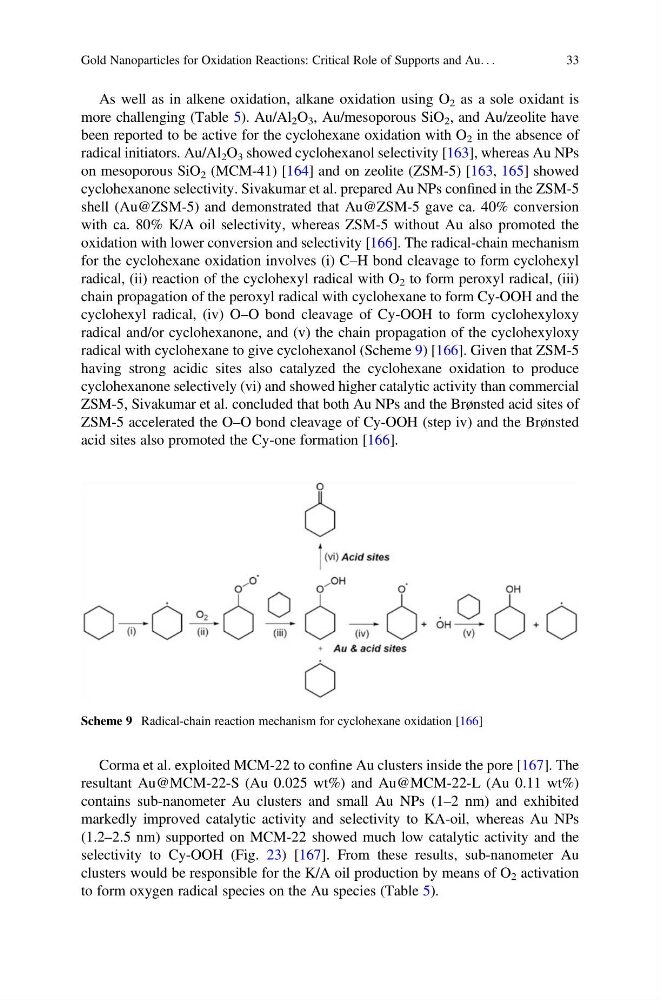
oxidation with lower conversion and selectivity [166]. The radical-chain mechanism
for the cyclohexane oxidation involves (i) C–H bond cleavage to form cyclohexyl
radical, (ii) reaction of the cyclohexyl radical with O 2 to form peroxyl radical, (iii)
chain propagation of the peroxyl radical with cyclohexane to form Cy-OOH and the
cyclohexyl radical, (iv) O–O bond cleavage of Cy-OOH to form cyclohexyloxy
radical and/or cyclohexanone, and (v) the chain propagation of the cyclohexyloxy
radical with cyclohexane to give cyclohexanol (Scheme 9) [166]. Given that ZSM-5
having strong acidic sites also catalyzed the cyclohexane oxidation to produce
cyclohexanone selectively (vi) and showed higher catalytic activity than commercial
ZSM-5, Sivakumar et al. concluded that both Au NPs and the Brønsted acid sites of
ZSM-5 accelerated the O–O bond cleavage of Cy-OOH (step iv) and the Brønsted
acid sites also promoted the Cy-one formation [166].
Corma et al. exploited MCM-22 to confine Au clusters inside the pore [167]. The
resultant Au@MCM-22-S (Au 0.025 wt%) and Au@MCM-22-L (Au 0.11 wt%)
contains sub-nanometer Au clusters and small Au NPs (1–2 nm) and exhibited
markedly improved catalytic activity and selectivity to KA-oil, whereas Au NPs
(1.2–2.5 nm) supported on MCM-22 showed much low catalytic activity and the
selectivity to Cy-OOH (Fig. 23) [167]. From these results, sub-nanometer Au
clusters would be responsible for the K/A oil production by means of O 2 activation
to form oxygen radical species on the Au species (Table 5).
Scheme 9 Radical-chain reaction mechanism for cyclohexane oxidation [166]
Gold Nanoparticles for Oxidation Reactions: Critical Role of Supports and Au. . .
33
more challenging (Table 5). Au/Al 2 O 3 , Au/mesoporous SiO 2 , and Au/zeolite have
been reported to be active for the cyclohexane oxidation with O 2 in the absence of
radical initiators. Au/Al 2 O 3 showed cyclohexanol selectivity [163], whereas Au NPs
on mesoporous SiO 2 (MCM-41) [164] and on zeolite (ZSM-5) [163, 165] showed
cyclohexanone selectivity. Sivakumar et al. prepared Au NPs confined in the ZSM-5
shell (Au@ZSM-5) and demonstrated that Au@ZSM-5 gave ca. 40% conversion
with ca. 80% K/A oil selectivity, whereas ZSM-5 without Au also promoted the
oxidation with lower conversion and selectivity [166]. The radical-chain mechanism
for the cyclohexane oxidation involves (i) C–H bond cleavage to form cyclohexyl
radical, (ii) reaction of the cyclohexyl radical with O 2 to form peroxyl radical, (iii)
chain propagation of the peroxyl radical with cyclohexane to form Cy-OOH and the
cyclohexyl radical, (iv) O–O bond cleavage of Cy-OOH to form cyclohexyloxy
radical and/or cyclohexanone, and (v) the chain propagation of the cyclohexyloxy
radical with cyclohexane to give cyclohexanol (Scheme 9) [166]. Given that ZSM-5
having strong acidic sites also catalyzed the cyclohexane oxidation to produce
cyclohexanone selectively (vi) and showed higher catalytic activity than commercial
ZSM-5, Sivakumar et al. concluded that both Au NPs and the Brønsted acid sites of
ZSM-5 accelerated the O–O bond cleavage of Cy-OOH (step iv) and the Brønsted
acid sites also promoted the Cy-one formation [166].
Corma et al. exploited MCM-22 to confine Au clusters inside the pore [167]. The
resultant Au@MCM-22-S (Au 0.025 wt%) and Au@MCM-22-L (Au 0.11 wt%)
contains sub-nanometer Au clusters and small Au NPs (1–2 nm) and exhibited
markedly improved catalytic activity and selectivity to KA-oil, whereas Au NPs
(1.2–2.5 nm) supported on MCM-22 showed much low catalytic activity and the
selectivity to Cy-OOH (Fig. 23) [167]. From these results, sub-nanometer Au
clusters would be responsible for the K/A oil production by means of O 2 activation
to form oxygen radical species on the Au species (Table 5).
Scheme 9 Radical-chain reaction mechanism for cyclohexane oxidation [166]
Gold Nanoparticles for Oxidation Reactions: Critical Role of Supports and Au. . .
33