

Cy-oxide significantly decreased after the deposition of Au, resulting in Cy-ol as a
major product [157]. WO 3 also showed Cy-oxide selectivity without Au, and the
deposition of Au onto WO 3 remarkably improved the conversion while keeping the
Cy-oxide selectivity [158].
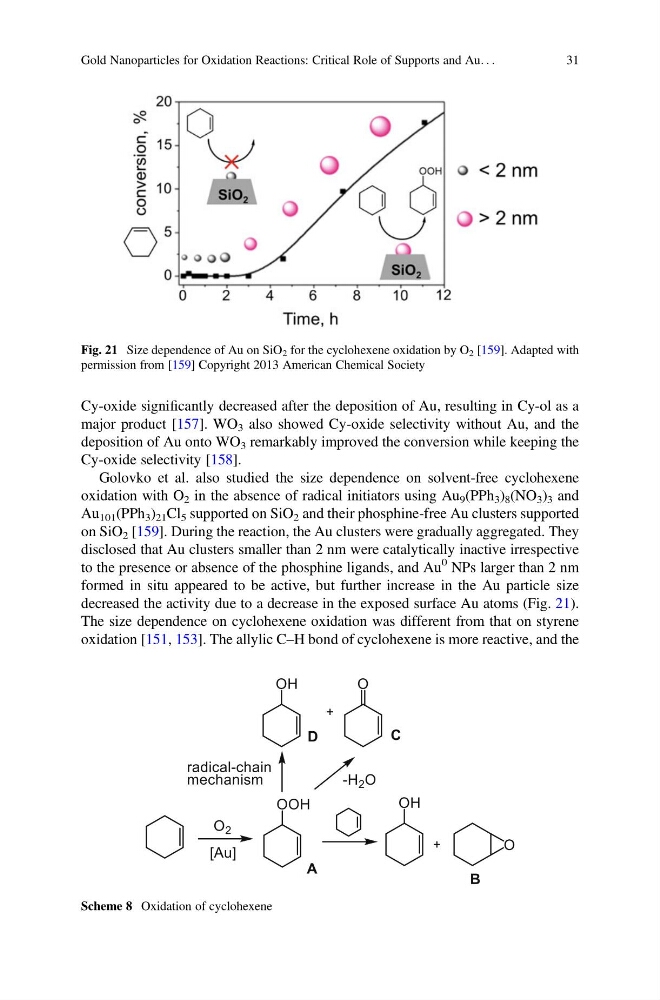
Golovko et al. also studied the size dependence on solvent-free cyclohexene
oxidation with O 2 in the absence of radical initiators using Au 9 (PPh 3 ) 8 (NO 3 ) 3 and
Au 101 (PPh 3 ) 21 Cl 5 supported on SiO 2 and their phosphine-free Au clusters supported
on SiO 2 [159]. During the reaction, the Au clusters were gradually aggregated. They
disclosed that Au clusters smaller than 2 nm were catalytically inactive irrespective
to the presence or absence of the phosphine ligands, and Au
0 NPs larger than 2 nm
formed in situ appeared to be active, but further increase in the Au particle size
decreased the activity due to a decrease in the exposed surface Au atoms (Fig. 21).
The size dependence on cyclohexene oxidation was different from that on styrene
oxidation [151, 153]. The allylic C–H bond of cyclohexene is more reactive, and the
Fig. 21 Size dependence of Au on SiO 2 for the cyclohexene oxidation by O 2 [159]. Adapted with
permission from [159] Copyright 2013 American Chemical Society
Scheme 8 Oxidation of cyclohexene
Gold Nanoparticles for Oxidation Reactions: Critical Role of Supports and Au. . .
31
major product [157]. WO 3 also showed Cy-oxide selectivity without Au, and the
deposition of Au onto WO 3 remarkably improved the conversion while keeping the
Cy-oxide selectivity [158].
Golovko et al. also studied the size dependence on solvent-free cyclohexene
oxidation with O 2 in the absence of radical initiators using Au 9 (PPh 3 ) 8 (NO 3 ) 3 and
Au 101 (PPh 3 ) 21 Cl 5 supported on SiO 2 and their phosphine-free Au clusters supported
on SiO 2 [159]. During the reaction, the Au clusters were gradually aggregated. They
disclosed that Au clusters smaller than 2 nm were catalytically inactive irrespective
to the presence or absence of the phosphine ligands, and Au
0 NPs larger than 2 nm
formed in situ appeared to be active, but further increase in the Au particle size
decreased the activity due to a decrease in the exposed surface Au atoms (Fig. 21).
The size dependence on cyclohexene oxidation was different from that on styrene
oxidation [151, 153]. The allylic C–H bond of cyclohexene is more reactive, and the
Fig. 21 Size dependence of Au on SiO 2 for the cyclohexene oxidation by O 2 [159]. Adapted with
permission from [159] Copyright 2013 American Chemical Society
Scheme 8 Oxidation of cyclohexene
Gold Nanoparticles for Oxidation Reactions: Critical Role of Supports and Au. . .
31