

finally produce benzaldehyde, styrene oxide, and acetophenone. No size effect in the
presence of TBHP was ascribed to the facile formation of peroxo species on the Au 13
core which leads to the intermediate B.
Hutchings et al. reported that Au/C containing ~5–50 nm Au NPs with the mean
diameter of ~25 nm catalyzed the aerobic oxidation of cyclohexene to give
cyclohexene oxide (Cy-oxide) as a major product with 50% selectivity at 30%
conversion in the presence of O 2 and TBHP in 1,2,3,5-trimethylbenzene
[154]. For cis-cyclooctene oxidation, Au/C produced cis-cyclooctene oxide with
81% selectivity at 8% conversion in the presence of O 2 and TBHP [154]. Au/Co-AlLDH (Au 4–70 nm) significantly improved the selectivity of cis-cyclooctene oxide
to 92% at 92% conversion [155].
The epoxidation of cyclohexene using O 2 without radical initiators is more
challenging, and cyclohexene hydroperoxide (Cy-OOH), cyclohex-2-en-1-ol
(Cy-ol), and cyclohexenone (Cy-one) are usually obtained instead of cyclohexene
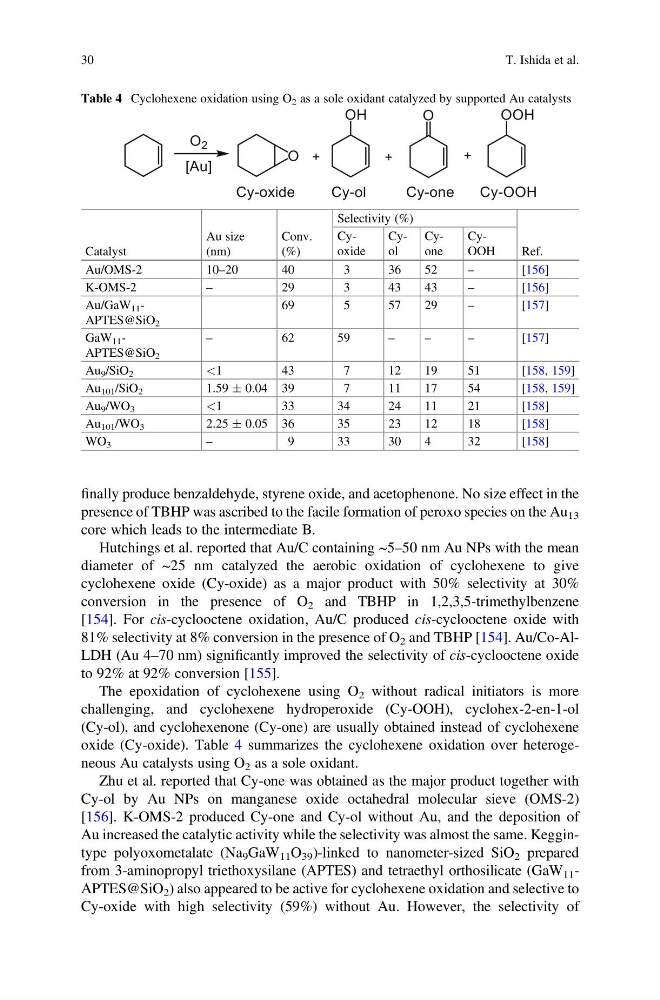
oxide (Cy-oxide). Table 4 summarizes the cyclohexene oxidation over heterogeneous Au catalysts using O 2 as a sole oxidant.
Zhu et al. reported that Cy-one was obtained as the major product together with
Cy-ol by Au NPs on manganese oxide octahedral molecular sieve (OMS-2)
[156]. K-OMS-2 produced Cy-one and Cy-ol without Au, and the deposition of
Au increased the catalytic activity while the selectivity was almost the same. Keggintype polyoxometalate (Na 9 GaW 11 O 39 )-linked to nanometer-sized SiO 2 prepared
from 3-aminopropyl triethoxysilane (APTES) and tetraethyl orthosilicate (GaW 11 -
APTES@SiO 2 ) also appeared to be active for cyclohexene oxidation and selective to
Cy-oxide with high selectivity (59%) without Au. However, the selectivity of
Table 4 Cyclohexene oxidation using O 2 as a sole oxidant catalyzed by supported Au catalysts
Catalyst
Au size
(nm)
Conv.
(%)
Selectivity (%)
Ref.
Cyoxide
Cyol
Cyone
CyOOH
Au/OMS-2
10–20
40
3
36
52
–
[156]
K-OMS-2
–
29
3
43
43
–
[156]
Au/GaW 11 -
APTES@SiO 2
69
5
57
29
–
[157]
GaW 11 -
APTES@SiO 2
–
62
59
–
–
–
[157]
Au 9 /SiO 2
<1
43
7
12
19
51
[158, 159]
Au 101 /SiO 2
1.59 Æ 0.04 39
7
11
17
54
[158, 159]
Au 9 /WO 3
<1
3 3
3 4
2 4
1 1
2 1
[ 158]
Au 101 /WO 3
2.25 Æ 0.05 36
35
23
12
18
[158]
WO 3
–
9
33
30
4
32
[158]
30
T. Ishida et al.
presence of TBHP was ascribed to the facile formation of peroxo species on the Au 13
core which leads to the intermediate B.
Hutchings et al. reported that Au/C containing ~5–50 nm Au NPs with the mean
diameter of ~25 nm catalyzed the aerobic oxidation of cyclohexene to give
cyclohexene oxide (Cy-oxide) as a major product with 50% selectivity at 30%
conversion in the presence of O 2 and TBHP in 1,2,3,5-trimethylbenzene
[154]. For cis-cyclooctene oxidation, Au/C produced cis-cyclooctene oxide with
81% selectivity at 8% conversion in the presence of O 2 and TBHP [154]. Au/Co-AlLDH (Au 4–70 nm) significantly improved the selectivity of cis-cyclooctene oxide
to 92% at 92% conversion [155].
The epoxidation of cyclohexene using O 2 without radical initiators is more
challenging, and cyclohexene hydroperoxide (Cy-OOH), cyclohex-2-en-1-ol
(Cy-ol), and cyclohexenone (Cy-one) are usually obtained instead of cyclohexene
oxide (Cy-oxide). Table 4 summarizes the cyclohexene oxidation over heterogeneous Au catalysts using O 2 as a sole oxidant.
Zhu et al. reported that Cy-one was obtained as the major product together with
Cy-ol by Au NPs on manganese oxide octahedral molecular sieve (OMS-2)
[156]. K-OMS-2 produced Cy-one and Cy-ol without Au, and the deposition of
Au increased the catalytic activity while the selectivity was almost the same. Keggintype polyoxometalate (Na 9 GaW 11 O 39 )-linked to nanometer-sized SiO 2 prepared
from 3-aminopropyl triethoxysilane (APTES) and tetraethyl orthosilicate (GaW 11 -
APTES@SiO 2 ) also appeared to be active for cyclohexene oxidation and selective to
Cy-oxide with high selectivity (59%) without Au. However, the selectivity of
Table 4 Cyclohexene oxidation using O 2 as a sole oxidant catalyzed by supported Au catalysts
Catalyst
Au size
(nm)
Conv.
(%)
Selectivity (%)
Ref.
Cyoxide
Cyol
Cyone
CyOOH
Au/OMS-2
10–20
40
3
36
52
–
[156]
K-OMS-2
–
29
3
43
43
–
[156]
Au/GaW 11 -
APTES@SiO 2
69
5
57
29
–
[157]
GaW 11 -
APTES@SiO 2
–
62
59
–
–
–
[157]
Au 9 /SiO 2
<1
43
7
12
19
51
[158, 159]
Au 101 /SiO 2
1.59 Æ 0.04 39
7
11
17
54
[158, 159]
Au 9 /WO 3
<1
3 3
3 4
2 4
1 1
2 1
[ 158]
Au 101 /WO 3
2.25 Æ 0.05 36
35
23
12
18
[158]
WO 3
–
9
33
30
4
32
[158]
30
T. Ishida et al.