

SiO 2 promoted the oxidation of styrene to produce styrene oxide (14–27% selectivities) using O 2 as a sole oxidant, although benzaldehyde was obtained as a major
product (64–82% selectivities). In contrast, SiO 2 -supported Au NPs larger than 2 nm
were inactive [151]. XPS results revealed that the Au 55 clusters were positively
charged. Given that BN and SiO 2 were inert supports, they proposed that the Au 55
clusters dissociatively adsorb O 2 to give O adatoms on Au, which is responsible for
the epoxidation of styrene. The Au clusters (<2 nm) deposited on silica hollow
nanosphere (HNS) also catalyzed the styrene epoxidation with O 2 as a sole oxidant
and recorded the 69% selectivity to styrene oxide at a moderate conversion [152].
Thiolate-protected Au 25 , Au 38 , and Au 144 clusters supported on HAP were
reported to be active for the styrene oxidation to produce benzaldehyde and styrene
oxide [153]. No obvious size effect was observed in the presence of TBHP, but the
conversions of cyclohexene increased as Au clusters became smaller,
Au 25 > Au 38 > Au 144 in the presence of O 2 without TBHP. They proposed the
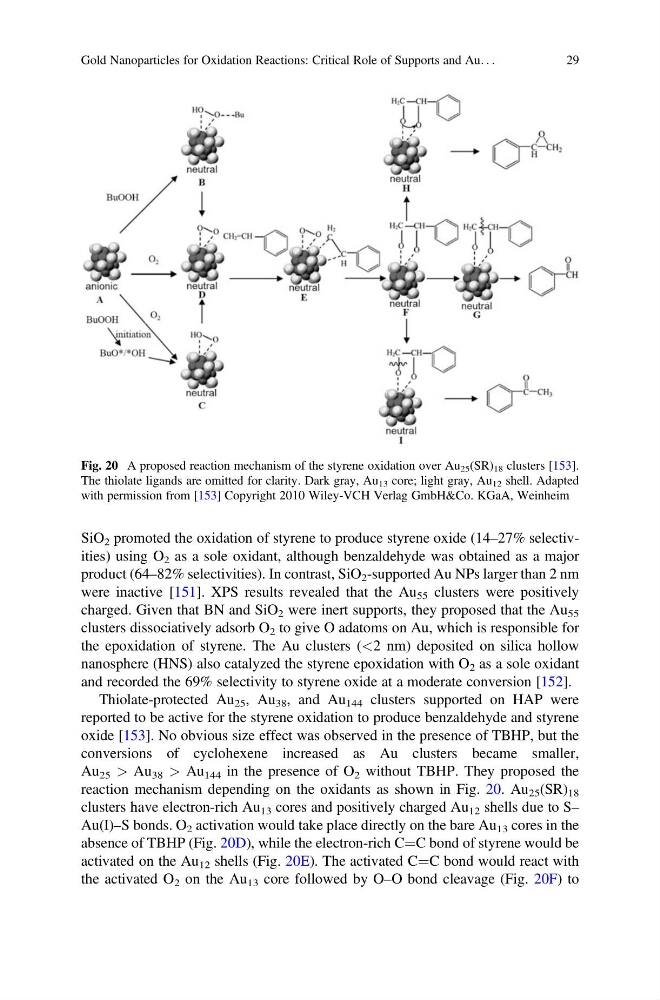
reaction mechanism depending on the oxidants as shown in Fig. 20. Au 25 (SR) 18
clusters have electron-rich Au 13 cores and positively charged Au 12 shells due to S–
Au(I)–S bonds. O 2 activation would take place directly on the bare Au 13 cores in the
absence of TBHP (Fig. 20D), while the electron-rich C¼C bond of styrene would be
activated on the Au 12 shells (Fig. 20E). The activated C¼C bond would react with
the activated O 2 on the Au 13 core followed by O–O bond cleavage (Fig. 20F) to
Fig. 20 A proposed reaction mechanism of the styrene oxidation over Au 25 (SR) 18 clusters [153].
The thiolate ligands are omitted for clarity. Dark gray, Au 13 core; light gray, Au 12 shell. Adapted
with permission from [153] Copyright 2010 Wiley-VCH Verlag GmbH&Co. KGaA, Weinheim
Gold Nanoparticles for Oxidation Reactions: Critical Role of Supports and Au. . .
29
product (64–82% selectivities). In contrast, SiO 2 -supported Au NPs larger than 2 nm
were inactive [151]. XPS results revealed that the Au 55 clusters were positively
charged. Given that BN and SiO 2 were inert supports, they proposed that the Au 55
clusters dissociatively adsorb O 2 to give O adatoms on Au, which is responsible for
the epoxidation of styrene. The Au clusters (<2 nm) deposited on silica hollow
nanosphere (HNS) also catalyzed the styrene epoxidation with O 2 as a sole oxidant
and recorded the 69% selectivity to styrene oxide at a moderate conversion [152].
Thiolate-protected Au 25 , Au 38 , and Au 144 clusters supported on HAP were
reported to be active for the styrene oxidation to produce benzaldehyde and styrene
oxide [153]. No obvious size effect was observed in the presence of TBHP, but the
conversions of cyclohexene increased as Au clusters became smaller,
Au 25 > Au 38 > Au 144 in the presence of O 2 without TBHP. They proposed the
reaction mechanism depending on the oxidants as shown in Fig. 20. Au 25 (SR) 18
clusters have electron-rich Au 13 cores and positively charged Au 12 shells due to S–
Au(I)–S bonds. O 2 activation would take place directly on the bare Au 13 cores in the
absence of TBHP (Fig. 20D), while the electron-rich C¼C bond of styrene would be
activated on the Au 12 shells (Fig. 20E). The activated C¼C bond would react with
the activated O 2 on the Au 13 core followed by O–O bond cleavage (Fig. 20F) to
Fig. 20 A proposed reaction mechanism of the styrene oxidation over Au 25 (SR) 18 clusters [153].
The thiolate ligands are omitted for clarity. Dark gray, Au 13 core; light gray, Au 12 shell. Adapted
with permission from [153] Copyright 2010 Wiley-VCH Verlag GmbH&Co. KGaA, Weinheim
Gold Nanoparticles for Oxidation Reactions: Critical Role of Supports and Au. . .
29