

such as WO 3 did not promote the dehydrogenation. In contrast, Au on basic supports
gave worse results for the hydrogen transfer from imine to give secondary amine. As
a result, Au on amphoteric ZrO 2 exhibited the highest selectivity of the secondary
amine [145]. One-pot reaction using nitro group as a hydrogen acceptor was also
reported [148].
Isomerization of allylic alcohols using an intramolecular hydrogen-borrowing
strategy was achieved by Au/NiO and Au-/La-doped NiO (Fig. 19b) [147]. Doping
of La into NiO reduced the size of Au particles from 2.5 nm for Au/NiO to 0.9 nm for
Au-/La-doped NiO, resulting in a greatly improved catalytic activity. According to a
DFT calculation using a Au 6 cluster, the β-hydride elimination of allylic alcohol at
the C-1 position and the hydrogen transfer to the C-3 position would take place on
the Au 6 cluster with low activation energy [97], suggesting that the Au clusters play
a crucial role in hydrogen transfer, and the basicity of La-NiO would facilitate the
deprotonation of the alcohol.
6 Oxidation of Alkenes
Au/TiO 2 was first reported to catalyze the gas-phase epoxidation of propylene to
propylene oxide (PO) in the presence of H 2 and O 2 in 1998 [6], and then the presence
of Ti-isolated sites in Ti-containing SiO 2 supports improved the catalytic performance of Au for the epoxidation [149]. Au is responsible for the formation of H 2 O 2
in situ from H 2 and O 2 , and the Ti site is responsible for the epoxidation via the
formation of Ti–OOH from H 2 O 2 formed on Au. Later, Au clusters deposited on
titanosilicalite-1 (TS-1) enable the propylene epoxidation by only O 2 in the presence
of H 2 O [150].
The epoxidation of alkenes, such as cyclohexene and styrene, has been also
studied in liquid phase. Early studies used radical initiators together with O 2 , but
recently, O 2 has been used as a sole oxidant. The comparison of Au-catalyzed
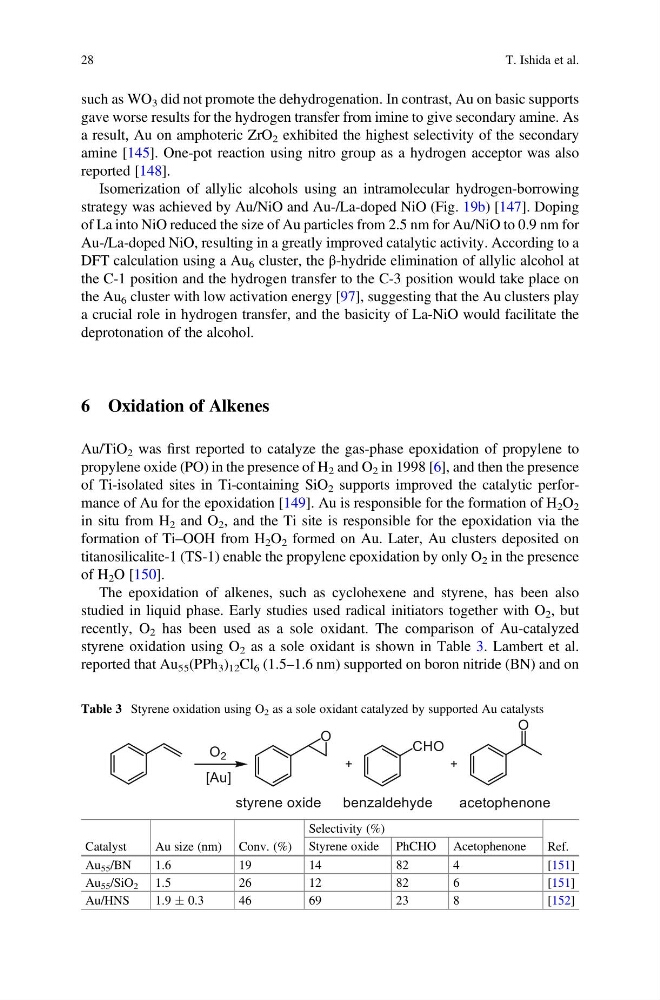
styrene oxidation using O 2 as a sole oxidant is shown in Table 3. Lambert et al.
reported that Au 55 (PPh 3 ) 12 Cl 6 (1.5–1.6 nm) supported on boron nitride (BN) and on
Table 3 Styrene oxidation using O 2 as a sole oxidant catalyzed by supported Au catalysts
Catalyst
Au size (nm) Conv. (%)
Selectivity (%)
Ref.
Styrene oxide PhCHO Acetophenone
Au 55 /BN
1.6
19
14
82
4
[151]
Au 55 /SiO 2 1.5
26
12
82
6
[151]
Au/HNS
1.9 Æ 0.3
46
69
23
8
[152]
28
T. Ishida et al.
gave worse results for the hydrogen transfer from imine to give secondary amine. As
a result, Au on amphoteric ZrO 2 exhibited the highest selectivity of the secondary
amine [145]. One-pot reaction using nitro group as a hydrogen acceptor was also
reported [148].
Isomerization of allylic alcohols using an intramolecular hydrogen-borrowing
strategy was achieved by Au/NiO and Au-/La-doped NiO (Fig. 19b) [147]. Doping
of La into NiO reduced the size of Au particles from 2.5 nm for Au/NiO to 0.9 nm for
Au-/La-doped NiO, resulting in a greatly improved catalytic activity. According to a
DFT calculation using a Au 6 cluster, the β-hydride elimination of allylic alcohol at
the C-1 position and the hydrogen transfer to the C-3 position would take place on
the Au 6 cluster with low activation energy [97], suggesting that the Au clusters play
a crucial role in hydrogen transfer, and the basicity of La-NiO would facilitate the
deprotonation of the alcohol.
6 Oxidation of Alkenes
Au/TiO 2 was first reported to catalyze the gas-phase epoxidation of propylene to
propylene oxide (PO) in the presence of H 2 and O 2 in 1998 [6], and then the presence
of Ti-isolated sites in Ti-containing SiO 2 supports improved the catalytic performance of Au for the epoxidation [149]. Au is responsible for the formation of H 2 O 2
in situ from H 2 and O 2 , and the Ti site is responsible for the epoxidation via the
formation of Ti–OOH from H 2 O 2 formed on Au. Later, Au clusters deposited on
titanosilicalite-1 (TS-1) enable the propylene epoxidation by only O 2 in the presence
of H 2 O [150].
The epoxidation of alkenes, such as cyclohexene and styrene, has been also
studied in liquid phase. Early studies used radical initiators together with O 2 , but
recently, O 2 has been used as a sole oxidant. The comparison of Au-catalyzed
styrene oxidation using O 2 as a sole oxidant is shown in Table 3. Lambert et al.
reported that Au 55 (PPh 3 ) 12 Cl 6 (1.5–1.6 nm) supported on boron nitride (BN) and on
Table 3 Styrene oxidation using O 2 as a sole oxidant catalyzed by supported Au catalysts
Catalyst
Au size (nm) Conv. (%)
Selectivity (%)
Ref.
Styrene oxide PhCHO Acetophenone
Au 55 /BN
1.6
19
14
82
4
[151]
Au 55 /SiO 2 1.5
26
12
82
6
[151]
Au/HNS
1.9 Æ 0.3
46
69
23
8
[152]
28
T. Ishida et al.