

activation mechanism. Namely, both O 2 is activated at the oxygen vacancies of CeO 2
without Au, whereas O 2 activation takes place at the Au–ZrO 2 interface, of which
perimeter length is maximized by decreasing the size of Au particles.
Oxidative esterification of 1-octanol with methanol in the absence of a base has
been reported for Au/Mg 5 Al-HT [141], Au/MgO [124], and Au/ZnO [139], and the
selectivities of methyl octanoate exceeded 94%. In contrast, the oxidative esterification of 1-octanol with ethanol to give ethyl octanoate is very limited in the absence
of base [139] and even in the presence of base [142]. For the base-free oxidative
esterification of 1-octanol with ethanol, Au/ZnO produced ethyl octanoate with 51%
selectivity at 68% conversion. Although the oxidation of ethanol to form acetaldehyde could not be avoided to produce by-products such as ethyl acetate and octyl
acetate, Au/ZnO was selective to give ethyl octanoate as a major product [139]. It
should be noted that the Au/CeO 2 and Au/ZrO 2 showed 45 and 50% selectivity to
ethyl octanoate, respectively, at both 4% conversion even in the presence of
base [142].
5 Dehydrogenation of Alcohols in the Absence of O 2
As mentioned in the Sect. 2.3.2, Zhang and Wang et al. reported that Au/HT
catalyzed the dehydrogenation of benzyl alcohol, although the catalytic activity
under inert atmosphere was much lower than that in the presence of O 2 [48]. In
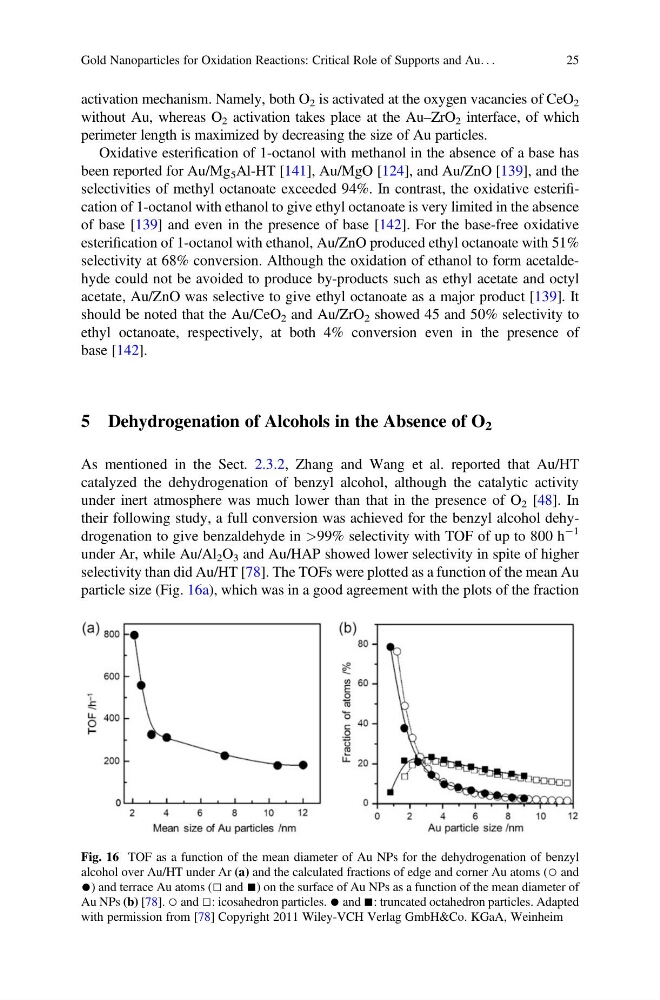
their following study, a full conversion was achieved for the benzyl alcohol dehydrogenation to give benzaldehyde in >99% selectivity with TOF of up to 800 h
À1
under Ar, while Au/Al 2 O 3 and Au/HAP showed lower selectivity in spite of higher
selectivity than did Au/HT [78]. The TOFs were plotted as a function of the mean Au
particle size (Fig. 16a), which was in a good agreement with the plots of the fraction
Fig. 16 TOF as a function of the mean diameter of Au NPs for the dehydrogenation of benzyl
alcohol over Au/HT under Ar (a) and the calculated fractions of edge and corner Au atoms (○ and
●) and terrace Au atoms (□ and ■) on the surface of Au NPs as a function of the mean diameter of
Au NPs (b) [78]. ○ and □: icosahedron particles. ● and ■: truncated octahedron particles. Adapted
with permission from [78] Copyright 2011 Wiley-VCH Verlag GmbH&Co. KGaA, Weinheim
Gold Nanoparticles for Oxidation Reactions: Critical Role of Supports and Au. . .
25
without Au, whereas O 2 activation takes place at the Au–ZrO 2 interface, of which
perimeter length is maximized by decreasing the size of Au particles.
Oxidative esterification of 1-octanol with methanol in the absence of a base has
been reported for Au/Mg 5 Al-HT [141], Au/MgO [124], and Au/ZnO [139], and the
selectivities of methyl octanoate exceeded 94%. In contrast, the oxidative esterification of 1-octanol with ethanol to give ethyl octanoate is very limited in the absence
of base [139] and even in the presence of base [142]. For the base-free oxidative
esterification of 1-octanol with ethanol, Au/ZnO produced ethyl octanoate with 51%
selectivity at 68% conversion. Although the oxidation of ethanol to form acetaldehyde could not be avoided to produce by-products such as ethyl acetate and octyl
acetate, Au/ZnO was selective to give ethyl octanoate as a major product [139]. It
should be noted that the Au/CeO 2 and Au/ZrO 2 showed 45 and 50% selectivity to
ethyl octanoate, respectively, at both 4% conversion even in the presence of
base [142].
5 Dehydrogenation of Alcohols in the Absence of O 2
As mentioned in the Sect. 2.3.2, Zhang and Wang et al. reported that Au/HT
catalyzed the dehydrogenation of benzyl alcohol, although the catalytic activity
under inert atmosphere was much lower than that in the presence of O 2 [48]. In
their following study, a full conversion was achieved for the benzyl alcohol dehydrogenation to give benzaldehyde in >99% selectivity with TOF of up to 800 h
À1
under Ar, while Au/Al 2 O 3 and Au/HAP showed lower selectivity in spite of higher
selectivity than did Au/HT [78]. The TOFs were plotted as a function of the mean Au
particle size (Fig. 16a), which was in a good agreement with the plots of the fraction
Fig. 16 TOF as a function of the mean diameter of Au NPs for the dehydrogenation of benzyl
alcohol over Au/HT under Ar (a) and the calculated fractions of edge and corner Au atoms (○ and
●) and terrace Au atoms (□ and ■) on the surface of Au NPs as a function of the mean diameter of
Au NPs (b) [78]. ○ and □: icosahedron particles. ● and ■: truncated octahedron particles. Adapted
with permission from [78] Copyright 2011 Wiley-VCH Verlag GmbH&Co. KGaA, Weinheim
Gold Nanoparticles for Oxidation Reactions: Critical Role of Supports and Au. . .
25