

ethanol to obtain ethyl methacrylate, but the high selectivity (97%) was achieved at
only low conversion (ca. 10%) [130]. For the oxidative esterification of octanal in
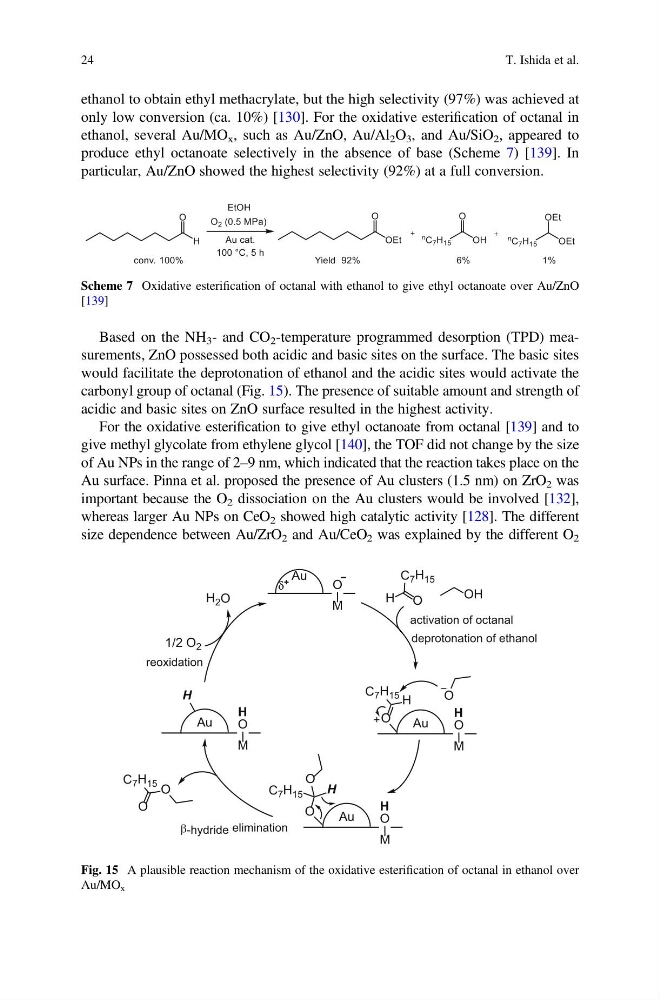
ethanol, several Au/MO x , such as Au/ZnO, Au/Al 2 O 3 , and Au/SiO 2 , appeared to
produce ethyl octanoate selectively in the absence of base (Scheme 7) [139]. In
particular, Au/ZnO showed the highest selectivity (92%) at a full conversion.
Based on the NH 3 - and CO 2 -temperature programmed desorption (TPD) measurements, ZnO possessed both acidic and basic sites on the surface. The basic sites
would facilitate the deprotonation of ethanol and the acidic sites would activate the
carbonyl group of octanal (Fig. 15). The presence of suitable amount and strength of
acidic and basic sites on ZnO surface resulted in the highest activity.
For the oxidative esterification to give ethyl octanoate from octanal [139] and to
give methyl glycolate from ethylene glycol [140], the TOF did not change by the size
of Au NPs in the range of 2–9 nm, which indicated that the reaction takes place on the
Au surface. Pinna et al. proposed the presence of Au clusters (1.5 nm) on ZrO 2 was
important because the O 2 dissociation on the Au clusters would be involved [132],
whereas larger Au NPs on CeO 2 showed high catalytic activity [128]. The different
size dependence between Au/ZrO 2 and Au/CeO 2 was explained by the different O 2
O
C 7 H 15
O
H
deprotonation of ethanol
1/2 O 2
H 2 O
β-hydride elimination
reoxidation
C 7 H 15
H O
OH
activation of octanal
O
C 7 H 15 H
M
O
Au
O
M
O
Au
δ +
H
O
C 7 H 15
H
M
O
Au
H
O
M
O
Au
H
Fig. 15 A plausible reaction mechanism of the oxidative esterification of octanal in ethanol over
Au/MO x
Scheme 7 Oxidative esterification of octanal with ethanol to give ethyl octanoate over Au/ZnO
[139]
24
T. Ishida et al.
only low conversion (ca. 10%) [130]. For the oxidative esterification of octanal in
ethanol, several Au/MO x , such as Au/ZnO, Au/Al 2 O 3 , and Au/SiO 2 , appeared to
produce ethyl octanoate selectively in the absence of base (Scheme 7) [139]. In
particular, Au/ZnO showed the highest selectivity (92%) at a full conversion.
Based on the NH 3 - and CO 2 -temperature programmed desorption (TPD) measurements, ZnO possessed both acidic and basic sites on the surface. The basic sites
would facilitate the deprotonation of ethanol and the acidic sites would activate the
carbonyl group of octanal (Fig. 15). The presence of suitable amount and strength of
acidic and basic sites on ZnO surface resulted in the highest activity.
For the oxidative esterification to give ethyl octanoate from octanal [139] and to
give methyl glycolate from ethylene glycol [140], the TOF did not change by the size
of Au NPs in the range of 2–9 nm, which indicated that the reaction takes place on the
Au surface. Pinna et al. proposed the presence of Au clusters (1.5 nm) on ZrO 2 was
important because the O 2 dissociation on the Au clusters would be involved [132],
whereas larger Au NPs on CeO 2 showed high catalytic activity [128]. The different
size dependence between Au/ZrO 2 and Au/CeO 2 was explained by the different O 2
O
C 7 H 15
O
H
deprotonation of ethanol
1/2 O 2
H 2 O
β-hydride elimination
reoxidation
C 7 H 15
H O
OH
activation of octanal
O
C 7 H 15 H
M
O
Au
O
M
O
Au
δ +
H
O
C 7 H 15
H
M
O
Au
H
O
M
O
Au
H
Fig. 15 A plausible reaction mechanism of the oxidative esterification of octanal in ethanol over
Au/MO x
Scheme 7 Oxidative esterification of octanal with ethanol to give ethyl octanoate over Au/ZnO
[139]
24
T. Ishida et al.