

of edge and corner Au atoms as a function of the size of Au (Fig. 16b). This result
suggested that the coordinatively unsaturated Au sites, i.e., edge and corner sites,
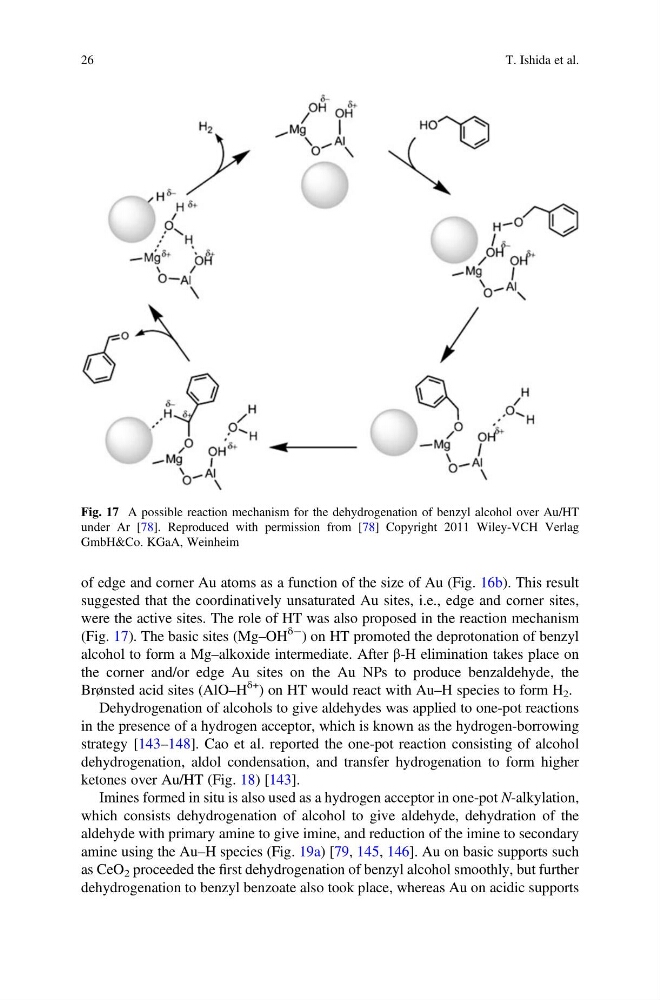
were the active sites. The role of HT was also proposed in the reaction mechanism
(Fig. 17). The basic sites (Mg–OH
δÀ
) on HT promoted the deprotonation of benzyl
alcohol to form a Mg–alkoxide intermediate. After β-H elimination takes place on
the corner and/or edge Au sites on the Au NPs to produce benzaldehyde, the
Brønsted acid sites (AlO–H
δ+
) on HT would react with Au–H species to form H 2 .
Dehydrogenation of alcohols to give aldehydes was applied to one-pot reactions
in the presence of a hydrogen acceptor, which is known as the hydrogen-borrowing
strategy [143–148]. Cao et al. reported the one-pot reaction consisting of alcohol
dehydrogenation, aldol condensation, and transfer hydrogenation to form higher
ketones over Au/HT (Fig. 18) [143].
Imines formed in situ is also used as a hydrogen acceptor in one-pot N-alkylation,
which consists dehydrogenation of alcohol to give aldehyde, dehydration of the
aldehyde with primary amine to give imine, and reduction of the imine to secondary
amine using the Au–H species (Fig. 19a) [79, 145, 146]. Au on basic supports such
as CeO 2 proceeded the first dehydrogenation of benzyl alcohol smoothly, but further
dehydrogenation to benzyl benzoate also took place, whereas Au on acidic supports
Fig. 17 A possible reaction mechanism for the dehydrogenation of benzyl alcohol over Au/HT
under Ar [78]. Reproduced with permission from [78] Copyright 2011 Wiley-VCH Verlag
GmbH&Co. KGaA, Weinheim
26
T. Ishida et al.
suggested that the coordinatively unsaturated Au sites, i.e., edge and corner sites,
were the active sites. The role of HT was also proposed in the reaction mechanism
(Fig. 17). The basic sites (Mg–OH
δÀ
) on HT promoted the deprotonation of benzyl
alcohol to form a Mg–alkoxide intermediate. After β-H elimination takes place on
the corner and/or edge Au sites on the Au NPs to produce benzaldehyde, the
Brønsted acid sites (AlO–H
δ+
) on HT would react with Au–H species to form H 2 .
Dehydrogenation of alcohols to give aldehydes was applied to one-pot reactions
in the presence of a hydrogen acceptor, which is known as the hydrogen-borrowing
strategy [143–148]. Cao et al. reported the one-pot reaction consisting of alcohol
dehydrogenation, aldol condensation, and transfer hydrogenation to form higher
ketones over Au/HT (Fig. 18) [143].
Imines formed in situ is also used as a hydrogen acceptor in one-pot N-alkylation,
which consists dehydrogenation of alcohol to give aldehyde, dehydration of the
aldehyde with primary amine to give imine, and reduction of the imine to secondary
amine using the Au–H species (Fig. 19a) [79, 145, 146]. Au on basic supports such
as CeO 2 proceeded the first dehydrogenation of benzyl alcohol smoothly, but further
dehydrogenation to benzyl benzoate also took place, whereas Au on acidic supports
Fig. 17 A possible reaction mechanism for the dehydrogenation of benzyl alcohol over Au/HT
under Ar [78]. Reproduced with permission from [78] Copyright 2011 Wiley-VCH Verlag
GmbH&Co. KGaA, Weinheim
26
T. Ishida et al.