

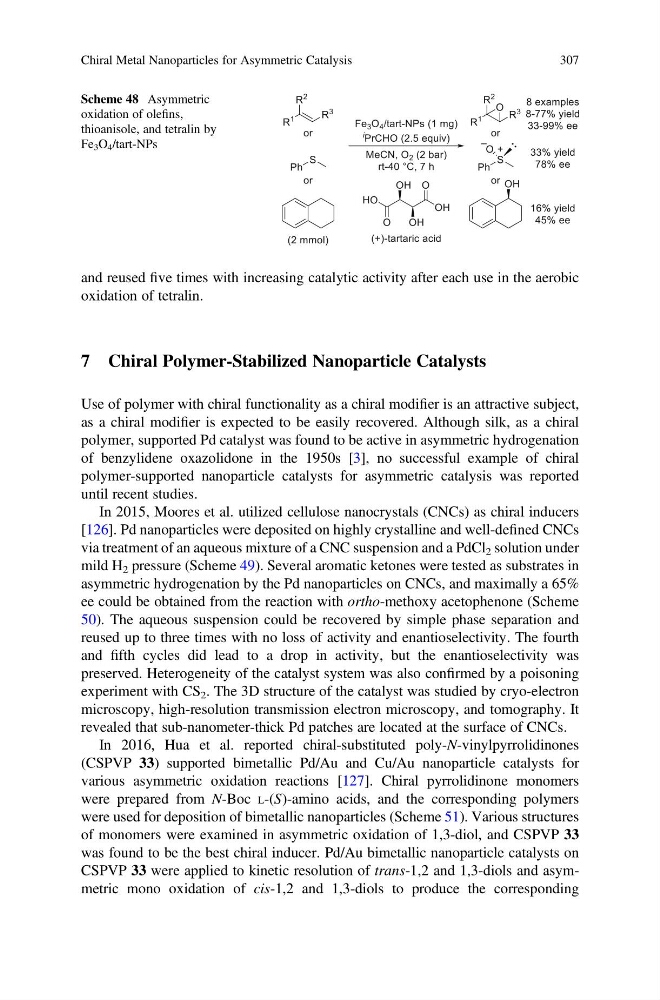
and reused five times with increasing catalytic activity after each use in the aerobic
oxidation of tetralin.
7 Chiral Polymer-Stabilized Nanoparticle Catalysts
Use of polymer with chiral functionality as a chiral modifier is an attractive subject,
as a chiral modifier is expected to be easily recovered. Although silk, as a chiral
polymer, supported Pd catalyst was found to be active in asymmetric hydrogenation
of benzylidene oxazolidone in the 1950s [3], no successful example of chiral
polymer-supported nanoparticle catalysts for asymmetric catalysis was reported
until recent studies.
In 2015, Moores et al. utilized cellulose nanocrystals (CNCs) as chiral inducers
[126]. Pd nanoparticles were deposited on highly crystalline and well-defined CNCs
via treatment of an aqueous mixture of a CNC suspension and a PdCl 2 solution under
mild H 2 pressure (Scheme 49). Several aromatic ketones were tested as substrates in
asymmetric hydrogenation by the Pd nanoparticles on CNCs, and maximally a 65%
ee could be obtained from the reaction with ortho-methoxy acetophenone (Scheme
50). The aqueous suspension could be recovered by simple phase separation and
reused up to three times with no loss of activity and enantioselectivity. The fourth
and fifth cycles did lead to a drop in activity, but the enantioselectivity was
preserved. Heterogeneity of the catalyst system was also confirmed by a poisoning
experiment with CS 2 . The 3D structure of the catalyst was studied by cryo-electron
microscopy, high-resolution transmission electron microscopy, and tomography. It
revealed that sub-nanometer-thick Pd patches are located at the surface of CNCs.
In 2016, Hua et al. reported chiral-substituted poly-N-vinylpyrrolidinones
(CSPVP 33) supported bimetallic Pd/Au and Cu/Au nanoparticle catalysts for
various asymmetric oxidation reactions [127]. Chiral pyrrolidinone monomers
were prepared from N-Boc L-(S)-amino acids, and the corresponding polymers
were used for deposition of bimetallic nanoparticles (Scheme 51). Various structures
of monomers were examined in asymmetric oxidation of 1,3-diol, and CSPVP 33
was found to be the best chiral inducer. Pd/Au bimetallic nanoparticle catalysts on
CSPVP 33 were applied to kinetic resolution of trans-1,2 and 1,3-diols and asymmetric mono oxidation of cis-1,2 and 1,3-diols to produce the corresponding
Scheme 48 Asymmetric
oxidation of olefins,
thioanisole, and tetralin by
Fe 3 O 4 /tart-NPs
Chiral Metal Nanoparticles for Asymmetric Catalysis
307
oxidation of tetralin.
7 Chiral Polymer-Stabilized Nanoparticle Catalysts
Use of polymer with chiral functionality as a chiral modifier is an attractive subject,
as a chiral modifier is expected to be easily recovered. Although silk, as a chiral
polymer, supported Pd catalyst was found to be active in asymmetric hydrogenation
of benzylidene oxazolidone in the 1950s [3], no successful example of chiral
polymer-supported nanoparticle catalysts for asymmetric catalysis was reported
until recent studies.
In 2015, Moores et al. utilized cellulose nanocrystals (CNCs) as chiral inducers
[126]. Pd nanoparticles were deposited on highly crystalline and well-defined CNCs
via treatment of an aqueous mixture of a CNC suspension and a PdCl 2 solution under
mild H 2 pressure (Scheme 49). Several aromatic ketones were tested as substrates in
asymmetric hydrogenation by the Pd nanoparticles on CNCs, and maximally a 65%
ee could be obtained from the reaction with ortho-methoxy acetophenone (Scheme
50). The aqueous suspension could be recovered by simple phase separation and
reused up to three times with no loss of activity and enantioselectivity. The fourth
and fifth cycles did lead to a drop in activity, but the enantioselectivity was
preserved. Heterogeneity of the catalyst system was also confirmed by a poisoning
experiment with CS 2 . The 3D structure of the catalyst was studied by cryo-electron
microscopy, high-resolution transmission electron microscopy, and tomography. It
revealed that sub-nanometer-thick Pd patches are located at the surface of CNCs.
In 2016, Hua et al. reported chiral-substituted poly-N-vinylpyrrolidinones
(CSPVP 33) supported bimetallic Pd/Au and Cu/Au nanoparticle catalysts for
various asymmetric oxidation reactions [127]. Chiral pyrrolidinone monomers
were prepared from N-Boc L-(S)-amino acids, and the corresponding polymers
were used for deposition of bimetallic nanoparticles (Scheme 51). Various structures
of monomers were examined in asymmetric oxidation of 1,3-diol, and CSPVP 33
was found to be the best chiral inducer. Pd/Au bimetallic nanoparticle catalysts on
CSPVP 33 were applied to kinetic resolution of trans-1,2 and 1,3-diols and asymmetric mono oxidation of cis-1,2 and 1,3-diols to produce the corresponding
Scheme 48 Asymmetric
oxidation of olefins,
thioanisole, and tetralin by
Fe 3 O 4 /tart-NPs
Chiral Metal Nanoparticles for Asymmetric Catalysis
307