

toluene and water was optimized to 8:1 to prevent hydrolysis of imines. Asymmetric
arylation of aromatic tosylimines proceeded smoothly to afford the corresponding
chiral (diarylmethyl)amines in high yields with excellent enantioselectivities in the
presence of PI/CB Rh/Ag and chiral diene 32. On the other hand, as aliphatic imines
are more sensitive to water than aromatic imines, the desired products of aliphatic
imines were obtained in moderate yields, while enantioselectivities were excellent.
In 2017, Kobayashi et al. further applied chiral Rh nanoparticle systems to
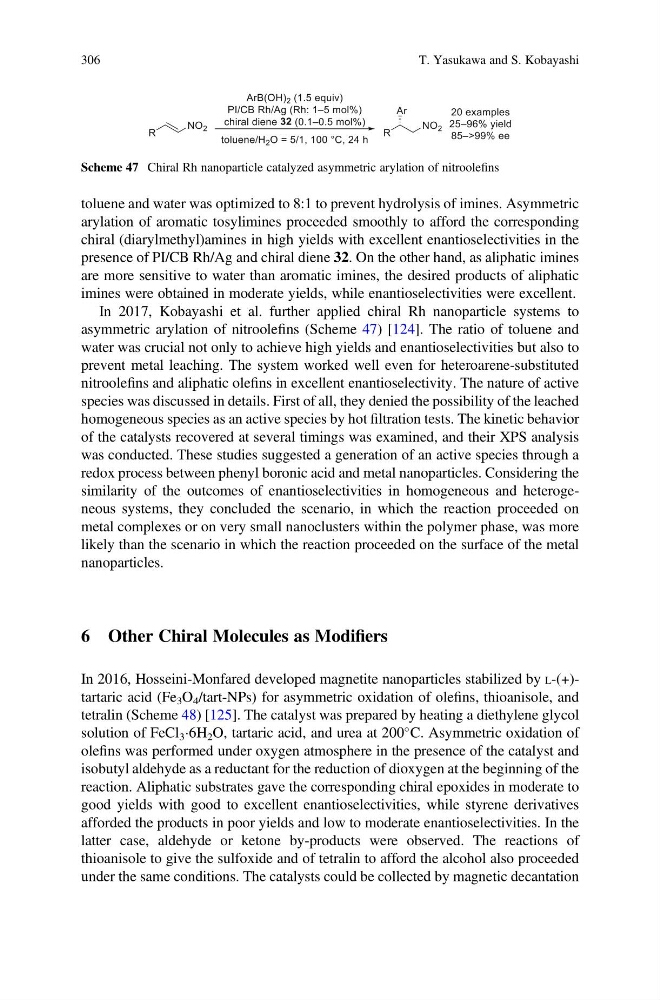
asymmetric arylation of nitroolefins (Scheme 47) [124]. The ratio of toluene and
water was crucial not only to achieve high yields and enantioselectivities but also to
prevent metal leaching. The system worked well even for heteroarene-substituted
nitroolefins and aliphatic olefins in excellent enantioselectivity. The nature of active
species was discussed in details. First of all, they denied the possibility of the leached
homogeneous species as an active species by hot filtration tests. The kinetic behavior
of the catalysts recovered at several timings was examined, and their XPS analysis
was conducted. These studies suggested a generation of an active species through a
redox process between phenyl boronic acid and metal nanoparticles. Considering the
similarity of the outcomes of enantioselectivities in homogeneous and heterogeneous systems, they concluded the scenario, in which the reaction proceeded on
metal complexes or on very small nanoclusters within the polymer phase, was more
likely than the scenario in which the reaction proceeded on the surface of the metal
nanoparticles.
6 Other Chiral Molecules as Modifiers
In 2016, Hosseini-Monfared developed magnetite nanoparticles stabilized by L-(+)tartaric acid (Fe 3 O 4 /tart-NPs) for asymmetric oxidation of olefins, thioanisole, and
tetralin (Scheme 48) [125]. The catalyst was prepared by heating a diethylene glycol
solution of FeCl 3 Á6H 2 O, tartaric acid, and urea at 200
C. Asymmetric oxidation of
olefins was performed under oxygen atmosphere in the presence of the catalyst and
isobutyl aldehyde as a reductant for the reduction of dioxygen at the beginning of the
reaction. Aliphatic substrates gave the corresponding chiral epoxides in moderate to
good yields with good to excellent enantioselectivities, while styrene derivatives
afforded the products in poor yields and low to moderate enantioselectivities. In the
latter case, aldehyde or ketone by-products were observed. The reactions of
thioanisole to give the sulfoxide and of tetralin to afford the alcohol also proceeded
under the same conditions. The catalysts could be collected by magnetic decantation
Scheme 47 Chiral Rh nanoparticle catalyzed asymmetric arylation of nitroolefins
306
T. Yasukawa and S. Kobayashi
arylation of aromatic tosylimines proceeded smoothly to afford the corresponding
chiral (diarylmethyl)amines in high yields with excellent enantioselectivities in the
presence of PI/CB Rh/Ag and chiral diene 32. On the other hand, as aliphatic imines
are more sensitive to water than aromatic imines, the desired products of aliphatic
imines were obtained in moderate yields, while enantioselectivities were excellent.
In 2017, Kobayashi et al. further applied chiral Rh nanoparticle systems to
asymmetric arylation of nitroolefins (Scheme 47) [124]. The ratio of toluene and
water was crucial not only to achieve high yields and enantioselectivities but also to
prevent metal leaching. The system worked well even for heteroarene-substituted
nitroolefins and aliphatic olefins in excellent enantioselectivity. The nature of active
species was discussed in details. First of all, they denied the possibility of the leached
homogeneous species as an active species by hot filtration tests. The kinetic behavior
of the catalysts recovered at several timings was examined, and their XPS analysis
was conducted. These studies suggested a generation of an active species through a
redox process between phenyl boronic acid and metal nanoparticles. Considering the
similarity of the outcomes of enantioselectivities in homogeneous and heterogeneous systems, they concluded the scenario, in which the reaction proceeded on
metal complexes or on very small nanoclusters within the polymer phase, was more
likely than the scenario in which the reaction proceeded on the surface of the metal
nanoparticles.
6 Other Chiral Molecules as Modifiers
In 2016, Hosseini-Monfared developed magnetite nanoparticles stabilized by L-(+)tartaric acid (Fe 3 O 4 /tart-NPs) for asymmetric oxidation of olefins, thioanisole, and
tetralin (Scheme 48) [125]. The catalyst was prepared by heating a diethylene glycol
solution of FeCl 3 Á6H 2 O, tartaric acid, and urea at 200
C. Asymmetric oxidation of
olefins was performed under oxygen atmosphere in the presence of the catalyst and
isobutyl aldehyde as a reductant for the reduction of dioxygen at the beginning of the
reaction. Aliphatic substrates gave the corresponding chiral epoxides in moderate to
good yields with good to excellent enantioselectivities, while styrene derivatives
afforded the products in poor yields and low to moderate enantioselectivities. In the
latter case, aldehyde or ketone by-products were observed. The reactions of
thioanisole to give the sulfoxide and of tetralin to afford the alcohol also proceeded
under the same conditions. The catalysts could be collected by magnetic decantation
Scheme 47 Chiral Rh nanoparticle catalyzed asymmetric arylation of nitroolefins
306
T. Yasukawa and S. Kobayashi