

mixing was used to suppress signals from chiral diene 32 in the solution phase and to
exchange the remaining magnetization of cellulose with nearby molecules that
would be anchored in the catalyst. The result suggested that the chiral diene 32
adsorbed on the Rh nanoparticles was observed selectively using this method.
Similar to the PI/CB Rh/Ag system, a positive nonlinear effect was observed in
this cellulose-supported Rh nanoparticle system.
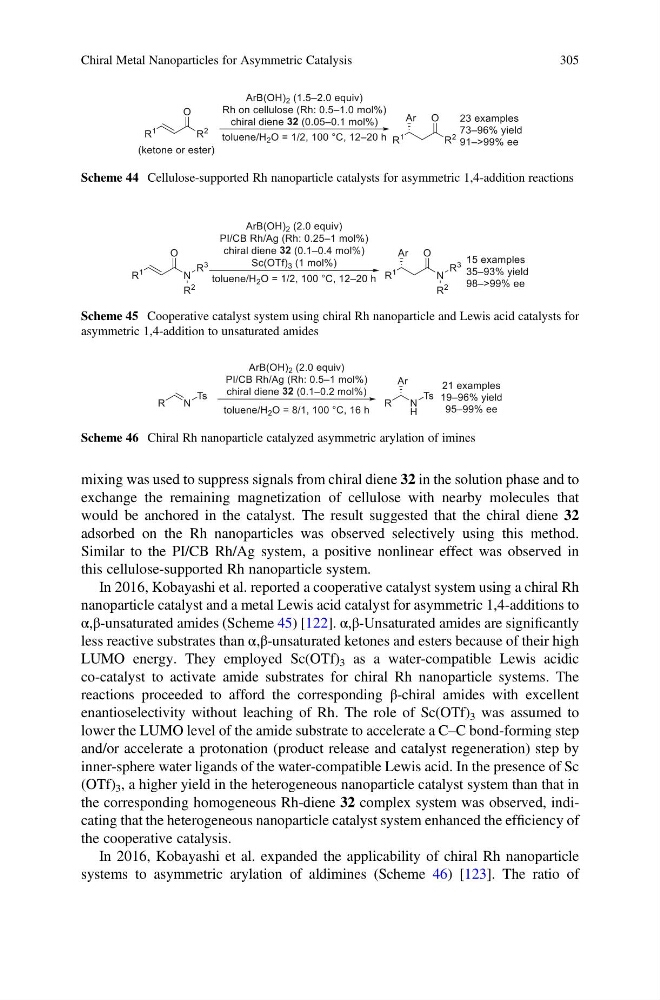
In 2016, Kobayashi et al. reported a cooperative catalyst system using a chiral Rh
nanoparticle catalyst and a metal Lewis acid catalyst for asymmetric 1,4-additions to
α,β-unsaturated amides (Scheme 45) [122]. α,β-Unsaturated amides are significantly
less reactive substrates than α,β-unsaturated ketones and esters because of their high
LUMO energy. They employed Sc(OTf) 3 as a water-compatible Lewis acidic
co-catalyst to activate amide substrates for chiral Rh nanoparticle systems. The
reactions proceeded to afford the corresponding β-chiral amides with excellent
enantioselectivity without leaching of Rh. The role of Sc(OTf) 3 was assumed to
lower the LUMO level of the amide substrate to accelerate a C–C bond-forming step
and/or accelerate a protonation (product release and catalyst regeneration) step by
inner-sphere water ligands of the water-compatible Lewis acid. In the presence of Sc
(OTf) 3 , a higher yield in the heterogeneous nanoparticle catalyst system than that in
the corresponding homogeneous Rh-diene 32 complex system was observed, indicating that the heterogeneous nanoparticle catalyst system enhanced the efficiency of
the cooperative catalysis.
In 2016, Kobayashi et al. expanded the applicability of chiral Rh nanoparticle
systems to asymmetric arylation of aldimines (Scheme 46) [123]. The ratio of
Scheme 45 Cooperative catalyst system using chiral Rh nanoparticle and Lewis acid catalysts for
asymmetric 1,4-addition to unsaturated amides
Scheme 46 Chiral Rh nanoparticle catalyzed asymmetric arylation of imines
Scheme 44 Cellulose-supported Rh nanoparticle catalysts for asymmetric 1,4-addition reactions
Chiral Metal Nanoparticles for Asymmetric Catalysis
305
exchange the remaining magnetization of cellulose with nearby molecules that
would be anchored in the catalyst. The result suggested that the chiral diene 32
adsorbed on the Rh nanoparticles was observed selectively using this method.
Similar to the PI/CB Rh/Ag system, a positive nonlinear effect was observed in
this cellulose-supported Rh nanoparticle system.
In 2016, Kobayashi et al. reported a cooperative catalyst system using a chiral Rh
nanoparticle catalyst and a metal Lewis acid catalyst for asymmetric 1,4-additions to
α,β-unsaturated amides (Scheme 45) [122]. α,β-Unsaturated amides are significantly
less reactive substrates than α,β-unsaturated ketones and esters because of their high
LUMO energy. They employed Sc(OTf) 3 as a water-compatible Lewis acidic
co-catalyst to activate amide substrates for chiral Rh nanoparticle systems. The
reactions proceeded to afford the corresponding β-chiral amides with excellent
enantioselectivity without leaching of Rh. The role of Sc(OTf) 3 was assumed to
lower the LUMO level of the amide substrate to accelerate a C–C bond-forming step
and/or accelerate a protonation (product release and catalyst regeneration) step by
inner-sphere water ligands of the water-compatible Lewis acid. In the presence of Sc
(OTf) 3 , a higher yield in the heterogeneous nanoparticle catalyst system than that in
the corresponding homogeneous Rh-diene 32 complex system was observed, indicating that the heterogeneous nanoparticle catalyst system enhanced the efficiency of
the cooperative catalysis.
In 2016, Kobayashi et al. expanded the applicability of chiral Rh nanoparticle
systems to asymmetric arylation of aldimines (Scheme 46) [123]. The ratio of
Scheme 45 Cooperative catalyst system using chiral Rh nanoparticle and Lewis acid catalysts for
asymmetric 1,4-addition to unsaturated amides
Scheme 46 Chiral Rh nanoparticle catalyzed asymmetric arylation of imines
Scheme 44 Cellulose-supported Rh nanoparticle catalysts for asymmetric 1,4-addition reactions
Chiral Metal Nanoparticles for Asymmetric Catalysis
305