

mixture, and a hot-filtration test confirmed that no reaction proceeded in the filtrate
that was obtained in the middle of the reaction.
In this work, several unique natures of Rh nanoparticle systems that were
different from the nature of the corresponding homogeneous Rh(I)-diene 32 complex were found. The comparison of the catalytic activity in a homogeneous Rh
(I) complex system and the chiral Rh nanoparticle system showed that superior
performance of the nanoparticle system in terms of activity and/or enantioselectivity
was observed for several substrates. Nonlinear effect analysis [117], which is a plot
of enantiopurity of a product against enantiopurity of a chiral ligand, was also
conducted in both systems. A positive nonlinear effect was observed in the heterogeneous nanoparticle system, whereas a linear relationship between enantiomeric
excess of a ligand and that of a product was observed in the homogeneous metal
complex system.
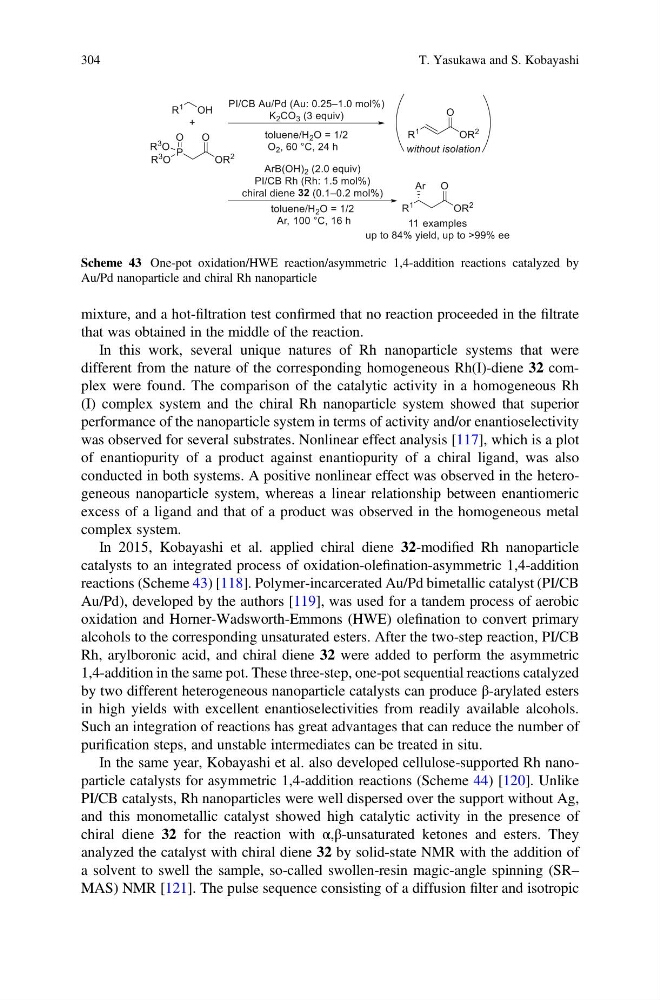
In 2015, Kobayashi et al. applied chiral diene 32-modified Rh nanoparticle
catalysts to an integrated process of oxidation-olefination-asymmetric 1,4-addition
reactions (Scheme 43) [118]. Polymer-incarcerated Au/Pd bimetallic catalyst (PI/CB
Au/Pd), developed by the authors [119], was used for a tandem process of aerobic
oxidation and Horner-Wadsworth-Emmons (HWE) olefination to convert primary
alcohols to the corresponding unsaturated esters. After the two-step reaction, PI/CB
Rh, arylboronic acid, and chiral diene 32 were added to perform the asymmetric
1,4-addition in the same pot. These three-step, one-pot sequential reactions catalyzed
by two different heterogeneous nanoparticle catalysts can produce β-arylated esters
in high yields with excellent enantioselectivities from readily available alcohols.
Such an integration of reactions has great advantages that can reduce the number of
purification steps, and unstable intermediates can be treated in situ.
In the same year, Kobayashi et al. also developed cellulose-supported Rh nanoparticle catalysts for asymmetric 1,4-addition reactions (Scheme 44) [120]. Unlike
PI/CB catalysts, Rh nanoparticles were well dispersed over the support without Ag,
and this monometallic catalyst showed high catalytic activity in the presence of
chiral diene 32 for the reaction with α,β-unsaturated ketones and esters. They
analyzed the catalyst with chiral diene 32 by solid-state NMR with the addition of
a solvent to swell the sample, so-called swollen-resin magic-angle spinning (SR–
MAS) NMR [121]. The pulse sequence consisting of a diffusion filter and isotropic
Scheme 43 One-pot oxidation/HWE reaction/asymmetric 1,4-addition reactions catalyzed by
Au/Pd nanoparticle and chiral Rh nanoparticle
304
T. Yasukawa and S. Kobayashi
that was obtained in the middle of the reaction.
In this work, several unique natures of Rh nanoparticle systems that were
different from the nature of the corresponding homogeneous Rh(I)-diene 32 complex were found. The comparison of the catalytic activity in a homogeneous Rh
(I) complex system and the chiral Rh nanoparticle system showed that superior
performance of the nanoparticle system in terms of activity and/or enantioselectivity
was observed for several substrates. Nonlinear effect analysis [117], which is a plot
of enantiopurity of a product against enantiopurity of a chiral ligand, was also
conducted in both systems. A positive nonlinear effect was observed in the heterogeneous nanoparticle system, whereas a linear relationship between enantiomeric
excess of a ligand and that of a product was observed in the homogeneous metal
complex system.
In 2015, Kobayashi et al. applied chiral diene 32-modified Rh nanoparticle
catalysts to an integrated process of oxidation-olefination-asymmetric 1,4-addition
reactions (Scheme 43) [118]. Polymer-incarcerated Au/Pd bimetallic catalyst (PI/CB
Au/Pd), developed by the authors [119], was used for a tandem process of aerobic
oxidation and Horner-Wadsworth-Emmons (HWE) olefination to convert primary
alcohols to the corresponding unsaturated esters. After the two-step reaction, PI/CB
Rh, arylboronic acid, and chiral diene 32 were added to perform the asymmetric
1,4-addition in the same pot. These three-step, one-pot sequential reactions catalyzed
by two different heterogeneous nanoparticle catalysts can produce β-arylated esters
in high yields with excellent enantioselectivities from readily available alcohols.
Such an integration of reactions has great advantages that can reduce the number of
purification steps, and unstable intermediates can be treated in situ.
In the same year, Kobayashi et al. also developed cellulose-supported Rh nanoparticle catalysts for asymmetric 1,4-addition reactions (Scheme 44) [120]. Unlike
PI/CB catalysts, Rh nanoparticles were well dispersed over the support without Ag,
and this monometallic catalyst showed high catalytic activity in the presence of
chiral diene 32 for the reaction with α,β-unsaturated ketones and esters. They
analyzed the catalyst with chiral diene 32 by solid-state NMR with the addition of
a solvent to swell the sample, so-called swollen-resin magic-angle spinning (SR–
MAS) NMR [121]. The pulse sequence consisting of a diffusion filter and isotropic
Scheme 43 One-pot oxidation/HWE reaction/asymmetric 1,4-addition reactions catalyzed by
Au/Pd nanoparticle and chiral Rh nanoparticle
304
T. Yasukawa and S. Kobayashi