

3.3.2 Rh Nanoparticle Catalysis
Asymmetric hydroformylation of olefins using inexpensive syngas is a useful
method to synthesize optical active aldehydes. While a chiral Rh complex was
often used for this reaction [89] and Rh nanoparticles were also studied for
non-asymmetric hydroformylation [90], development of chiral Rh nanoparticle
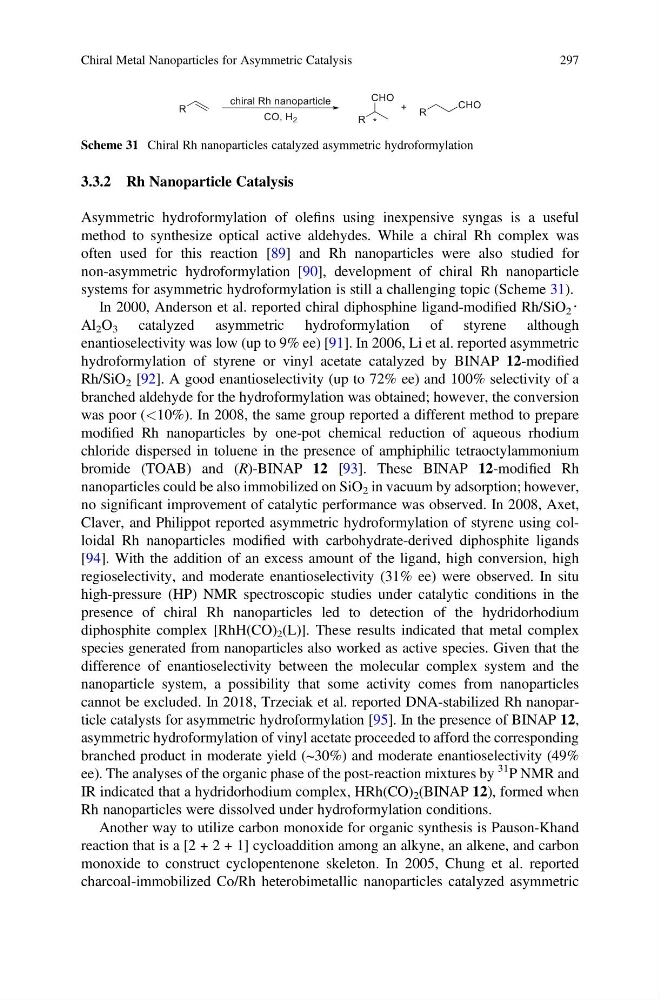
systems for asymmetric hydroformylation is still a challenging topic (Scheme 31).
In 2000, Anderson et al. reported chiral diphosphine ligand-modified Rh/SiO 2 ‧
Al 2 O 3 catalyzed asymmetric hydroformylation of styrene although
enantioselectivity was low (up to 9% ee) [91]. In 2006, Li et al. reported asymmetric
hydroformylation of styrene or vinyl acetate catalyzed by BINAP 12-modified
Rh/SiO 2 [92]. A good enantioselectivity (up to 72% ee) and 100% selectivity of a
branched aldehyde for the hydroformylation was obtained; however, the conversion
was poor (<10%). In 2008, the same group reported a different method to prepare
modified Rh nanoparticles by one-pot chemical reduction of aqueous rhodium
chloride dispersed in toluene in the presence of amphiphilic tetraoctylammonium
bromide (TOAB) and (R)-BINAP 12 [93]. These BINAP 12-modified Rh
nanoparticles could be also immobilized on SiO 2 in vacuum by adsorption; however,
no significant improvement of catalytic performance was observed. In 2008, Axet,
Claver, and Philippot reported asymmetric hydroformylation of styrene using colloidal Rh nanoparticles modified with carbohydrate-derived diphosphite ligands
[94]. With the addition of an excess amount of the ligand, high conversion, high
regioselectivity, and moderate enantioselectivity (31% ee) were observed. In situ
high-pressure (HP) NMR spectroscopic studies under catalytic conditions in the
presence of chiral Rh nanoparticles led to detection of the hydridorhodium
diphosphite complex [RhH(CO) 2 (L)]. These results indicated that metal complex
species generated from nanoparticles also worked as active species. Given that the
difference of enantioselectivity between the molecular complex system and the
nanoparticle system, a possibility that some activity comes from nanoparticles
cannot be excluded. In 2018, Trzeciak et al. reported DNA-stabilized Rh nanoparticle catalysts for asymmetric hydroformylation [95]. In the presence of BINAP 12,
asymmetric hydroformylation of vinyl acetate proceeded to afford the corresponding
branched product in moderate yield (~30%) and moderate enantioselectivity (49%
ee). The analyses of the organic phase of the post-reaction mixtures by
31 P NMR and
IR indicated that a hydridorhodium complex, HRh(CO) 2 (BINAP 12), formed when
Rh nanoparticles were dissolved under hydroformylation conditions.
Another way to utilize carbon monoxide for organic synthesis is Pauson-Khand
reaction that is a [2 + 2 + 1] cycloaddition among an alkyne, an alkene, and carbon
monoxide to construct cyclopentenone skeleton. In 2005, Chung et al. reported
charcoal-immobilized Co/Rh heterobimetallic nanoparticles catalyzed asymmetric
Scheme 31 Chiral Rh nanoparticles catalyzed asymmetric hydroformylation
Chiral Metal Nanoparticles for Asymmetric Catalysis
297
Asymmetric hydroformylation of olefins using inexpensive syngas is a useful
method to synthesize optical active aldehydes. While a chiral Rh complex was
often used for this reaction [89] and Rh nanoparticles were also studied for
non-asymmetric hydroformylation [90], development of chiral Rh nanoparticle
systems for asymmetric hydroformylation is still a challenging topic (Scheme 31).
In 2000, Anderson et al. reported chiral diphosphine ligand-modified Rh/SiO 2 ‧
Al 2 O 3 catalyzed asymmetric hydroformylation of styrene although
enantioselectivity was low (up to 9% ee) [91]. In 2006, Li et al. reported asymmetric
hydroformylation of styrene or vinyl acetate catalyzed by BINAP 12-modified
Rh/SiO 2 [92]. A good enantioselectivity (up to 72% ee) and 100% selectivity of a
branched aldehyde for the hydroformylation was obtained; however, the conversion
was poor (<10%). In 2008, the same group reported a different method to prepare
modified Rh nanoparticles by one-pot chemical reduction of aqueous rhodium
chloride dispersed in toluene in the presence of amphiphilic tetraoctylammonium
bromide (TOAB) and (R)-BINAP 12 [93]. These BINAP 12-modified Rh
nanoparticles could be also immobilized on SiO 2 in vacuum by adsorption; however,
no significant improvement of catalytic performance was observed. In 2008, Axet,
Claver, and Philippot reported asymmetric hydroformylation of styrene using colloidal Rh nanoparticles modified with carbohydrate-derived diphosphite ligands
[94]. With the addition of an excess amount of the ligand, high conversion, high
regioselectivity, and moderate enantioselectivity (31% ee) were observed. In situ
high-pressure (HP) NMR spectroscopic studies under catalytic conditions in the
presence of chiral Rh nanoparticles led to detection of the hydridorhodium
diphosphite complex [RhH(CO) 2 (L)]. These results indicated that metal complex
species generated from nanoparticles also worked as active species. Given that the
difference of enantioselectivity between the molecular complex system and the
nanoparticle system, a possibility that some activity comes from nanoparticles
cannot be excluded. In 2018, Trzeciak et al. reported DNA-stabilized Rh nanoparticle catalysts for asymmetric hydroformylation [95]. In the presence of BINAP 12,
asymmetric hydroformylation of vinyl acetate proceeded to afford the corresponding
branched product in moderate yield (~30%) and moderate enantioselectivity (49%
ee). The analyses of the organic phase of the post-reaction mixtures by
31 P NMR and
IR indicated that a hydridorhodium complex, HRh(CO) 2 (BINAP 12), formed when
Rh nanoparticles were dissolved under hydroformylation conditions.
Another way to utilize carbon monoxide for organic synthesis is Pauson-Khand
reaction that is a [2 + 2 + 1] cycloaddition among an alkyne, an alkene, and carbon
monoxide to construct cyclopentenone skeleton. In 2005, Chung et al. reported
charcoal-immobilized Co/Rh heterobimetallic nanoparticles catalyzed asymmetric
Scheme 31 Chiral Rh nanoparticles catalyzed asymmetric hydroformylation
Chiral Metal Nanoparticles for Asymmetric Catalysis
297