

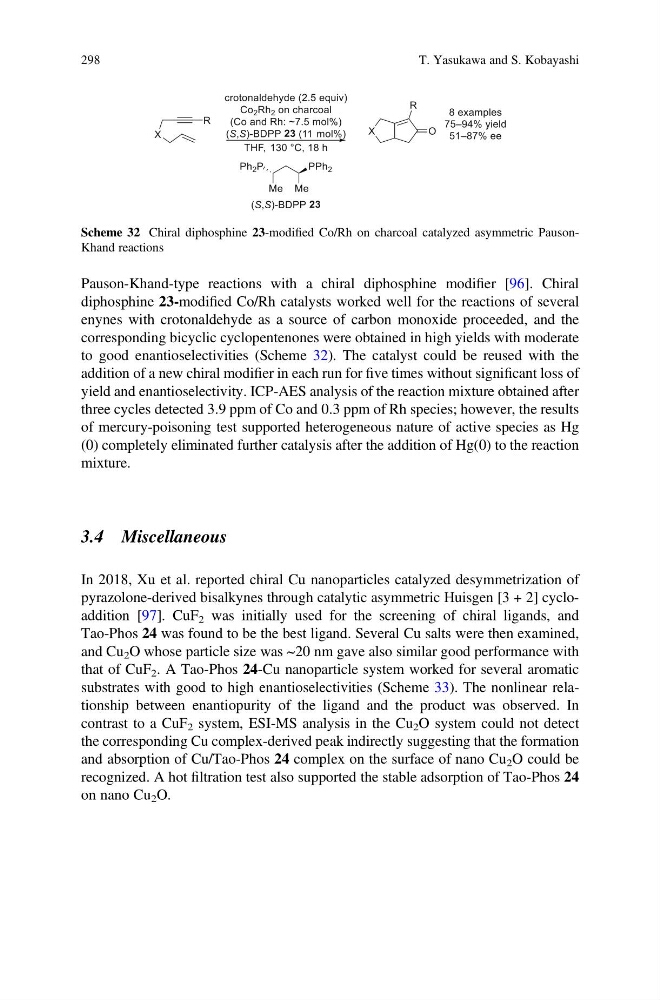
Pauson-Khand-type reactions with a chiral diphosphine modifier [96]. Chiral
diphosphine 23-modified Co/Rh catalysts worked well for the reactions of several
enynes with crotonaldehyde as a source of carbon monoxide proceeded, and the
corresponding bicyclic cyclopentenones were obtained in high yields with moderate
to good enantioselectivities (Scheme 32). The catalyst could be reused with the
addition of a new chiral modifier in each run for five times without significant loss of
yield and enantioselectivity. ICP-AES analysis of the reaction mixture obtained after
three cycles detected 3.9 ppm of Co and 0.3 ppm of Rh species; however, the results
of mercury-poisoning test supported heterogeneous nature of active species as Hg
(0) completely eliminated further catalysis after the addition of Hg(0) to the reaction
mixture.
3.4 Miscellaneous
In 2018, Xu et al. reported chiral Cu nanoparticles catalyzed desymmetrization of
pyrazolone-derived bisalkynes through catalytic asymmetric Huisgen [3 + 2] cycloaddition [97]. CuF 2 was initially used for the screening of chiral ligands, and
Tao-Phos 24 was found to be the best ligand. Several Cu salts were then examined,
and Cu 2 O whose particle size was ~20 nm gave also similar good performance with
that of CuF 2 . A Tao-Phos 24-Cu nanoparticle system worked for several aromatic
substrates with good to high enantioselectivities (Scheme 33). The nonlinear relationship between enantiopurity of the ligand and the product was observed. In
contrast to a CuF 2 system, ESI-MS analysis in the Cu 2 O system could not detect
the corresponding Cu complex-derived peak indirectly suggesting that the formation
and absorption of Cu/Tao-Phos 24 complex on the surface of nano Cu 2 O could be
recognized. A hot filtration test also supported the stable adsorption of Tao-Phos 24
on nano Cu 2 O.
Scheme 32 Chiral diphosphine 23-modified Co/Rh on charcoal catalyzed asymmetric PausonKhand reactions
298
T. Yasukawa and S. Kobayashi
diphosphine 23-modified Co/Rh catalysts worked well for the reactions of several
enynes with crotonaldehyde as a source of carbon monoxide proceeded, and the
corresponding bicyclic cyclopentenones were obtained in high yields with moderate
to good enantioselectivities (Scheme 32). The catalyst could be reused with the
addition of a new chiral modifier in each run for five times without significant loss of
yield and enantioselectivity. ICP-AES analysis of the reaction mixture obtained after
three cycles detected 3.9 ppm of Co and 0.3 ppm of Rh species; however, the results
of mercury-poisoning test supported heterogeneous nature of active species as Hg
(0) completely eliminated further catalysis after the addition of Hg(0) to the reaction
mixture.
3.4 Miscellaneous
In 2018, Xu et al. reported chiral Cu nanoparticles catalyzed desymmetrization of
pyrazolone-derived bisalkynes through catalytic asymmetric Huisgen [3 + 2] cycloaddition [97]. CuF 2 was initially used for the screening of chiral ligands, and
Tao-Phos 24 was found to be the best ligand. Several Cu salts were then examined,
and Cu 2 O whose particle size was ~20 nm gave also similar good performance with
that of CuF 2 . A Tao-Phos 24-Cu nanoparticle system worked for several aromatic
substrates with good to high enantioselectivities (Scheme 33). The nonlinear relationship between enantiopurity of the ligand and the product was observed. In
contrast to a CuF 2 system, ESI-MS analysis in the Cu 2 O system could not detect
the corresponding Cu complex-derived peak indirectly suggesting that the formation
and absorption of Cu/Tao-Phos 24 complex on the surface of nano Cu 2 O could be
recognized. A hot filtration test also supported the stable adsorption of Tao-Phos 24
on nano Cu 2 O.
Scheme 32 Chiral diphosphine 23-modified Co/Rh on charcoal catalyzed asymmetric PausonKhand reactions
298
T. Yasukawa and S. Kobayashi