

product (R-21) at 60
C or above. In 2008, the same group improved the
enantioselectivity of this reaction to 82% ee by changing the chiral modifier to
ferrocenyl phosphine ligand 22 (Scheme 29) [85]. No temperature dependence on
the enantioselectivity was observed again (at 60 and 120
C). In the corresponding
homogeneous metal complex system, the same enantiomer of the product (S-21) was
produced; however, the enantioselectivity was decreased by increasing the reaction
temperature from 85% ee at 60
C to 55% ee at 120
C. In 2010, the same group
reported detailed studies of the nature of the active species in Pd/Al 2 O 3 -BINAP 12
system and emphasized heterogeneity [86]. The oxidation state of Pd was elucidated
by in situ X-ray absorption near-edge structure (XANES) analysis in a reaction
mixture. Partially oxidized surface of Pd nanoparticles could be reduced by the
reaction components, such as the solvent and sodium dimethyl malonate to maintain
their reduced state during the reaction without Pd leaching. In contrast, the addition
of a chlorinated solvent, such as chloroform, favored dissolution of metallic Pd to
form homogeneous catalyst species.
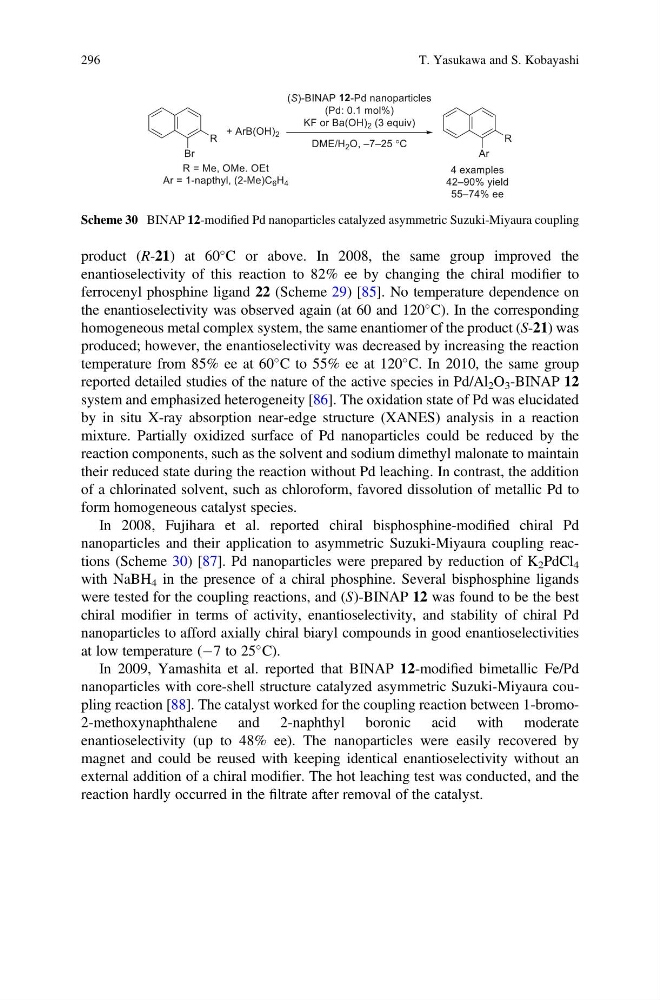
In 2008, Fujihara et al. reported chiral bisphosphine-modified chiral Pd
nanoparticles and their application to asymmetric Suzuki-Miyaura coupling reactions (Scheme 30) [87]. Pd nanoparticles were prepared by reduction of K 2 PdCl 4
with NaBH 4 in the presence of a chiral phosphine. Several bisphosphine ligands
were tested for the coupling reactions, and (S)-BINAP 12 was found to be the best
chiral modifier in terms of activity, enantioselectivity, and stability of chiral Pd
nanoparticles to afford axially chiral biaryl compounds in good enantioselectivities
at low temperature (À7 to 25
C).
In 2009, Yamashita et al. reported that BINAP 12-modified bimetallic Fe/Pd
nanoparticles with core-shell structure catalyzed asymmetric Suzuki-Miyaura coupling reaction [88]. The catalyst worked for the coupling reaction between 1-bromo2-methoxynaphthalene and 2-naphthyl boronic acid with moderate
enantioselectivity (up to 48% ee). The nanoparticles were easily recovered by
magnet and could be reused with keeping identical enantioselectivity without an
external addition of a chiral modifier. The hot leaching test was conducted, and the
reaction hardly occurred in the filtrate after removal of the catalyst.
Scheme 30 BINAP 12-modified Pd nanoparticles catalyzed asymmetric Suzuki-Miyaura coupling
296
T. Yasukawa and S. Kobayashi
C or above. In 2008, the same group improved the
enantioselectivity of this reaction to 82% ee by changing the chiral modifier to
ferrocenyl phosphine ligand 22 (Scheme 29) [85]. No temperature dependence on
the enantioselectivity was observed again (at 60 and 120
C). In the corresponding
homogeneous metal complex system, the same enantiomer of the product (S-21) was
produced; however, the enantioselectivity was decreased by increasing the reaction
temperature from 85% ee at 60
C to 55% ee at 120
C. In 2010, the same group
reported detailed studies of the nature of the active species in Pd/Al 2 O 3 -BINAP 12
system and emphasized heterogeneity [86]. The oxidation state of Pd was elucidated
by in situ X-ray absorption near-edge structure (XANES) analysis in a reaction
mixture. Partially oxidized surface of Pd nanoparticles could be reduced by the
reaction components, such as the solvent and sodium dimethyl malonate to maintain
their reduced state during the reaction without Pd leaching. In contrast, the addition
of a chlorinated solvent, such as chloroform, favored dissolution of metallic Pd to
form homogeneous catalyst species.
In 2008, Fujihara et al. reported chiral bisphosphine-modified chiral Pd
nanoparticles and their application to asymmetric Suzuki-Miyaura coupling reactions (Scheme 30) [87]. Pd nanoparticles were prepared by reduction of K 2 PdCl 4
with NaBH 4 in the presence of a chiral phosphine. Several bisphosphine ligands
were tested for the coupling reactions, and (S)-BINAP 12 was found to be the best
chiral modifier in terms of activity, enantioselectivity, and stability of chiral Pd
nanoparticles to afford axially chiral biaryl compounds in good enantioselectivities
at low temperature (À7 to 25
C).
In 2009, Yamashita et al. reported that BINAP 12-modified bimetallic Fe/Pd
nanoparticles with core-shell structure catalyzed asymmetric Suzuki-Miyaura coupling reaction [88]. The catalyst worked for the coupling reaction between 1-bromo2-methoxynaphthalene and 2-naphthyl boronic acid with moderate
enantioselectivity (up to 48% ee). The nanoparticles were easily recovered by
magnet and could be reused with keeping identical enantioselectivity without an
external addition of a chiral modifier. The hot leaching test was conducted, and the
reaction hardly occurred in the filtrate after removal of the catalyst.
Scheme 30 BINAP 12-modified Pd nanoparticles catalyzed asymmetric Suzuki-Miyaura coupling
296
T. Yasukawa and S. Kobayashi