

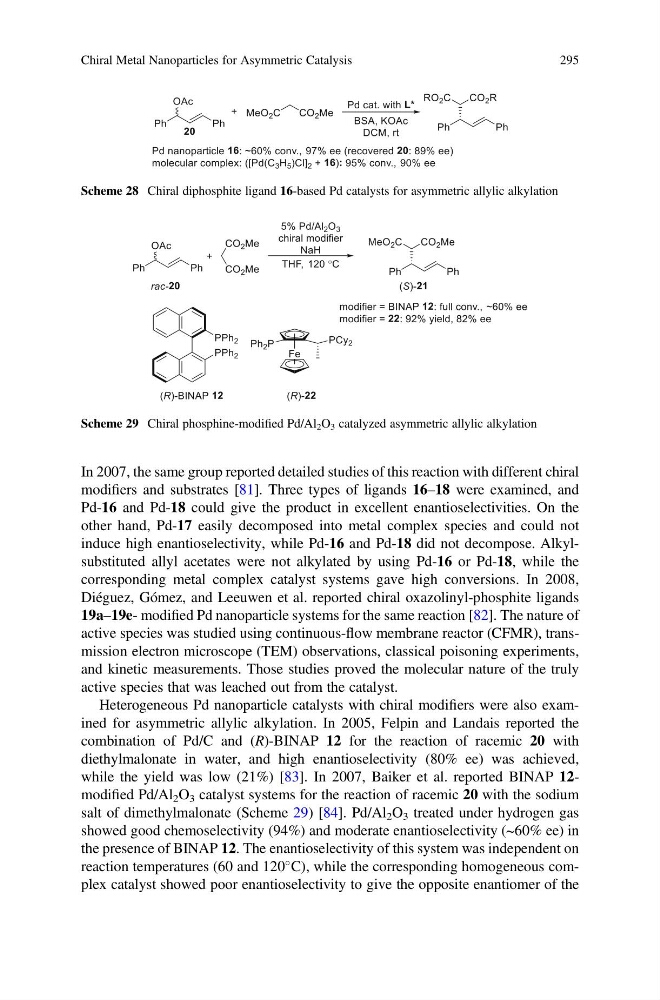
In 2007, the same group reported detailed studies of this reaction with different chiral
modifiers and substrates [81]. Three types of ligands 16–18 were examined, and
Pd-16 and Pd-18 could give the product in excellent enantioselectivities. On the
other hand, Pd-17 easily decomposed into metal complex species and could not
induce high enantioselectivity, while Pd-16 and Pd-18 did not decompose. Alkylsubstituted allyl acetates were not alkylated by using Pd-16 or Pd-18, while the
corresponding metal complex catalyst systems gave high conversions. In 2008,
Diéguez, Gómez, and Leeuwen et al. reported chiral oxazolinyl-phosphite ligands
19a–19e- modified Pd nanoparticle systems for the same reaction [82]. The nature of
active species was studied using continuous-flow membrane reactor (CFMR), transmission electron microscope (TEM) observations, classical poisoning experiments,
and kinetic measurements. Those studies proved the molecular nature of the truly
active species that was leached out from the catalyst.
Heterogeneous Pd nanoparticle catalysts with chiral modifiers were also examined for asymmetric allylic alkylation. In 2005, Felpin and Landais reported the
combination of Pd/C and (R)-BINAP 12 for the reaction of racemic 20 with
diethylmalonate in water, and high enantioselectivity (80% ee) was achieved,
while the yield was low (21%) [83]. In 2007, Baiker et al. reported BINAP 12modified Pd/Al 2 O 3 catalyst systems for the reaction of racemic 20 with the sodium
salt of dimethylmalonate (Scheme 29) [84]. Pd/Al 2 O 3 treated under hydrogen gas
showed good chemoselectivity (94%) and moderate enantioselectivity (~60% ee) in
the presence of BINAP 12. The enantioselectivity of this system was independent on
reaction temperatures (60 and 120
C), while the corresponding homogeneous complex catalyst showed poor enantioselectivity to give the opposite enantiomer of the
Scheme 28 Chiral diphosphite ligand 16-based Pd catalysts for asymmetric allylic alkylation
Scheme 29 Chiral phosphine-modified Pd/Al 2 O 3 catalyzed asymmetric allylic alkylation
Chiral Metal Nanoparticles for Asymmetric Catalysis
295
modifiers and substrates [81]. Three types of ligands 16–18 were examined, and
Pd-16 and Pd-18 could give the product in excellent enantioselectivities. On the
other hand, Pd-17 easily decomposed into metal complex species and could not
induce high enantioselectivity, while Pd-16 and Pd-18 did not decompose. Alkylsubstituted allyl acetates were not alkylated by using Pd-16 or Pd-18, while the
corresponding metal complex catalyst systems gave high conversions. In 2008,
Diéguez, Gómez, and Leeuwen et al. reported chiral oxazolinyl-phosphite ligands
19a–19e- modified Pd nanoparticle systems for the same reaction [82]. The nature of
active species was studied using continuous-flow membrane reactor (CFMR), transmission electron microscope (TEM) observations, classical poisoning experiments,
and kinetic measurements. Those studies proved the molecular nature of the truly
active species that was leached out from the catalyst.
Heterogeneous Pd nanoparticle catalysts with chiral modifiers were also examined for asymmetric allylic alkylation. In 2005, Felpin and Landais reported the
combination of Pd/C and (R)-BINAP 12 for the reaction of racemic 20 with
diethylmalonate in water, and high enantioselectivity (80% ee) was achieved,
while the yield was low (21%) [83]. In 2007, Baiker et al. reported BINAP 12modified Pd/Al 2 O 3 catalyst systems for the reaction of racemic 20 with the sodium
salt of dimethylmalonate (Scheme 29) [84]. Pd/Al 2 O 3 treated under hydrogen gas
showed good chemoselectivity (94%) and moderate enantioselectivity (~60% ee) in
the presence of BINAP 12. The enantioselectivity of this system was independent on
reaction temperatures (60 and 120
C), while the corresponding homogeneous complex catalyst showed poor enantioselectivity to give the opposite enantiomer of the
Scheme 28 Chiral diphosphite ligand 16-based Pd catalysts for asymmetric allylic alkylation
Scheme 29 Chiral phosphine-modified Pd/Al 2 O 3 catalyzed asymmetric allylic alkylation
Chiral Metal Nanoparticles for Asymmetric Catalysis
295